Dun foal “Luna” (second) belonging to Connie Rivas of HP Quarter Horses
The Dun Dilution Factor works on all horse colours. It can appear in black, bay, chestnut, palomino, buckskin, cremello, roan, and even appears in grey horses prior to the horse greying out. Like the Cream Gene, the Dun Dilution lightens the base coat colour, adds primitive markings, but leaves black colour alone. There are so many different shades of dun and the nomenclature varies between horse breeds and regionally. We will describe them related to their base color. Black horses are unique because the resulting dun horses have a specific name called grullo/grulla. Dark bays and blacks can be almost impossible to distinguish.
A black horse with a Dun Dilution turns the horse a lighter shade, with primitive markings, and guard hairs (lighter hairs on the outside of the mane and tail). The head is usually darker. The resulting horses have a slate-blue with less red present although some can have a warm tone. They generally have a very dark head. Without genetic testing, we are only guessing at the actual chromosomes of these horses. .
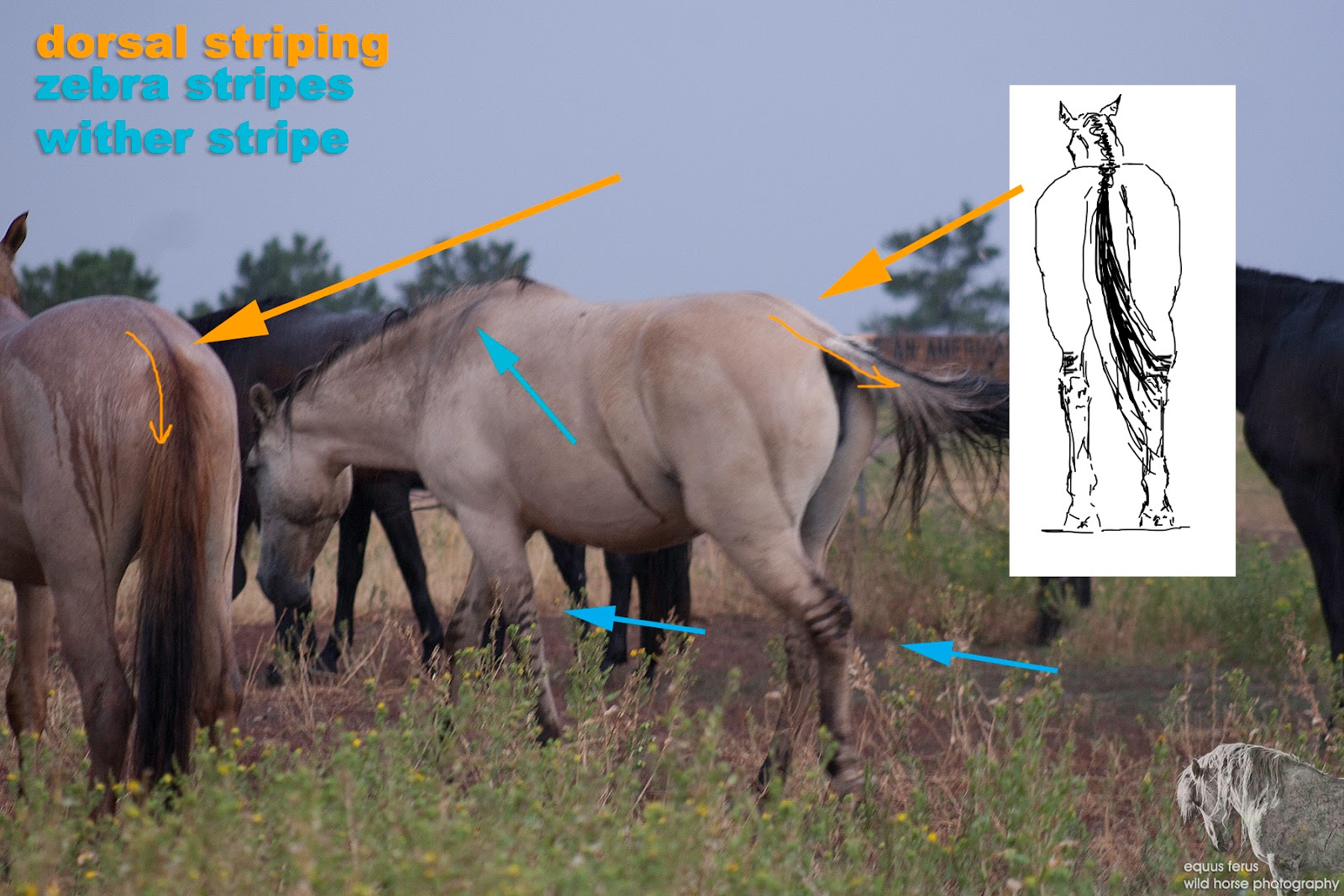
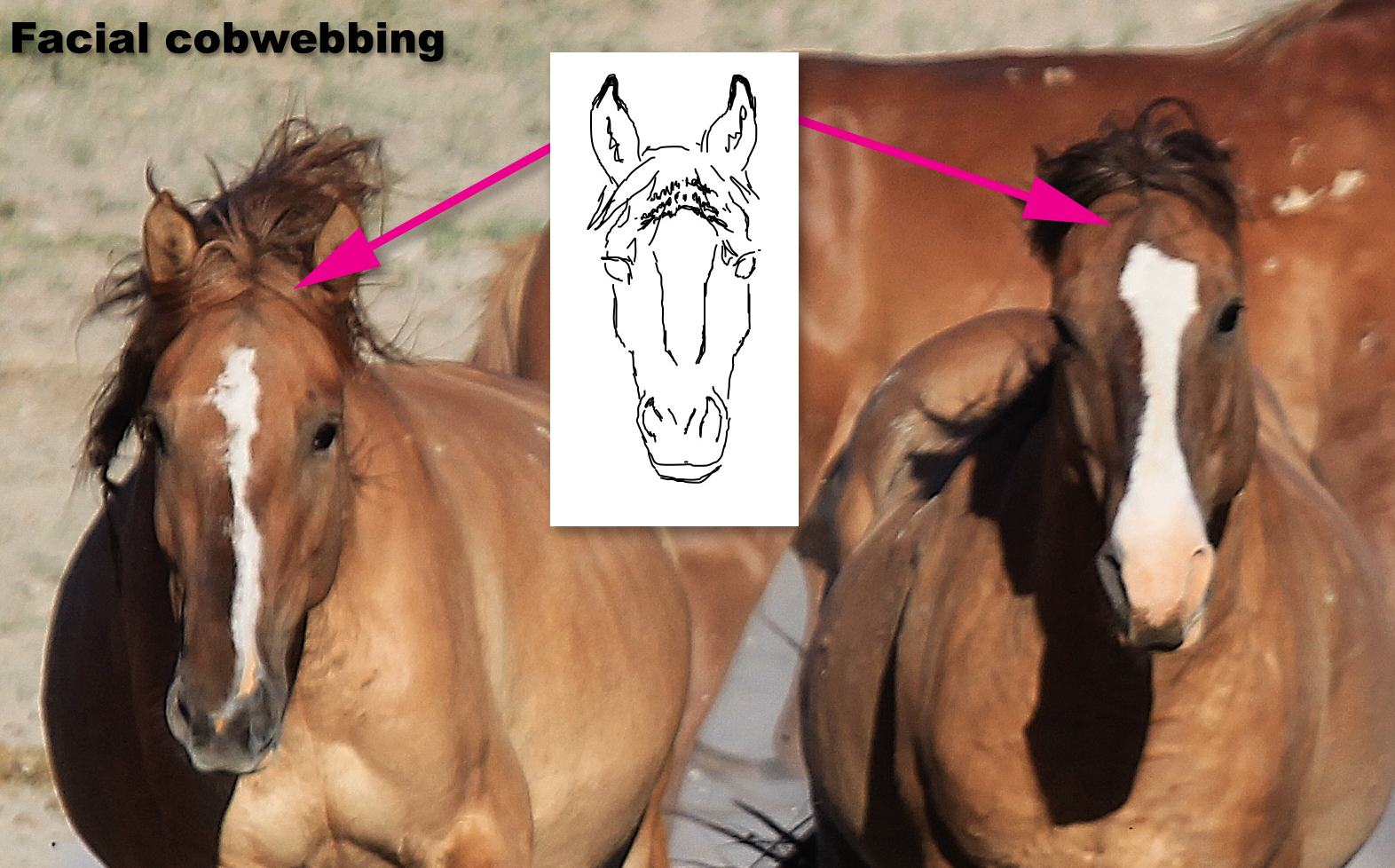
Primitive markings are named for markings found on ancient horse breeds such as the Przewalski or Tappan horse. They include a continuous line from the withers to the dock (top of the tail). Other markings include wither and/or neck stripes, cobwebbing: faint stripes on the face, zebra stripes on the legs, chest stripes, and darker ear tips. Zebra stripes are the colour of the underlying coat color, so a chestnut horse has darker chestnut stripes and a bay has black zebra stripes. Lighter hair on either side of the mane and each side of the tail, called ‘guard hairs’ may also be present.
The management are with the most Duns relative to the population is Pryor, they are plentiful there. Sand Wash Basin has many as well, and they are present at the Salt River. Little Book Cliffs has them, but McCullough Peaks does not have many. Great Desert Basin also does not have a large population. The Dun trait is autosomal dominant:
From UC Davis (they do genetic testing in equines)
Alleles: D = Dun dilute, nd1 = Non-dun 1, nd2 = Non-dun 2
Horses with nd2/nd2 genotype will not be dun dilute and will not have primitive markings. They cannot transmit a dun dilution variant to their offspring.
Horses with nd1/nd2 genotype will not be dun dilute, but may have primitive markings. They may transmit the non-dun 1 variant to 50% of their offspring.
Horses with nd1/nd1 genotype will not be dun dilute, but may have primitive markings. They will transmit the non-dun 1 variant to all of their offspring.
Horses with D/nd1 or D/nd2 genotype will be dun dilute and will display primitive markings. They may transmit the dun dilute variant to 50% of their offspring. Matings with N/N genotype will results in a 50% chance of producing a dun dilute foal.
Horses with D/D genoytpe will be dun dilute and will transmit the dun dilute variant to all of their offspring. Matings with any genotype are predicted to produce dun dilute offspring.
(Click on all the photos to enlarge them)
A typical Bay dunBlack horse becomes a “grullo (male) or grulla (female)Bay horses become a yellow-tan shade with their points (legs, mane, and tail remain black)Left photo: Bay horse. The photo on the right shows a dun in front and a bay to the right. Note the reduction of red, resulting in a more warm golden colour A solid chestnut horse becomes a lighter, golden horse with deep red pointsA chestnut horse with a flaxen mane and tail becomes a lighter Dun -note the reduction of redA liver chestnut horse becomes a deeper, darker Liver Chestnut DunSome dorsal stripes have marks perpendicular to the stripe, like hatch marks. Also, note the prominent wither marks and some neck marks.A nice example of a line-back dorsal stripe in a Grullo MustangWell-marked wither and neck marks in a bay dun.Duns can be very pale, such as this “buttermilk” dun on the right. Base colour buckskin, or light bay. A grullo is the second from the left.A nice red dun on the left, and pale dun to the rightDuns can occur in buckskin horses- they are usually tan and hard to distinguish from more yellow duns. Genetic testing may reveal their genes. In this photo, we have three shades of Dun. The horse in the top right may be a DunskinA family of Duns. The foal is a Chestnut dun (chestnut base), the Stallion is a Chestnut dun, and the mare is a Bay dunBay dun mare with a red dun foalThe same pair as above- note the dark ear tip on the foal characteristic of duns. Other colors may have dark ear tips, so this alone is not a way to determine a dunTwo duns (Black dun, then a Bay Dun), a bay, and a roan bay peeking a head over the last horse…This foal looks like a dun, but never trust a foal coat… they change constantly.This is a dun that is greying out. Eventually, the dorsal stripe and zebra stripes will fade as the horse whitens with ageFeeling confident about your ability to spot Duns? There is one Dun in this photoAnd one Dun in this photo… This might be a DunskinA pale Chestnut, a darker Chestnut, a bay and a roan- a comparison of red colours.A Dunalino (Palomino + Dun, note the dorsal stripe, zebra stripes on the legs, and shoulder markings. This is Corona of Sand Wash Basin. Next to him is a Chestnut Dun pinto named Little Thunder: note the zebra stripes on the front legs, a dorsal stripe), and a chestnut behind.Two Grullos/dark bays of different shades… A warm dun base coat is most likely a dark chestnut base.A pale dun, bay base (because it has black points)A gorgeous red dun stallion on the left- probably liver chestnut base and a dark warm grullo/dark bay. Grullos tend to have very dark headsSome call this shade a peanut butter dunWarm grulla/dark bay mare- gravidA pale grulla, often referred to a silver dunDark grullo/dark bay- may be a lobo dunDark grullo and a bay roanCorona from Sand Wash Basin is a Dunalino or a Dun PalominoOne Chestnut Dun and two pale duns- possibly Dunskins (Buckskin + Dun)Two handsome red duns; note the slightly darker red zebra stripes on both stallionsA Bay Dun Roan- with a Chestnut Dun foal. Dun roans often have paler dorsal stripes (the stallion off to the right is a Black Roan).You can appreciate the zebra stripes and how they reflect the underlying colour in the dun bay roan. She also has faint spider webbing on her face in a diamond shape around her forehead.Bay dun roanBay Dun roanA Liver Chestnut Roan in front, with a Bay Dun Roan behind.The Bay Dunstallion at the top of this image demonstrates the guard hairs as they travel down the mane, across the back, and into the tail. Three Bay duns and a blue RoanA grulla in front, a bay dun, and a normal bay- you can appreciate how much red is reduced in the dun when compared to a bayIt’s an interesting Bay Dun, possibly a Dunskin from Onaqui.Same horse from the back
Horses that look like Duns, but aren’t…
Two buckskins- they resemble duns but lack zebra striping and a dorsal stripe. The mare looks like she has a dorsal stripe, but it is fuzzy and incomplete.Same pair from the sideThe Blackroan looks like he has a dorsal stripe, but it is pale and incomplete. There are also no zebra stripes.A beautiful buckskin mare (yes, this is a mare) with a similar yellow-tone coatThe Bay Roan in the back (top) is normal; the buckskin roan may be a dun- roans are sometimes hard to distinguish from dun roans because the roaning pattern may obscure the dorsal stripe and create a pattern similar to zebra stripes.A buckskin greying out resembles a warm grullo- there are some faint zebra stripes and perhaps some wither and neck marks… only genetic testing will confirm The first horse is bay, and the second has a faint dorsal stripe and guard hairs, potentially making it a pale Bay Dun; the third horse is a Bay Dun Roan, and the last horse is a Bay Dun.Same group as above with a bay roan at the back and remember, never trust a foal coat.Sometimes, wild horses make the identification of coat colour a challenge…Answers to the who’s who…
Bibliography Gower, J. (1999). Horse color explained: A breeder’s perspective. North Pomfret, VT: Trafalgar Square.
Kathman, L. (2014). The equine tapestry: An introduction to horse colors and patterns. Charlotte, NC.: Blackberry Lane Press.
Sponenberg, D. P. (1996). Equine color genetics. Ames: Iowa State University Press.
Primitive markings refer to stripes and lines darker than the coat colour that appear on horses carrying the Dun trait (Dn+). The most common marking is a dorsal stripe also called a lineback. The line travels from the mane, down the back and into the tail. Many horses have a dorsal stripe but in duns, the stripe extends from the mane through the tail. There is some debate as to whether the Dun factor- the lightening of red and black on the body- is linked to a separate gene causing the primitive marking, or if they are on the same gene.
Dr. Sponenberg states that if the Dun factor and the primitive markings were located on separate genes, we would see far more horses with primitive markings who are not Duns and more Dun horses without primitive markings (Sponenberg, 2009). Neither of those situations commonly occur, so the traits are most likely located on the same gene.
Other makings are zebra stripes on the legs, shoulder or wither stripes- some extending up the neck. Cobwebbing- or facial markings are the rarest. It is extremely rare to find a Dun without a dorsal stripe and zebra stripes are usually present but may be so pale they are not detectable except under certain circumstances.
Guard hairs- or lighter hairs on either side of the mane may occur (see photo to the right). Horse Management Areas with a large Dun populations are Sand Wash Basin in Colorado, and Pryor Mountain in Montana, amongst others. There may be darker edges to the ears and mottling/striping on the chest or sides. The Dun factor lightens the body leaving the ‘points’ or lower legs, mane, and tail darker. The head is also left darker which can cause confusion when separating Duns from Roans. The Blue Roan in the photo on the right may have the Dun factor in addition to the Roan which makes identification even more challenging.
The primitive markings are found on some of the oldest horse breeds such as Sorraia, Icelandic horses, and Norwegian Fjords. They are also seen on Przewalski’s Horse. However, the Dun trait is also seen on more modern breeds such as the Quarter Horse, Spanish Horse breeds and European draft breeds (Stachurska, 1999). The presence of the Dun factor does not mean the horse is from an ancient lineage- the Dun trait is autosomal dominant. This means that if the parent is homozygous (DnDn) or heterozygous (Dndn)- they will have a dun coat and pass the dun trait on to 75% off their offspring making this inherited coat colour common in isolated populations.
Sponenberg, D. (1996). Equine color genetics. Ames: Iowa State University Press.
Stachurska, A. (1999). Inheritance of primitive markings in horses. Journal of Animal Breeding and Genetics, 29-38.