Primitive Markings in Dun Horses

The Primitive Markings

 © Equus ferus- Wild Horse Photography & Karen McLain Studio

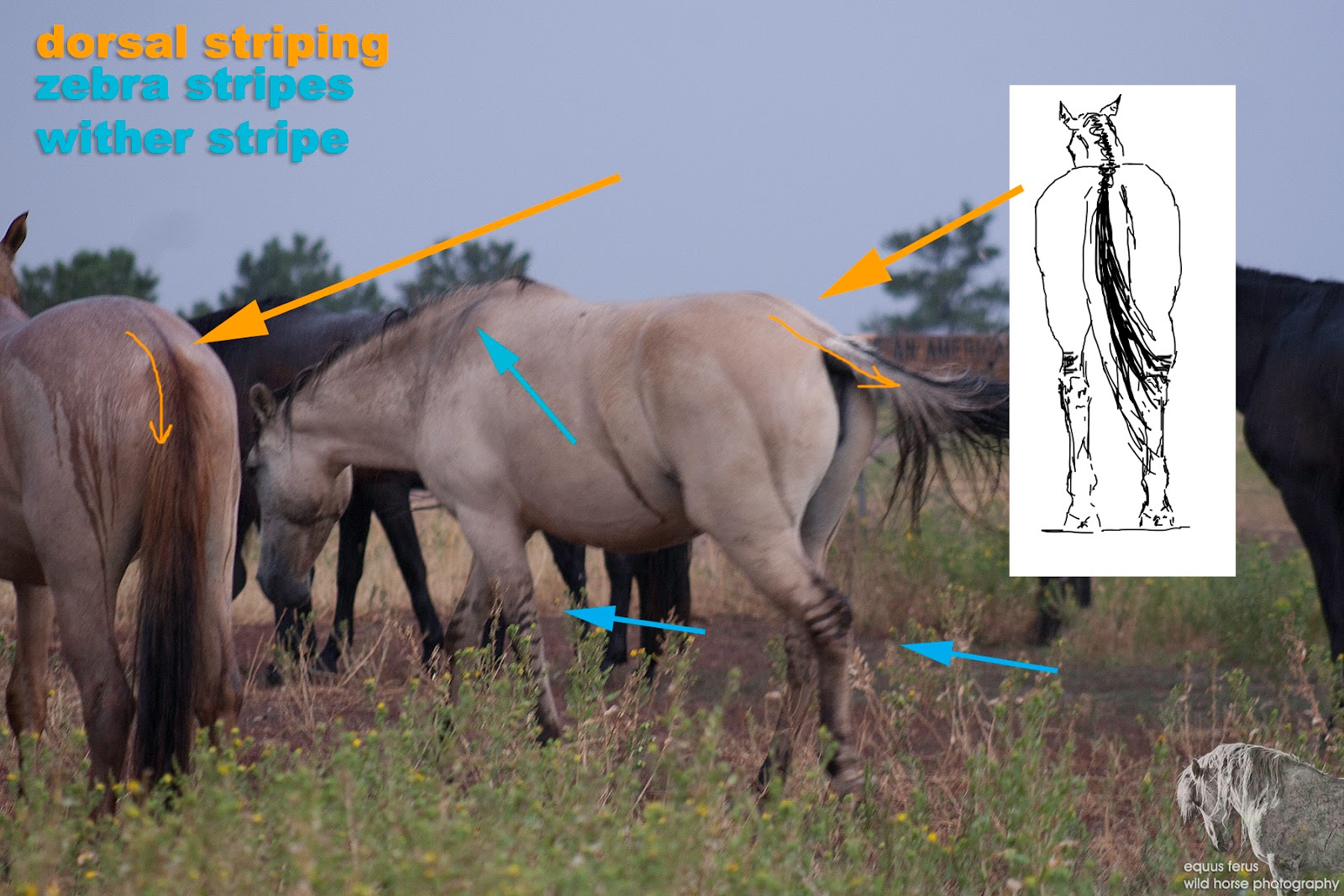
Primitive markings refer to stripes and lines darker than the coat colour that appear on horses carrying the Dun trait (Dn+). The most common marking is a dorsal stripe also called a lineback. The line travels from the mane, down the back and into the tail. Many horses have a dorsal stripe but in duns, the stripe extends from the mane through the tail. There is some debate as to whether the Dun factor- the lightening of red and black on the body- is linked to a separate gene causing the primitive marking, or if they are on the same gene.

Dr. Sponenberg states that if the Dun factor and the primitive markings were located on separate genes, we would see far more horses with primitive markings who are not Duns and more Dun horses without primitive markings (Sponenberg, 2009). Neither of those situations commonly occur, so the traits are most likely located on the same gene. 

© Equus ferus- Wild Horse Photography & Karen McLain Studio

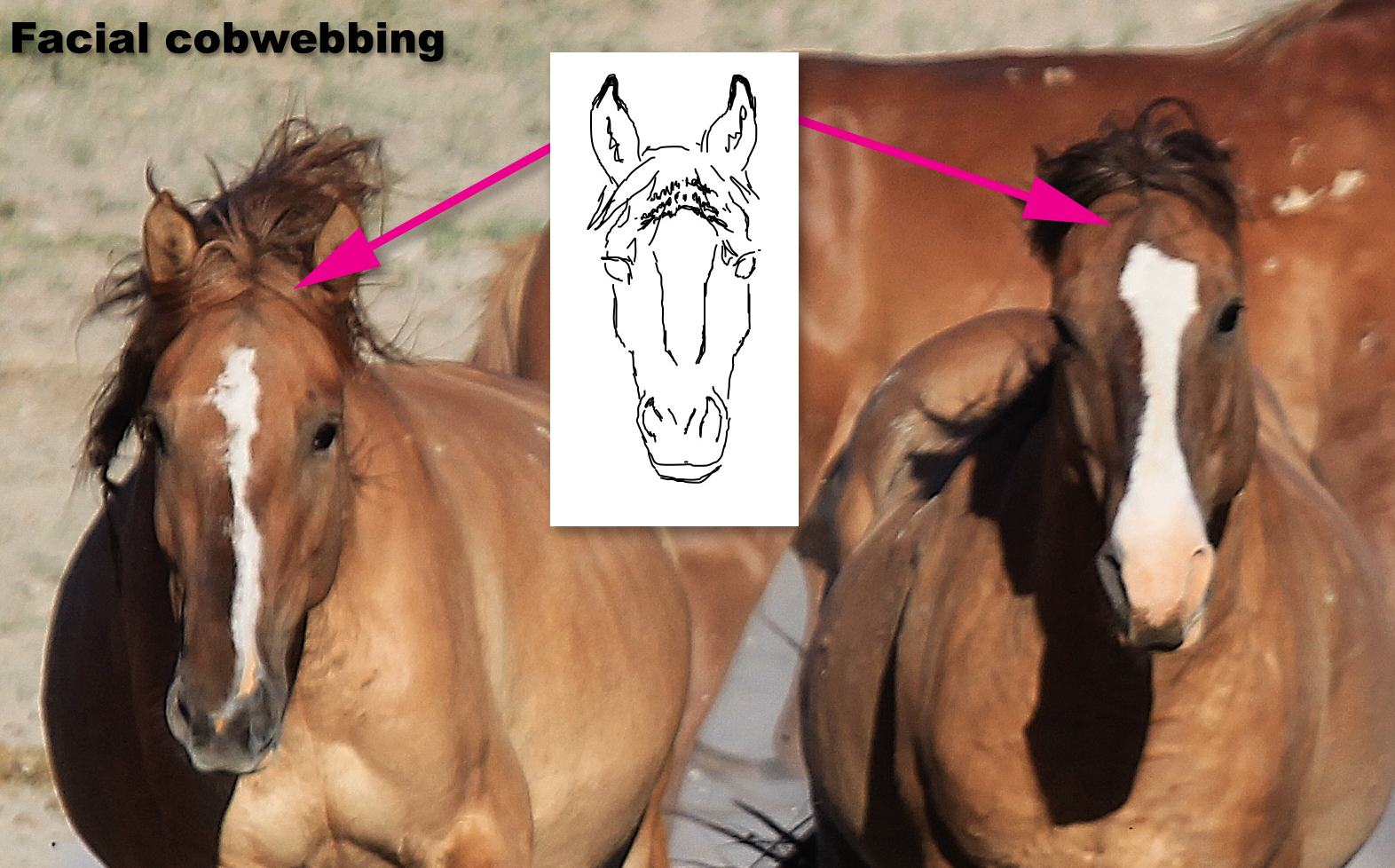
Other makings are zebra stripes on the legs, shoulder or wither stripes- some extending up the neck. Cobwebbing- or facial markings are the rarest. It is extremely rare to find a Dun without a dorsal stripe and zebra stripes are usually present but may be so pale they are not detectable except under certain circumstances. 


© Equus ferus- Wild Horse Photography & Karen McLain Studio

Guard hairs- or lighter hairs on either side of the mane may occur (see photo to the right). Horse Management Areas with a large Dun populations are Sand Wash Basin in Colorado, and Pryor Mountain in Montana, amongst others. There may be darker edges to the ears and mottling/striping on the chest or sides. The Dun factor lightens the body leaving the ‘points’ or lower legs, mane, and tail darker. The head is also left darker which can cause confusion when separating Duns from Roans. The Blue Roan in the photo on the right may have the Dun factor in addition to the Roan which makes identification even more challenging.


© Equus ferus- Wild Horse Photography & Karen McLain Studio

The primitive markings are found on some of the oldest horse breeds such as Sorraia, Icelandic horses, and Norwegian Fjords. They are also seen on Przewalski’s Horse. However, the Dun trait is also seen on more modern breeds such as the Quarter Horse, Spanish Horse breeds and European draft breeds (Stachurska, 1999). The presence of the Dun factor does not mean the horse is from an ancient lineage- the Dun trait is autosomal dominant. This means that if the parent is homozygous (DnDn) or heterozygous (Dndn)- they will have a dun coat and pass the dun trait on to 75% off their offspring making this inherited coat colour common in isolated populations.


Sponenberg, D. (1996). Equine color genetics. Ames: Iowa State University Press.
Stachurska, A. (1999). Inheritance of primitive markings in horses. Journal of Animal Breeding and Genetics, 29-38.


The wild horses of the Salt River

In light of the recent uproar regarding the future of the Salt River Horses in Arizona, including the false alarm of a “round-up in progress”, I thought I’d take some time to jot a few things down. Bear in mind I am playing the devil’s advocate in some of these comments and I firmly feel those horses deserve the right to live free at the River. I do not feel they represent a safety hazard to anyone nor have there been any negative incidents involving horse-human interactions. Cool heads need to prevail and present the facts clearly and calmly. 

The Salt River Horses of Arizona are in danger of losing their freedom. Advocates are scrambling to find rationales for preserving this beautiful population of wild horses. You may read that they are descendent of Spanish Colonial Horses and therefore they should be protected. Unfortunately, as soon as domestic horses were allowed to interbreed with the Salt River horses over the years, the lineage became diluted and their historical value diminished. There is no test currently, that allows us to differentiate a wild horse from a domestic horse. This is the principal reason the United States Department of Fish and Wildlife denied the recent petition to make the mustang an endangered species. We cannot tell them apart from domestic horses. The wild horses have no genetic mutations that are unique and therefore they cannot be isolated or differentiated from the domestic population. Even conformation isn’t reliable as the wild horses are the result mixing different breeds and similarities as well as differences exist among both domestic and wild horses.
Other attempts at proving uniqueness are that the Salt River horses are the only horses that eat river grass. The consumption of aquatic vegetation is actually quite common in the the wild horses of Camargue region of France and in the ponies of Assateague and Chincoteague. So the “mermaid horses” or more correctly the hippocampus of the Salt River is mere fancy. Another point cited to set this population apart is that there are a lot of grey horses in the Salt River herds. Anyone who has been to Sand Wash Basin or Spring Creek Basin will tell you that there are a lot of grey horses at those horse management sites. It is a dominant color and therefore, rather common in every wild horse population. The presence of the dun color, which is frequent in the more ‘primitive’ or ancient breeds (such as Spanish Colonial Horses, Nordic breeds, and/or the horse’s wild cousin, Przewalski’s Horse) is present in the Salt River Horses, but duns are far more far more abundant in wild horse populations that are more isolated. The Pryor horses represent a more bottle-necked population and they have a large number of dun horses, more proportionally than the Salt River.

Instead of struggling to find characteristics which are unique to the horses of the Salt River, perhaps we ought to focus on what they represent. They represent freedom, they represent our heritage and they played a significant role in how the west was truly won. They are a beautiful addition to the landscape of Arizona and the Salt River would be empty without them. They remind us of the beauty of nature and they bring visitors to the Tonto National Forest every year. I have seen these beautiful horses and they have captivated me. Do whatever you can to help these horses. 
Senator John McCain, Phoenix office, 2201 East Camelback Road, Suite 115, Phoenix, AZ 85016. Main: (602) 952-2410 and Senator Jeff Flake. (P: 202-224-4521
 Neil Boswell – Forest supervisor 602-225-5201
Carrie Templin, Public Affairs Officer, Tonto National Forest. 602-225-5290