Primitive Markings in Dun Horses

The Primitive Markings

 © Equus ferus- Wild Horse Photography & Karen McLain Studio

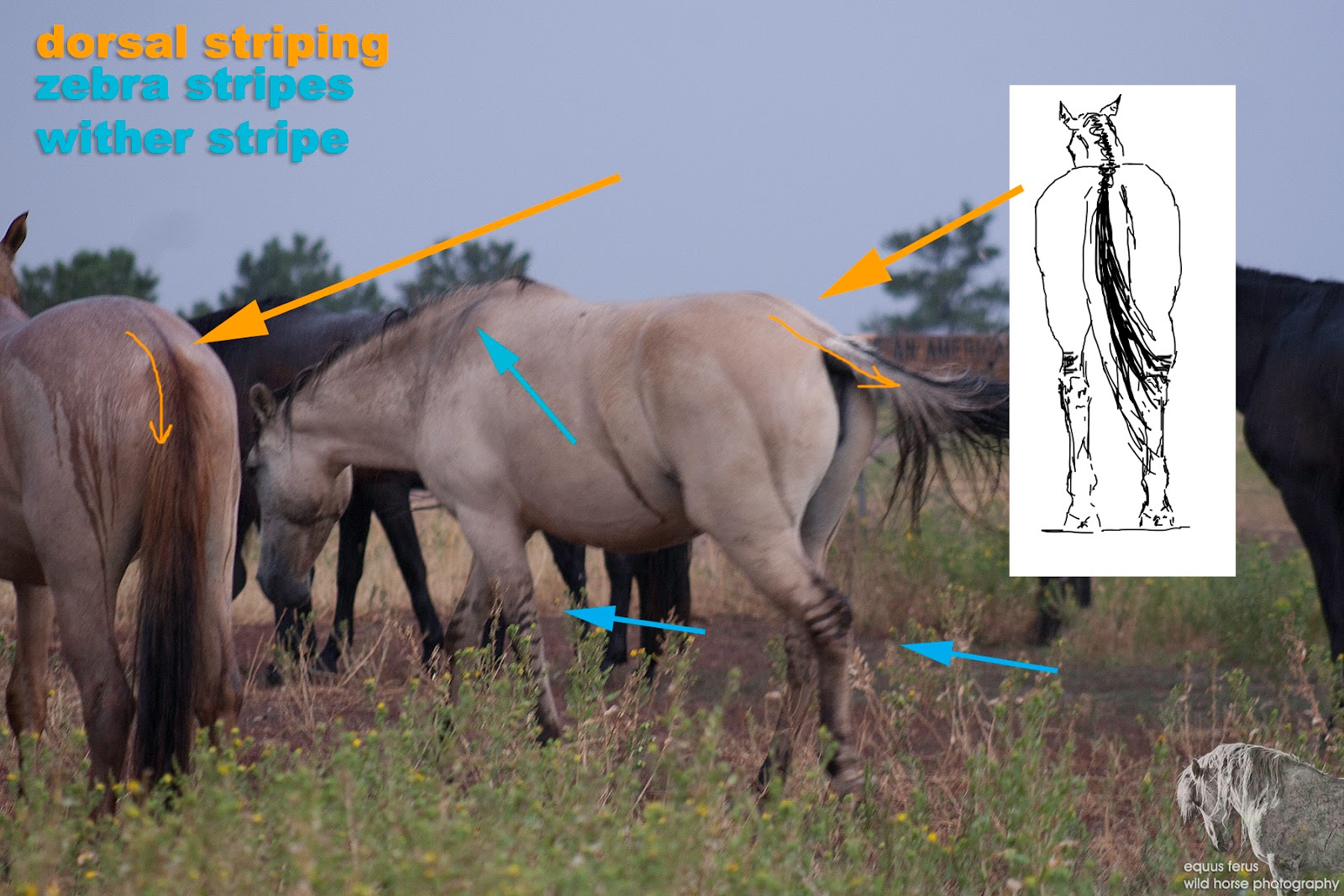
Primitive markings refer to stripes and lines darker than the coat colour that appear on horses carrying the Dun trait (Dn+). The most common marking is a dorsal stripe also called a lineback. The line travels from the mane, down the back and into the tail. Many horses have a dorsal stripe but in duns, the stripe extends from the mane through the tail. There is some debate as to whether the Dun factor- the lightening of red and black on the body- is linked to a separate gene causing the primitive marking, or if they are on the same gene.

Dr. Sponenberg states that if the Dun factor and the primitive markings were located on separate genes, we would see far more horses with primitive markings who are not Duns and more Dun horses without primitive markings (Sponenberg, 2009). Neither of those situations commonly occur, so the traits are most likely located on the same gene. 

© Equus ferus- Wild Horse Photography & Karen McLain Studio

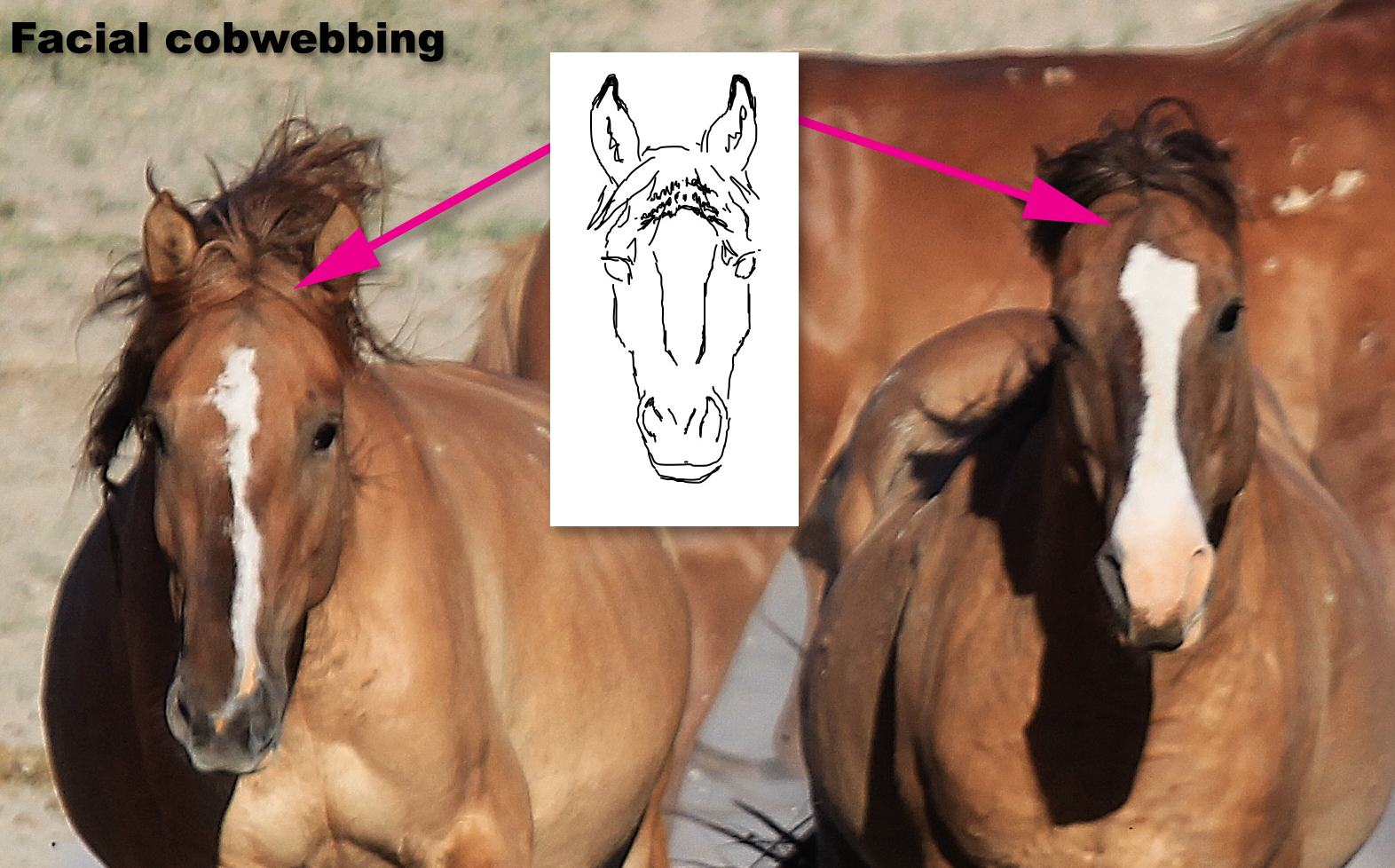
Other makings are zebra stripes on the legs, shoulder or wither stripes- some extending up the neck. Cobwebbing- or facial markings are the rarest. It is extremely rare to find a Dun without a dorsal stripe and zebra stripes are usually present but may be so pale they are not detectable except under certain circumstances. 


© Equus ferus- Wild Horse Photography & Karen McLain Studio

Guard hairs- or lighter hairs on either side of the mane may occur (see photo to the right). Horse Management Areas with a large Dun populations are Sand Wash Basin in Colorado, and Pryor Mountain in Montana, amongst others. There may be darker edges to the ears and mottling/striping on the chest or sides. The Dun factor lightens the body leaving the ‘points’ or lower legs, mane, and tail darker. The head is also left darker which can cause confusion when separating Duns from Roans. The Blue Roan in the photo on the right may have the Dun factor in addition to the Roan which makes identification even more challenging.


© Equus ferus- Wild Horse Photography & Karen McLain Studio

The primitive markings are found on some of the oldest horse breeds such as Sorraia, Icelandic horses, and Norwegian Fjords. They are also seen on Przewalski’s Horse. However, the Dun trait is also seen on more modern breeds such as the Quarter Horse, Spanish Horse breeds and European draft breeds (Stachurska, 1999). The presence of the Dun factor does not mean the horse is from an ancient lineage- the Dun trait is autosomal dominant. This means that if the parent is homozygous (DnDn) or heterozygous (Dndn)- they will have a dun coat and pass the dun trait on to 75% off their offspring making this inherited coat colour common in isolated populations.


Sponenberg, D. (1996). Equine color genetics. Ames: Iowa State University Press.
Stachurska, A. (1999). Inheritance of primitive markings in horses. Journal of Animal Breeding and Genetics, 29-38.


Lethal White

Fleck and her foal 2015, most likely sire Picasso

Equus ferus– Equine Coat Colour Genetic -LETHAL WHITE

One of the mares at the Sand Wash Basin was believed to have given birth to a foal with Lethal White Syndrome.  And although we cannot be absolutely sure the foal was a Lethal White foal, the behaviour strongly suggests it might have been. Lethal White Syndrome has been talked about in groups and on Facebook, hence this blog post. Without a necropsy (autopsy on an animal) we won’t know for certain but here is what we do know…

 
Similar to Hirschsprung’s disease in humans, Lethal White Syndrome affects the colon by making it non-functional and in horses it also affects pigment of the coat. The affected foals are born pure white with blue/grey eyes and occasionally a smudge or darker colour on the body or near the tail however, they die within 72 hours of birth. The colon in these foals is a dead-end and the foals cannot pass feces. They do not act normally and exhibit signs of distress.


Lethal white foal (Picasso x Mingo) photo credit Nancy Roberts 2011
 
 
Picasso and Mingo 2012 photo credit Karen McLain
 
The trait, which is inherited, is carried by the horses who also carry the paint trait frame overo. Frame Overo horses typically have jagged white markings along the center of the body. The back and belly may remain solid colored so the effect is a framed area of white. They may have white faces (apron or bald face) and they may have blue eyes although not always. Some horses may minimally express the trait and the only evidence of the frame overo paint trait is a little spot of white along the neck and an unusually shaped blaze. Some horses may also carry other paint traits such as tobiano and they horses are referred to as toveros. Without genetic testing, nothing is certain so we are basing our assumptions on what we have observed and the reproductive history of the individual mustangs.
Yahtzee (R) & Van Gogh (L)
Photo credit Meredith Hudes-Lowder of Equus ferus Wild Horse Photography
In order to produce a foal with Lethal White Syndrome, both parents must be overo. Not all overo horses carry the trait according to the American Paint Horse Association (http://www.apha.com/breed/geneticsarticles/lethal-whites-1) and not all blue-eyed white foals carry the Lethal White gene. Because  Lethal White Syndrome is autosomal recessive, it means when two horses that are overo and each carry the gene , there is a 25% chance the foal with be born with the syndrome. If a dam with the trait and a sire with the trait have three normal foals, it does not mean the fourth foal will carry the trait; the chances a foal will inherit the syndrome resets each gestation and remains one in four with each subsequent preganncy. 
——————————————————
In the Punnett Square below (Horse drawings by Karen McLain)
Oo outside the square
 on top represent the SIRE
Along the left side, the Oo represents the DAM
Both are Overo represented Oo and the carry the trait


The RESULT:
One Solid foal (unaffected) -25%
Two Overo foals- CARRIERS of the Lethal White Trait- 50%
One Lethal White Foal 25%


One Solid Foal (OO) 25%
One Overo Foal (Oo) 25%
ONe Overo Foal (Oo) 25%
One Lethal White Foal (oo) 25%
 
————————————————————————————-

PUNNETT SQUARE REPRESENTING AUTOSOMAL RECESSIVE INHERITANCE

 
————————————————————————————-
 
The photos below are by Danielle M. Williams and they show Fleck’s foal. Fleck is frame overo and the father is believed to be Eagle, a minimally marked frame overo so it is quite possible the foal carries the Lethal White Syndrome.  Sometimes Lethal White Foals do have darker pigment on the muzzle but this foal is not hunched over in the typical posture of a horse in gastric distress however the witness/photographer Danielle did say the foal did not look well and laid down frequently. She said the foal was unable to stand for any length of time. This is consistent with Lethal White Syndrome and the foals with the disorder often roll from side to side. Another possibility is that the foal may have perished in the fight between the band stallion Eagle and Diego who took over part of the band. Stallion infanticide is unfortunately unavoidable and may be more common than previously thought. Regardless of the manner of death, it is heartbreaking to see a young life extinguished so soon.
 
Fleck and her foal
Photo by Danielle M. Williams
 
Fleck and her foal
Photo by Danielle M. Williams
 
 
Fleck and her foal
Photo by Danielle M. Williams
Please email Meredith with any questions regarding the genetic behind Lethal White Syndrome or horse colour genetic in general.
Equus ferus- Wild Horse Photography
Visit us on Facebook:


Dr. Meredith Hudes-Lowder DNP, WHNP-BC, MSN, BSN, RNC, BS Biology
Meredith received a Bachelor of Science Degree from Binghamton University with an emphasis in ethology and genetics. She received a Bachelor of Science in Nursing also from Binghamton and a Masters of Nursing in Perinatal/Women’s Health from Stony Brook University. She currently practices medicine as a Nurse Practitioner in Manhattan for Advantage Care Physicians. She is also enrolled in the Doctoral program at Stony Brook and graduated in 2016 with a Doctorate of Nursing Practice. Her doctoral thesis was a research study on cervical cancer screening intervals. She is a member of several professional organizations and was inducted into Sigma Theta Tau- the nursing honor society in 2007.