GETTING READY for the MUSTANG WALKABOUT 2016

Today I took out and examined my equipment (happy dance)…

Camera: I bring a Canon 7D Mark ii and a back-up Canon Rebel T3ii. The lenses fit both. I usually have them professionally cleaned over the winter so they are ready for the spring, summer, and autumn photography trips.

Lenses: I use a 100-400mm image stabilised Canon lens most of the time. The Rebel has a 18-135 mm for panoramic vistas. I carry both in the field to make sure my lenses overlap. I also have a 18-55 mm but that won’t cover the area from 55-100 mm so I bring the 18-135 mm. This way I have a full range of lens choice that overlap. A lot of camera stores sell refurbished used lenses and this is a great way to get a lens for a reduced price.  You must have a lens with a minimum distance of 300 mm because you cannot approach the horses closer than 100 feet in most management areas so a long lens is crucial.

Memory Cards: I buy new cards every year. The most important thing is the speed and the size. Get a size that you won’t have to swap cards out frequently, but make sure to have extras. I find the highest speeds to be the best for mustang photography. For the SD Cards, go for 90-95mb/sec read/write and Class 3. Compact Flash Cards come in 120mb/s for the high speed setting. You want to be able to use the camera’s rapid fire capability, so you’ll want the card to match the speed of the camera. I also recommend many smaller sized cards versus one huge card. I usually carry 64MB, 32MB and few 16MB.

If something spectacular happens (and it often does), those photos may turn out to be some of your best work, take the card out of the camera and put it in a safe place when the action is over. The precious photos will be safe and you won’t have to deal with a card failure (rare, but it happens). I kept my first photos of Picasso on a CF Card and carried all the way home after backing it up multiple times.  Another trick- I keep empty cards in my right pocket, and used cards in my left. They are numbered 1,2,3 etc and this way I instantly know what cards are used and which are empty.

Batteries: I carry four. Two are in the battery-grip for the camera all the time and so far, I haven’t had to replace the double battery even after 12 hours of shooting. But I always carry four freshly charged batteries in the field. The back-up camera has a single battery and I carry a spare. We charge them using car charger adaptors or we also use a PowerVerter or Power Inverter which offers plugs and uses the car lighter for the power source. We charge batteries while we drive to save time.

Monopod/Tripod: There are wonderful to stabilise your camera. At places like the waterhole, there is a lot of action going on all the time. Karen usually has one leg of her tripod extended and she will drop the other two if it looks like we will be stationary for a while. I usually carry the tripod with all three legs extended.

External Hard Drives: I carry a 2TB hard drive and a ColorSpace UDMA2 and I upload every night. I don’t even look at the photos until they are backed-up on two external hard drives and then, sparingly. Once I am home, they get backed up via the Cloud and the hard drive goes into the safe. Only then do I go through all the photos. The nice part about the ColorSpace is functions as a hard drive AND as a file viewer with a nice sized LCD screen.

Computer/ Laptop: I bring my Macbook into the field. It is very light and has a nice sized screen. I opted for the Macbook over the Macbook-Air because the Macbook run Photoshop- always useful to have to examine photos if necessary or after they are backed-up.

Binoculars: As an avid bird watcher, I have a good sturdy pair. You’ll need them for the bands in the distance.  I have a simple pair of 8×42 Bushnell.

Sundries:

  • Snake bite kit, yes there are snakes out on the range. So far, no one has been bitten, just watch where you put your feet at all times. The Prairie Rattlesnake is generally docile but even the shyest snake will bite if it is stepped on. Some people wear snake-gaiters and I carry a pair.
  • Sunscreen- tons of the stuff
  • Cooling evaporative towel (Frog Tog)
  • Lens cleaning kits
  • Storm covers- some of the best photos are just before a storm but protect your camera at all times.
  • Food/water/cellphone with car charger

*Always let some know where you are, how long you plan to be there and when you expect to return.

Mustang Walkabout 2016

MUSTANG WALKABOUT 2016: Packing List

Essential Items
Notification– Always let someone know where you are going and how long you plan to be there. Someone who is not with you in the Horse Management Area.  It is a big place, and it is easy to get turned around and cell service is not relaible.

Car with high clearance– High clearance is the most useful feature for your mustang-finding-vehicle but four wheel drive comes in handy and will offer you peace of mind. We will carpool at Sand Wash if necessary so let us know what vehicle you have/need.

SLR Digital Camera-If you can afford it, the best choice is a DSLR camera (digital single lens reflex)- Canon, Nikon, Olympus- whatever is most affordable, start with used if finances are an issue. B&H Camera and Video is an excellent resource and they have good on-line service.

Cell phone with car charger- this is an obvious one

Memory cards– I use smaller cards, about 32 MB and switch frequently. You can’t have enough cards. If I manage to get an amazing series of photos, I will remove that memory card, stash it some place safe and continue with a fresh card. This way you don’t ever run the risk of losing precious photos. Spend the extra money on the fast cards- each card has a speed- we use 90MB/second or faster.

Snacks-there is no food in Sand Wash so bring some of your own- salty foods are good, turkey/beef jerky, chips, fruit, sandwiches- all good choices. We can go eight hours without a ‘real meal’.

Water– Hydration is essential- Gatoraid, sports drinks, etc. Bring twice as much as you think you’ll need. A cooler with ice is very nice.

Map- You can get one in Maybell at the gas station- they have an excellent “hunter’s map” and they are very friendly. We will highlight where the horses are on your map. The BLM office in Craig, Colorado also has maps available if you’re near that location.

OtherSunscreen, insect repellent, sturdy boots, hat, Frog Tog (or similar cooling cloth)


Other Useful, but not critical items

Photography vest– a slightly dorky but rather useful article of clothing. It has about 15 pockets of varying sizes. Make sure, if you don’t have a driver friend, put your car keys in a very safe place- zippered pockets are nice and secure. You don’t want to search through sagebrush for your cars keys. The nice thing about the vest is it holds extra lenses, water, monopod, memory cards and lens cloths without a backpack. Useful for hot summer days especially when you have to hoof-it for a mile…. (I’m wearing one in the photo on the right).

Telephoto lens– most cameras come with a 35-110 or 200 mm lens as a package deal. I love my 18-200mm. For mustangs, you will probably want to invest in a 100-400mm and IS is best. (Image Stabilized). You want the most portable lenses you can carry- literally.

Monopod/Tripod- this handy item comes as a single cane-like support for your camera. It has only one leg but if you find your images are blurry, try using a monopod or tripod.

Lens cloth/cleaner- It is quite dusty at Sand Wash

Waterproof cover for your camera

Email us for any questions: Meredith 

Primitive Markings in Dun Horses

The Primitive Markings

 © Equus ferus- Wild Horse Photography & Karen McLain Studio

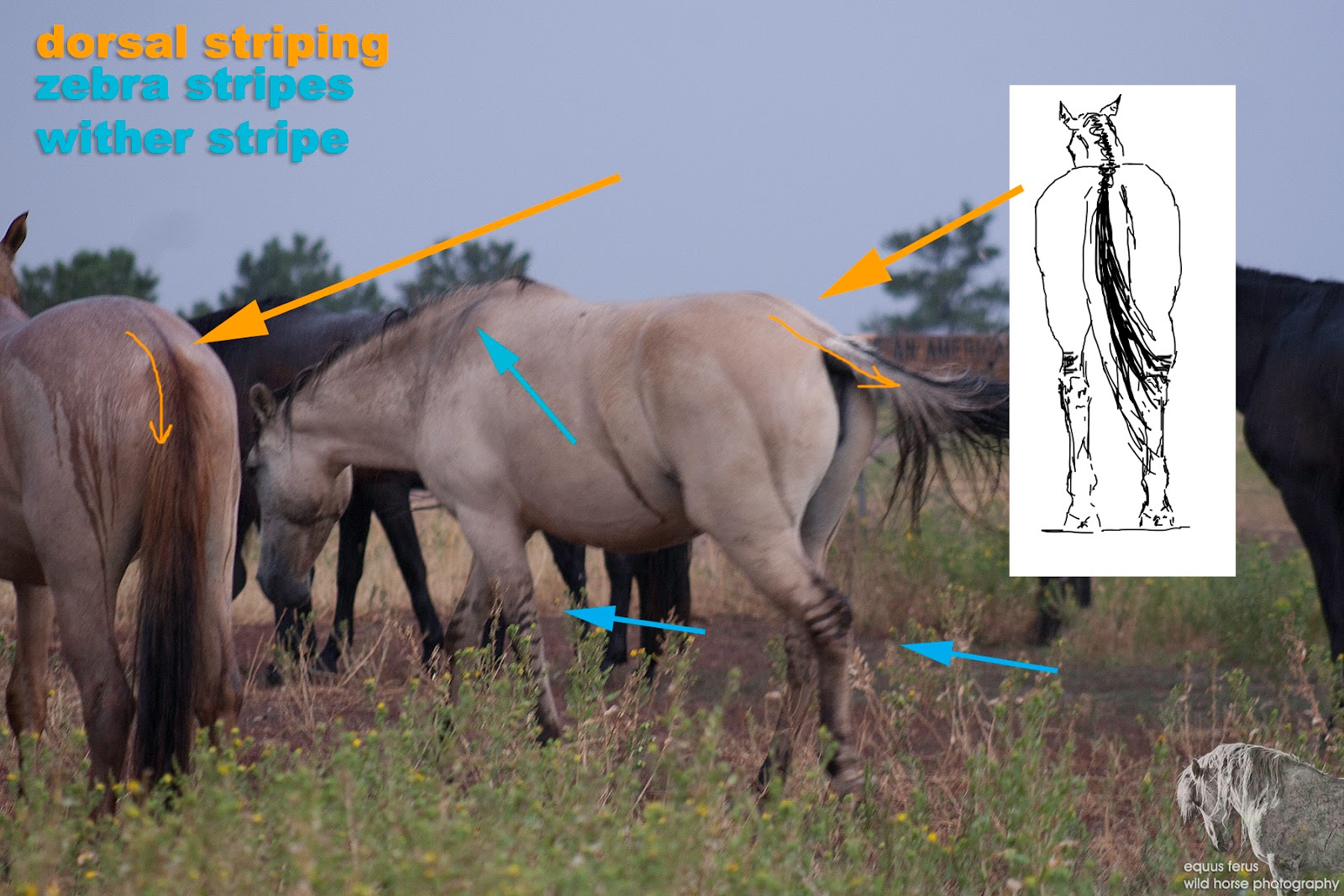
Primitive markings refer to stripes and lines darker than the coat colour that appear on horses carrying the Dun trait (Dn+). The most common marking is a dorsal stripe also called a lineback. The line travels from the mane, down the back and into the tail. Many horses have a dorsal stripe but in duns, the stripe extends from the mane through the tail. There is some debate as to whether the Dun factor- the lightening of red and black on the body- is linked to a separate gene causing the primitive marking, or if they are on the same gene.

Dr. Sponenberg states that if the Dun factor and the primitive markings were located on separate genes, we would see far more horses with primitive markings who are not Duns and more Dun horses without primitive markings (Sponenberg, 2009). Neither of those situations commonly occur, so the traits are most likely located on the same gene. 

© Equus ferus- Wild Horse Photography & Karen McLain Studio

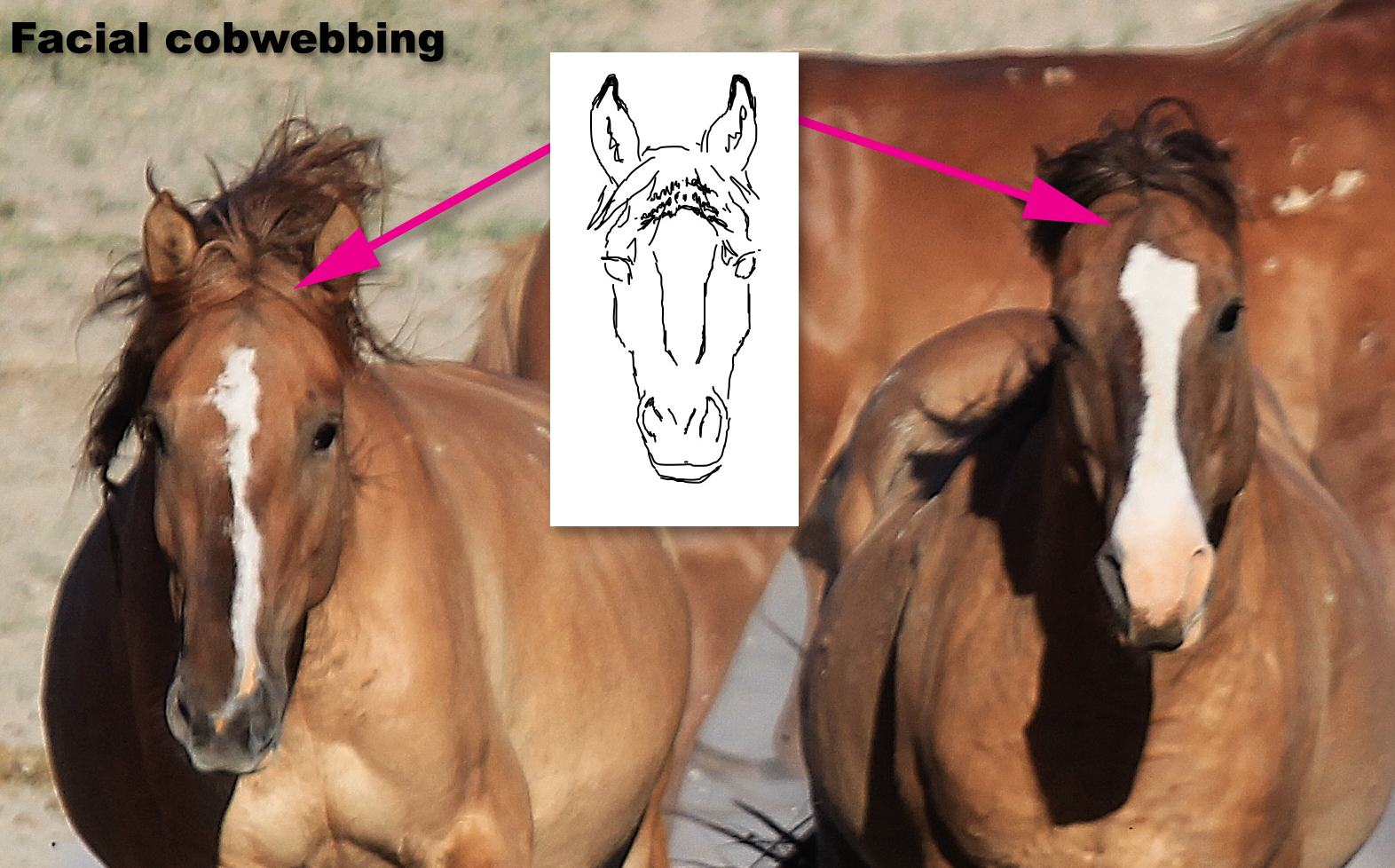
Other makings are zebra stripes on the legs, shoulder or wither stripes- some extending up the neck. Cobwebbing- or facial markings are the rarest. It is extremely rare to find a Dun without a dorsal stripe and zebra stripes are usually present but may be so pale they are not detectable except under certain circumstances. 


© Equus ferus- Wild Horse Photography & Karen McLain Studio

Guard hairs- or lighter hairs on either side of the mane may occur (see photo to the right). Horse Management Areas with a large Dun populations are Sand Wash Basin in Colorado, and Pryor Mountain in Montana, amongst others. There may be darker edges to the ears and mottling/striping on the chest or sides. The Dun factor lightens the body leaving the ‘points’ or lower legs, mane, and tail darker. The head is also left darker which can cause confusion when separating Duns from Roans. The Blue Roan in the photo on the right may have the Dun factor in addition to the Roan which makes identification even more challenging.


© Equus ferus- Wild Horse Photography & Karen McLain Studio

The primitive markings are found on some of the oldest horse breeds such as Sorraia, Icelandic horses, and Norwegian Fjords. They are also seen on Przewalski’s Horse. However, the Dun trait is also seen on more modern breeds such as the Quarter Horse, Spanish Horse breeds and European draft breeds (Stachurska, 1999). The presence of the Dun factor does not mean the horse is from an ancient lineage- the Dun trait is autosomal dominant. This means that if the parent is homozygous (DnDn) or heterozygous (Dndn)- they will have a dun coat and pass the dun trait on to 75% off their offspring making this inherited coat colour common in isolated populations.


Sponenberg, D. (1996). Equine color genetics. Ames: Iowa State University Press.
Stachurska, A. (1999). Inheritance of primitive markings in horses. Journal of Animal Breeding and Genetics, 29-38.


Lethal White

Fleck and her foal 2015, most likely sire Picasso

Equus ferus– Equine Coat Colour Genetic -LETHAL WHITE

One of the mares at the Sand Wash Basin was believed to have given birth to a foal with Lethal White Syndrome.  And although we cannot be absolutely sure the foal was a Lethal White foal, the behaviour strongly suggests it might have been. Lethal White Syndrome has been talked about in groups and on Facebook, hence this blog post. Without a necropsy (autopsy on an animal) we won’t know for certain but here is what we do know…

 
Similar to Hirschsprung’s disease in humans, Lethal White Syndrome affects the colon by making it non-functional and in horses it also affects pigment of the coat. The affected foals are born pure white with blue/grey eyes and occasionally a smudge or darker colour on the body or near the tail however, they die within 72 hours of birth. The colon in these foals is a dead-end and the foals cannot pass feces. They do not act normally and exhibit signs of distress.


Lethal white foal (Picasso x Mingo) photo credit Nancy Roberts 2011
 
 
Picasso and Mingo 2012 photo credit Karen McLain
 
The trait, which is inherited, is carried by the horses who also carry the paint trait frame overo. Frame Overo horses typically have jagged white markings along the center of the body. The back and belly may remain solid colored so the effect is a framed area of white. They may have white faces (apron or bald face) and they may have blue eyes although not always. Some horses may minimally express the trait and the only evidence of the frame overo paint trait is a little spot of white along the neck and an unusually shaped blaze. Some horses may also carry other paint traits such as tobiano and they horses are referred to as toveros. Without genetic testing, nothing is certain so we are basing our assumptions on what we have observed and the reproductive history of the individual mustangs.
Yahtzee (R) & Van Gogh (L)
Photo credit Meredith Hudes-Lowder of Equus ferus Wild Horse Photography
In order to produce a foal with Lethal White Syndrome, both parents must be overo. Not all overo horses carry the trait according to the American Paint Horse Association (http://www.apha.com/breed/geneticsarticles/lethal-whites-1) and not all blue-eyed white foals carry the Lethal White gene. Because  Lethal White Syndrome is autosomal recessive, it means when two horses that are overo and each carry the gene , there is a 25% chance the foal with be born with the syndrome. If a dam with the trait and a sire with the trait have three normal foals, it does not mean the fourth foal will carry the trait; the chances a foal will inherit the syndrome resets each gestation and remains one in four with each subsequent preganncy. 
——————————————————
In the Punnett Square below (Horse drawings by Karen McLain)
Oo outside the square
 on top represent the SIRE
Along the left side, the Oo represents the DAM
Both are Overo represented Oo and the carry the trait


The RESULT:
One Solid foal (unaffected) -25%
Two Overo foals- CARRIERS of the Lethal White Trait- 50%
One Lethal White Foal 25%


One Solid Foal (OO) 25%
One Overo Foal (Oo) 25%
ONe Overo Foal (Oo) 25%
One Lethal White Foal (oo) 25%
 
————————————————————————————-

PUNNETT SQUARE REPRESENTING AUTOSOMAL RECESSIVE INHERITANCE

 
————————————————————————————-
 
The photos below are by Danielle M. Williams and they show Fleck’s foal. Fleck is frame overo and the father is believed to be Eagle, a minimally marked frame overo so it is quite possible the foal carries the Lethal White Syndrome.  Sometimes Lethal White Foals do have darker pigment on the muzzle but this foal is not hunched over in the typical posture of a horse in gastric distress however the witness/photographer Danielle did say the foal did not look well and laid down frequently. She said the foal was unable to stand for any length of time. This is consistent with Lethal White Syndrome and the foals with the disorder often roll from side to side. Another possibility is that the foal may have perished in the fight between the band stallion Eagle and Diego who took over part of the band. Stallion infanticide is unfortunately unavoidable and may be more common than previously thought. Regardless of the manner of death, it is heartbreaking to see a young life extinguished so soon.
 
Fleck and her foal
Photo by Danielle M. Williams
 
Fleck and her foal
Photo by Danielle M. Williams
 
 
Fleck and her foal
Photo by Danielle M. Williams
Please email Meredith with any questions regarding the genetic behind Lethal White Syndrome or horse colour genetic in general.
Equus ferus- Wild Horse Photography
Visit us on Facebook:


Dr. Meredith Hudes-Lowder DNP, WHNP-BC, MSN, BSN, RNC, BS Biology
Meredith received a Bachelor of Science Degree from Binghamton University with an emphasis in ethology and genetics. She received a Bachelor of Science in Nursing also from Binghamton and a Masters of Nursing in Perinatal/Women’s Health from Stony Brook University. She currently practices medicine as a Nurse Practitioner in Manhattan for Advantage Care Physicians. She is also enrolled in the Doctoral program at Stony Brook and graduated in 2016 with a Doctorate of Nursing Practice. Her doctoral thesis was a research study on cervical cancer screening intervals. She is a member of several professional organizations and was inducted into Sigma Theta Tau- the nursing honor society in 2007.