GETTING READY for the MUSTANG WALKABOUT 2016

Today I took out and examined my equipment (happy dance)…

Camera: I bring a Canon 7D Mark ii and a back-up Canon Rebel T3ii. The lenses fit both. I usually have them professionally cleaned over the winter so they are ready for the spring, summer, and autumn photography trips.

Lenses: I use a 100-400mm image stabilised Canon lens most of the time. The Rebel has a 18-135 mm for panoramic vistas. I carry both in the field to make sure my lenses overlap. I also have a 18-55 mm but that won’t cover the area from 55-100 mm so I bring the 18-135 mm. This way I have a full range of lens choice that overlap. A lot of camera stores sell refurbished used lenses and this is a great way to get a lens for a reduced price.  You must have a lens with a minimum distance of 300 mm because you cannot approach the horses closer than 100 feet in most management areas so a long lens is crucial.

Memory Cards: I buy new cards every year. The most important thing is the speed and the size. Get a size that you won’t have to swap cards out frequently, but make sure to have extras. I find the highest speeds to be the best for mustang photography. For the SD Cards, go for 90-95mb/sec read/write and Class 3. Compact Flash Cards come in 120mb/s for the high speed setting. You want to be able to use the camera’s rapid fire capability, so you’ll want the card to match the speed of the camera. I also recommend many smaller sized cards versus one huge card. I usually carry 64MB, 32MB and few 16MB.

If something spectacular happens (and it often does), those photos may turn out to be some of your best work, take the card out of the camera and put it in a safe place when the action is over. The precious photos will be safe and you won’t have to deal with a card failure (rare, but it happens). I kept my first photos of Picasso on a CF Card and carried all the way home after backing it up multiple times.  Another trick- I keep empty cards in my right pocket, and used cards in my left. They are numbered 1,2,3 etc and this way I instantly know what cards are used and which are empty.

Batteries: I carry four. Two are in the battery-grip for the camera all the time and so far, I haven’t had to replace the double battery even after 12 hours of shooting. But I always carry four freshly charged batteries in the field. The back-up camera has a single battery and I carry a spare. We charge them using car charger adaptors or we also use a PowerVerter or Power Inverter which offers plugs and uses the car lighter for the power source. We charge batteries while we drive to save time.

Monopod/Tripod: There are wonderful to stabilise your camera. At places like the waterhole, there is a lot of action going on all the time. Karen usually has one leg of her tripod extended and she will drop the other two if it looks like we will be stationary for a while. I usually carry the tripod with all three legs extended.

External Hard Drives: I carry a 2TB hard drive and a ColorSpace UDMA2 and I upload every night. I don’t even look at the photos until they are backed-up on two external hard drives and then, sparingly. Once I am home, they get backed up via the Cloud and the hard drive goes into the safe. Only then do I go through all the photos. The nice part about the ColorSpace is functions as a hard drive AND as a file viewer with a nice sized LCD screen.

Computer/ Laptop: I bring my Macbook into the field. It is very light and has a nice sized screen. I opted for the Macbook over the Macbook-Air because the Macbook run Photoshop- always useful to have to examine photos if necessary or after they are backed-up.

Binoculars: As an avid bird watcher, I have a good sturdy pair. You’ll need them for the bands in the distance.  I have a simple pair of 8×42 Bushnell.

Sundries:

  • Snake bite kit, yes there are snakes out on the range. So far, no one has been bitten, just watch where you put your feet at all times. The Prairie Rattlesnake is generally docile but even the shyest snake will bite if it is stepped on. Some people wear snake-gaiters and I carry a pair.
  • Sunscreen- tons of the stuff
  • Cooling evaporative towel (Frog Tog)
  • Lens cleaning kits
  • Storm covers- some of the best photos are just before a storm but protect your camera at all times.
  • Food/water/cellphone with car charger

*Always let some know where you are, how long you plan to be there and when you expect to return.

Primitive Markings in Dun Horses

The Primitive Markings

 © Equus ferus- Wild Horse Photography & Karen McLain Studio

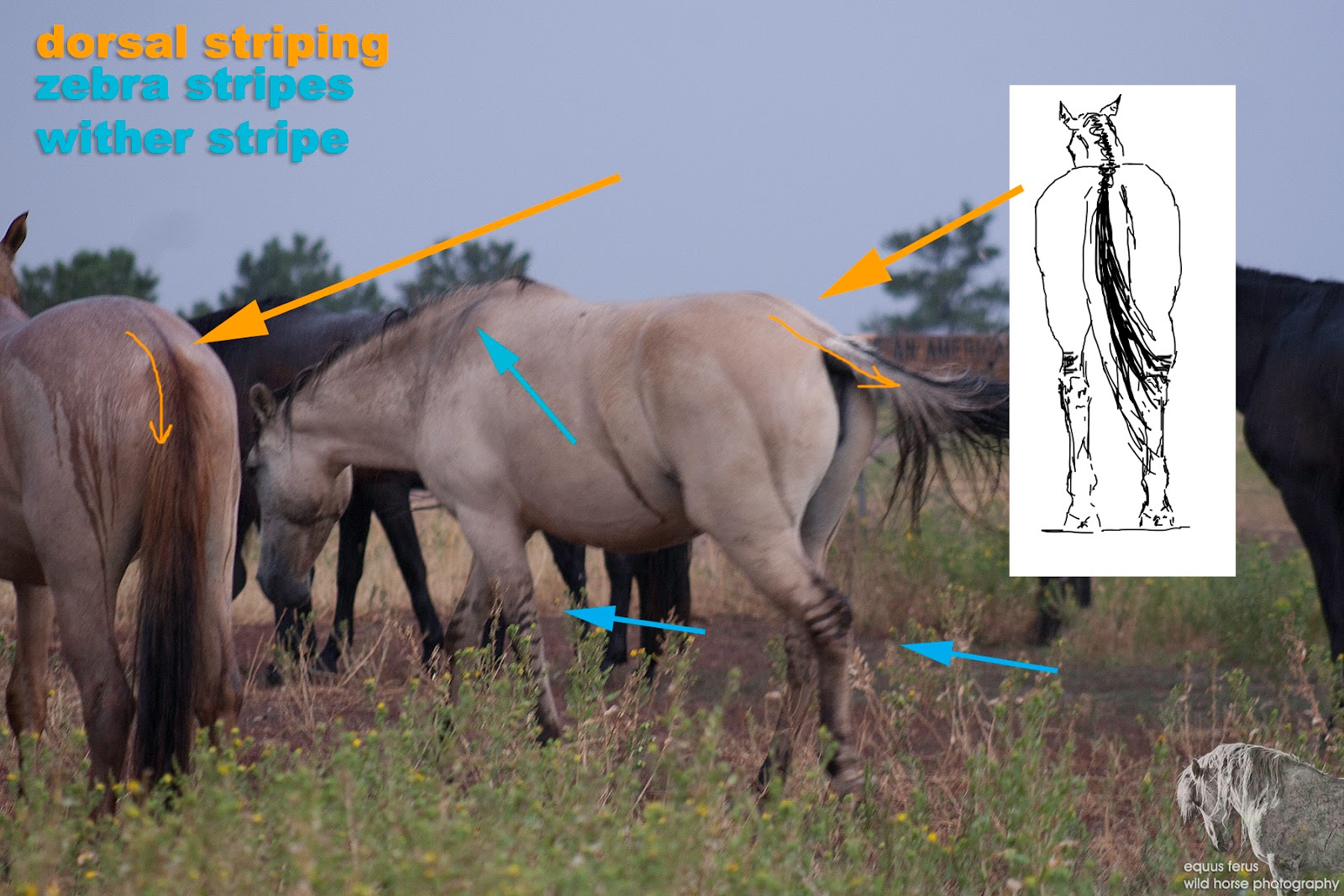
Primitive markings refer to stripes and lines darker than the coat colour that appear on horses carrying the Dun trait (Dn+). The most common marking is a dorsal stripe also called a lineback. The line travels from the mane, down the back and into the tail. Many horses have a dorsal stripe but in duns, the stripe extends from the mane through the tail. There is some debate as to whether the Dun factor- the lightening of red and black on the body- is linked to a separate gene causing the primitive marking, or if they are on the same gene.

Dr. Sponenberg states that if the Dun factor and the primitive markings were located on separate genes, we would see far more horses with primitive markings who are not Duns and more Dun horses without primitive markings (Sponenberg, 2009). Neither of those situations commonly occur, so the traits are most likely located on the same gene. 

© Equus ferus- Wild Horse Photography & Karen McLain Studio

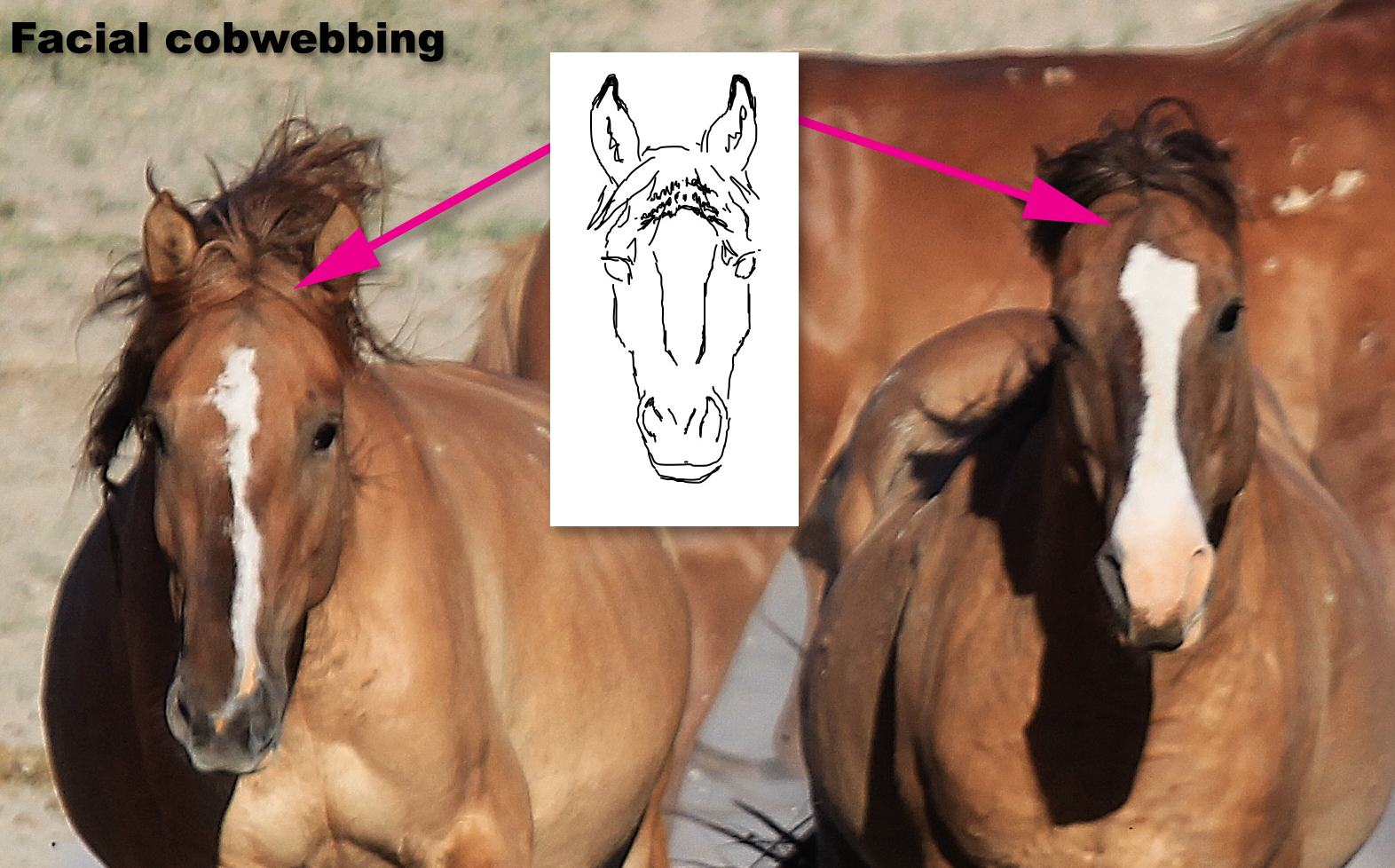
Other makings are zebra stripes on the legs, shoulder or wither stripes- some extending up the neck. Cobwebbing- or facial markings are the rarest. It is extremely rare to find a Dun without a dorsal stripe and zebra stripes are usually present but may be so pale they are not detectable except under certain circumstances. 


© Equus ferus- Wild Horse Photography & Karen McLain Studio

Guard hairs- or lighter hairs on either side of the mane may occur (see photo to the right). Horse Management Areas with a large Dun populations are Sand Wash Basin in Colorado, and Pryor Mountain in Montana, amongst others. There may be darker edges to the ears and mottling/striping on the chest or sides. The Dun factor lightens the body leaving the ‘points’ or lower legs, mane, and tail darker. The head is also left darker which can cause confusion when separating Duns from Roans. The Blue Roan in the photo on the right may have the Dun factor in addition to the Roan which makes identification even more challenging.


© Equus ferus- Wild Horse Photography & Karen McLain Studio

The primitive markings are found on some of the oldest horse breeds such as Sorraia, Icelandic horses, and Norwegian Fjords. They are also seen on Przewalski’s Horse. However, the Dun trait is also seen on more modern breeds such as the Quarter Horse, Spanish Horse breeds and European draft breeds (Stachurska, 1999). The presence of the Dun factor does not mean the horse is from an ancient lineage- the Dun trait is autosomal dominant. This means that if the parent is homozygous (DnDn) or heterozygous (Dndn)- they will have a dun coat and pass the dun trait on to 75% off their offspring making this inherited coat colour common in isolated populations.


Sponenberg, D. (1996). Equine color genetics. Ames: Iowa State University Press.
Stachurska, A. (1999). Inheritance of primitive markings in horses. Journal of Animal Breeding and Genetics, 29-38.


2015- a new year begins…


Corona’s Band. Sand Wash Basin, Colorado ’14
Happy New Year 2015

The past year was a wonderful one for Equus ferus- Wild Horse Photography. We were given the prestigious honor of participating in the Cloud Foundation Art and Music Festival in Colorado Springs over the summer and, to our delight, we sold prints. We had a successful Mustang Walkabout (our summer trip out west to photograph the mustangs) and continue to sell photographs, calendars and prints. We opened an e-store at Red Bubble and are slowly adding to the items fans may purchase.  If you see a photo you’d like as an iPhone cover or mouse pad- or even correctly proportioned for an iPhone or Android (those are free), please don’t hesitate to ask; we can make it happen. Remember all net proceeds from our sales go back to the mustangs!!!

Perhaps the most important event in 2014 was attaining a quarter of a million fans and later passing the 300,000 fan mark. Without our fans, we are just another ordinary Facebook horse-related page. So by way of thanks, we will continue to randomly give away items such as our 2015 Calendar “The Stallion Edition”, and next year, we’ll have The Foal Edition” so stay tuned.
Picasso of the Sand Wash Basin, Colorado ’13
We are planning our summer 2015 Mustang Walkabout and we will visit the Sand Wash Basin, the McCullough Peaks, the Pryor Mountains, Little Book Cliffs and anything interesting along the way. However, before the summer, I will visit the Salt River in Arizona while attending a Mayo Clinic medical conference. I am probably the only person who finds medical conferences based solely on their proximity to wild mustangs. In the fall I will be in Salt Lake City for another conference and therefore will be obligated to visit the Onaqui HMA.
This summer also saw an end to my right anterior cruciate ligament, my medial collateral ligament and both meniscus were torn in my right knee. Since I performed this amazing orthopaedic trick two decades earlier, the ligament used to repair my torn ligament had to be borrowed from a cadaver. I will be spared during the Zombie Apocalypse since I already have a zombie part in my knee, or so my daughter Abigail cheerfully informed me. I had to take an unintended break from riding, Okinawan Kobudo, and even my 34 string Celtic Floor Harp- but I am back at the harp, will start up Kobudo in February and riding will wait until the spring. I was however, able to remain in school this semester, continued editing/posting photos during my convalescence and did not have to take much time off from my job.
I am hoping in 2015 to continue editing the photos collected throughout the year and to have an amazing time with the mustangs so we can bring them to you. I am always available to anyone who is interested in going out to see them; it is easier than you think- just email me. If you happen to be in the neighborhood of the horse management areas in the summer… I’ll guide you out there myself.

We will also be starting a series on ‘Equine Coat Colour’ where we’ll explore the genetics behind the marvellously coloured mustangs… 
Best wishes for health, happiness and joy for 2015
Cloud and I. Pryor Mountains, Montana ’14

Out West Day Seven- Sand Wash Basin final day

It is 7:30am an we are heading back to the Sand Wash Basin in Moffat County Colorado… I spoke to John ad he gave us some tips in where to find the elusive Picasso. It is 48F but there is no wind so it is better than the Butte yesterday!
———–
Well it is 12:30p and we didn’t see Picasso… However we did see almost everyone else- we estimated we saw 75+ mustangs today. We ended at 90F and a few more bruises and scratches… but it was worth every moment. The gorgeous Corona made
an appearance and I managed only a mere hundred or so photos of him.. I saw horses I have only seen in photos of the Sand Wash horse club on Facebook or John Wagner’s page.

My little photo buddy Abby walked with me -every mile up and down the ridges and bluffs, through the gullies and sagebrush. All in all we took over 9,000 photographs between Little Book Cliffs, Pilot Butte and Sand Wash Basin Horse Management Areas. The cameras are cleaned and put away. All compact flash cards are reformatted and stored in their cases and I have transferred the photos to both the laptop and the external hard drive. Currently I have Lightroom making a catalog of the weeks adventures. Just glancing thru the photographs- Abby and I took some very nice ones that we hopefully will sell and make money for the mustang rescue groups. I am so happy both my children were able to see wild horses roaming “free”- that being a relative term but it was a privilege to witness the lives of these magnificent creatures.

Stay tuned,
Meredith

Out West Day Six- Driving to the Sand Wash

We are driving on Wyoming 430 towards Colorado and the Sand Wash Basin… This entire area, which is managed by the BLM, is desolate and mostly sage and scrub brush… There are horses here- a few scattered herds- and we managed to find a herd of three. A bay stallion, a dark brown/black mare and a chestnut foal. Abby and I had to crawl under a barbed wire fence but a fifteen foot deep gully prevented us from getting closer to the tiny herd. But we managed a few photos nevertheless.

We passed over the state line into Colorado and the road becomes a dirt road. It is an ‘open range’ which means we have to watch for cows on the road. Most of the time it isn’t a problem but once in a while we run into a cow-jam. The road, Moffat County Road, travels through a gorgeous canyon called ‘Irish Canyon’ which was a favorite hide-out for bandits and bad-boys of the old West. Butch Cassidy reputedly buried $30,000 in silver coins here and there are other rumors of $150,000 in gold ingots hidden in the canyon. It gives me the oogies (chills, the good kind).

Irish Canyon is also as Area of Critical Concern- environmentally speaking. The photo of the sign mentions some critically endangered plants. There are petroglyphs – ancient writing as well.

We are determined photographers and Abby has definitely inherited my tenacity! At Pilot Butte she was adamant about getting out of the warm car to photograph the mustangs despite being severely under-dressed for the cold. Clad in only Wellys, a sweatshirt and shorts she bravely went with me to photograph the herd… The mother in me wanted to send her back to the warm car but I gave in, allowed her to decide if it was too chilly and admired her spirit.

Out West Day Six – The Sand Wash Basin

Well here we are at Sand Wash- John Wagner is here today so maybe we’ll see him. 160,000 acres and we covered almost all of it! Eight hours of traveling by car and on foot… We shot over 1,000 photos once we found the herds in 90 F heat. Quite a change from this morning’s 45 F! Most if the herds were off the road quite a distance do Abby and I ‘hoofed it’ to get closer. We brought water with us and loads of sunscreen!

Ben and Bruce sat patiently in the car while Abby and I walked miles and miles across sage brush…. I have numerous cuts and scratches marking our travels. But we got the photos and saw a brand new foal- John Wagner says her name is ‘Wild Spirit’. We didn’t see John or his spiffy new camera but we did chat on Facebook later-

We will return to Sand Wash tomorrow and hit the water spots first- from my observations of mustangs, they often go to water first thing in the morning!

Out West Day Six -Morning on the Butte

Chilly morning on the butte- 45 degrees and with the windchill it is in the upper 30’s… But when you see the mustangs, you forget everything. We were concerned because we didn’t find any horses last night at Pilot Butte.

This morning we were lucky and found two small herds with horses we recognized from last year including Skye & Kira. It is so nice to see last years’ foals all grown up and looking healthy.

The horses don’t always oblige us by standing next to road- we often have to hike quite a distance. The longest was a mile if my GPS was accurate (I think it was longer!). The two photos of the landscape are mustangs in the distance with one cropped to prove there actually are horses in that photo…

It was a gorgeous morning at Pilot Butte albeit freezing. The sun finally cleared the clouds and we warmed up a bit. There’s a quality of lighting on the Butte that reminds me a bit of the Hudson River School of artists. Granted they are the Thomas Kincaid of the Mid-Nineteenth Century but it is still breathtaking. I’d like to go to Tuscany some day- they say the lighting is similar but they don’t have mustangs there so perhaps not… However I am lucky enough to live in the Hudson Valley where the artists used the beautiful lighting there to compose their paintings…

Out West Days Four & Five- Pilot Butte

We arrived late last night in Green River Wyoming after a long day fossil hunting all over Utah & Colorado. We made it to the Butte at disk and for a free good shots in… Then our tire popped and we limped back to the hotel. We changed the tire and my husband Bruce took the car to a garage this morning to buy a new tire. It isn’t wise to go into some of these horse management areas without a good spare tire. We missed the early morning light on the Butte but we all slept in and we will catch the light tomorrow morning!

Now we are off to Fossil Butte and ‘Fossil Safari’ to find 55 million year old fossils! Then up to the Butte for the late afternoon lighting!

Out West Day Three- Holy mustangs Batman

Wow! It is 1:09pm and we just finished, we drove 40 miles in and about the Little Book Cliffs Wild Horse Management Area… We saw over 30 horses, some new from our trip yesterday. Paints, duns, roans, sorrels, blacks, buckskins, palominos, creamellos and one beautiful Appaloosa… It was amazing! The weather was mostly overcast and cool in the mid 60’s and the horses were very active. Yesterday was in the high 80’s yesterday and the horses barely moved. Today they were fighting and running and generally being rowdy and we got some incredible shots. Abby was by my side most of the time but occasionally she’d end up at about 90 degrees from my vantage point and she would get a wonderfully different perspective!

It is now raining lightly as we make our way out of the horse management area. We are all hungry and tired in a satisfied kind of way. My grateful thanks to Bruce for fearlessly driving over roads that gave me the willies and to Ben who patiently sat in the car while Abby and I photographed the mustangs.

The cameras are put away safely- all the Compact Flash cards are in their cases and carefully stored. I had so many good pictures that I changed the CF cards four times. Generally after shooting some action, I use another card just for security. I once accidentally reformatted a card with photos on it so I am extra careful.

A pretty amazing day- I can’t wait to see the photographs later at our hotel!