Primitive Markings in Dun Horses

The Primitive Markings

 © Equus ferus- Wild Horse Photography & Karen McLain Studio

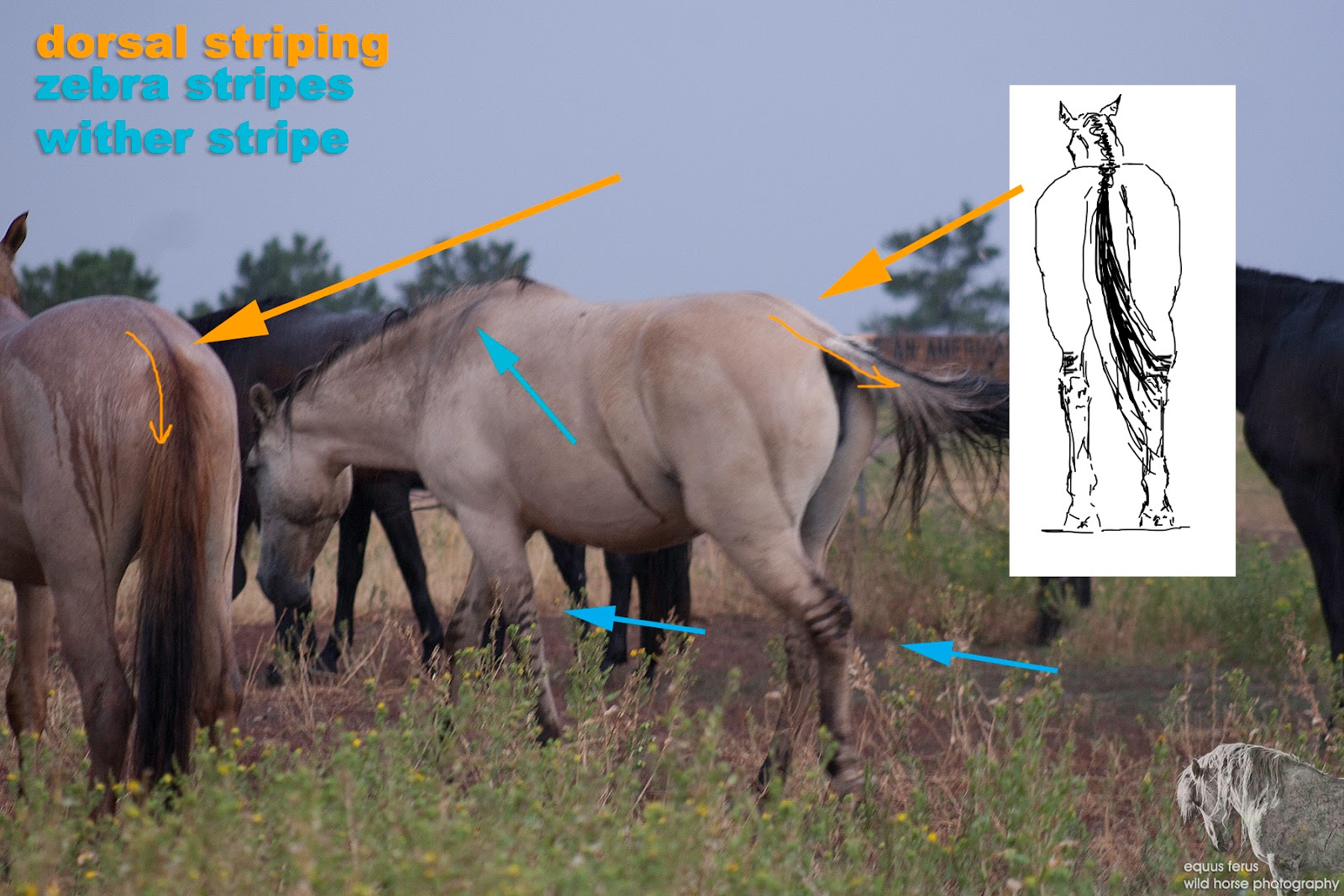
Primitive markings refer to stripes and lines darker than the coat colour that appear on horses carrying the Dun trait (Dn+). The most common marking is a dorsal stripe also called a lineback. The line travels from the mane, down the back and into the tail. Many horses have a dorsal stripe but in duns, the stripe extends from the mane through the tail. There is some debate as to whether the Dun factor- the lightening of red and black on the body- is linked to a separate gene causing the primitive marking, or if they are on the same gene.

Dr. Sponenberg states that if the Dun factor and the primitive markings were located on separate genes, we would see far more horses with primitive markings who are not Duns and more Dun horses without primitive markings (Sponenberg, 2009). Neither of those situations commonly occur, so the traits are most likely located on the same gene. 

© Equus ferus- Wild Horse Photography & Karen McLain Studio

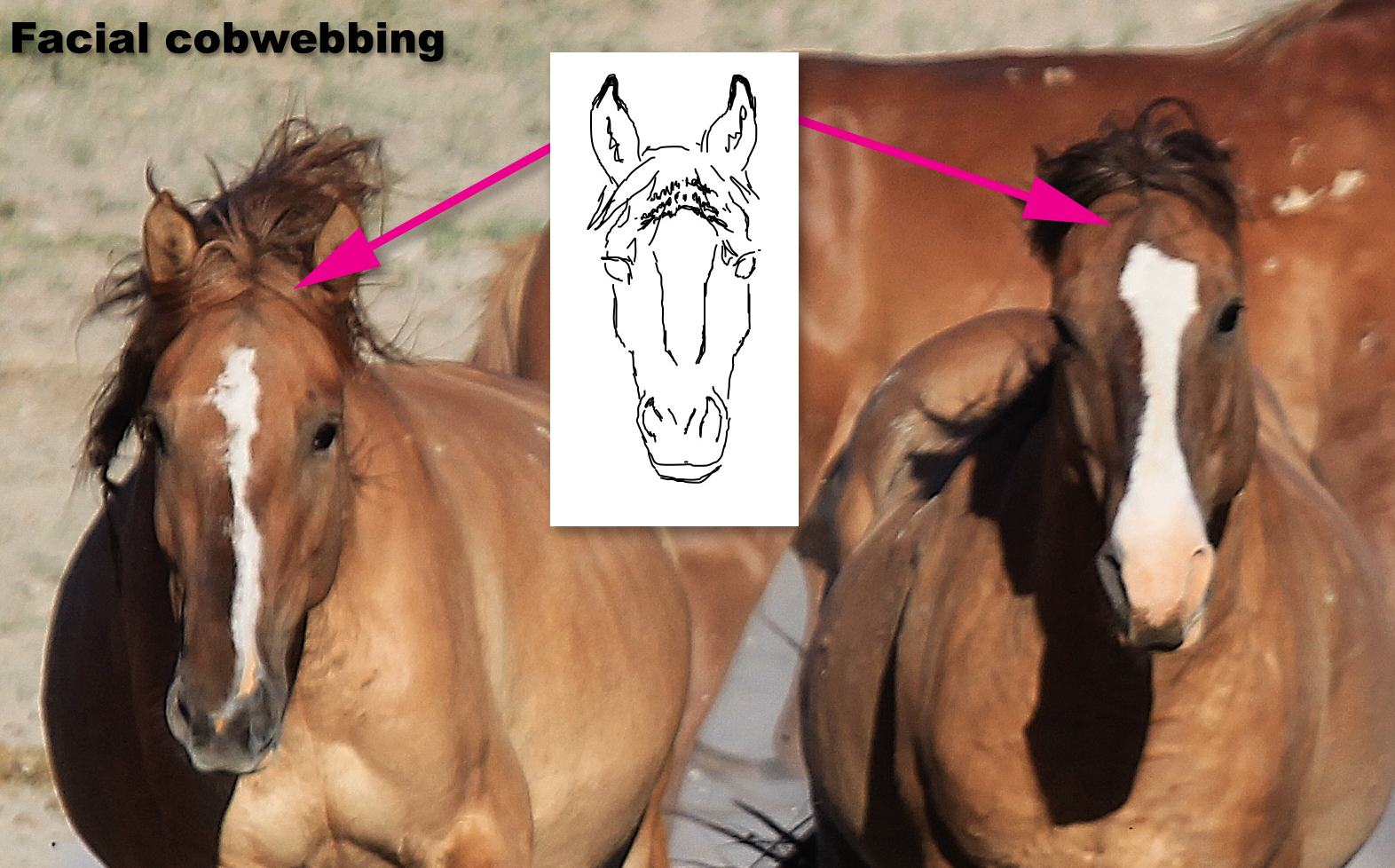
Other makings are zebra stripes on the legs, shoulder or wither stripes- some extending up the neck. Cobwebbing- or facial markings are the rarest. It is extremely rare to find a Dun without a dorsal stripe and zebra stripes are usually present but may be so pale they are not detectable except under certain circumstances. 


© Equus ferus- Wild Horse Photography & Karen McLain Studio

Guard hairs- or lighter hairs on either side of the mane may occur (see photo to the right). Horse Management Areas with a large Dun populations are Sand Wash Basin in Colorado, and Pryor Mountain in Montana, amongst others. There may be darker edges to the ears and mottling/striping on the chest or sides. The Dun factor lightens the body leaving the ‘points’ or lower legs, mane, and tail darker. The head is also left darker which can cause confusion when separating Duns from Roans. The Blue Roan in the photo on the right may have the Dun factor in addition to the Roan which makes identification even more challenging.


© Equus ferus- Wild Horse Photography & Karen McLain Studio

The primitive markings are found on some of the oldest horse breeds such as Sorraia, Icelandic horses, and Norwegian Fjords. They are also seen on Przewalski’s Horse. However, the Dun trait is also seen on more modern breeds such as the Quarter Horse, Spanish Horse breeds and European draft breeds (Stachurska, 1999). The presence of the Dun factor does not mean the horse is from an ancient lineage- the Dun trait is autosomal dominant. This means that if the parent is homozygous (DnDn) or heterozygous (Dndn)- they will have a dun coat and pass the dun trait on to 75% off their offspring making this inherited coat colour common in isolated populations.


Sponenberg, D. (1996). Equine color genetics. Ames: Iowa State University Press.
Stachurska, A. (1999). Inheritance of primitive markings in horses. Journal of Animal Breeding and Genetics, 29-38.


Assateague Island National Park 2015

Hello Everyone!!!
We’re back at Assateague Island NP for a long weekend of photography.  Karen McLain has already been here for over a week as an “Artist-in-Residence”. This is a prestigious appointment in which an artist, often a painter, is invited to spend a fortnight at a location and uses the opportunity to hone their artistic skill in a new environment and they often teach classes as well. 


I joined Karen today after driving down the coast from the Hudson Valley in New York. We shot a few of the ponies, although the conditions were less than optimal with an intermittent light mist falling. We broke early and had a wonderful dinner at a restaurant in Salisbury, Maryland called “Brew River”- the specialty was crab cakes and they did the cakes justice.  The oysters on the half-shell were amazing and we thoroughly enjoyed this dining experience.


It was also nice to see a horse that had been a foal, when we were last here in 2012. One of the things I particularly enjoy is seeing foals grow up and get bands of their own or give birth to their own foals. It lends a more personal aspect to the photography.
Foal 2015- Today
Foal 2012
Same foal today 2015


Tomorrow we are up early and plan to have a full day in the park. Karen is teaching a class for the Assateague Island Alliance on Saturday so we will prepare for that- a local paper did a nice segment of Karen’s residency here . 


As always, continue sharing Equus ferus’ photos! We will be posting live from the park.

Mustang Walkabout 2015

As I sit at 30,000 feet flying to my home in New York, I find myself reflecting over the past two weeks. Karen and I went to three Horse Management Areas: McCullough Peaks, Pryor Mountain and Sand Wash Basin.  We camped out in the horse ranges and we had the privilege of sharing the lives of these magnificent creatures and my photography will be all the better for such intimate contact. It wasn’t easy, the temperatures never dropped below 90 F during the day, the dust was abundant and I had altitude sickness on Pryor Mountain… 

But we persevered and rose each day at dawn and photographed until the sun was directly overhead when we took lunch and a siesta. We resumed photographing the horses until dusk. We drove all over the management areas and often hiking mile after mile to find the mustangs. We drank water and Fresca by the gallon, made cream of wheat in the morning & yaku soba noodles in the evening and treated ourselves to s’mores. We listened to coyotes, thunder and the sound of horses running by our camp… And we photographed- all aspects of the mustangs living free.  Karen took time to paint while I photographed.  We met and spent time with some extraordinary people like Patty, Deb, Rachel, Connie, Robin, Julie, Michael, Heather by proxy…

Still, it is nice to return home, and see the family. I missed Abby, Ben and Bruce as well as my Thoroughbred Ashe and all our pugs plus Stormy and of course, Puppy. It will be wonderful to have a shower every day, indoor plumbing, electricity on demand  and to  luxuriate in air conditioning. But I miss the mustangs and the camaraderie of the other horse people,  especially my best friend Karen.  We are already planning our next Mustang Walkabout for 2016. But before then, I have over 30,000 photographs to catalog and to edit, a new website to update and go live, a book to write, a research paper on ‘Stallion Infanticide’ to finish, and this incredibly fun thing I call work… I miss my patients and my colleagues. I missed my 34-string Celtic floor harp more than I thought and can’t wait to practice. But each evening, when the sun gets low, my thoughts will turn to the horses- is Picasso okay? How is Cloud doing? How are all the new foals thriving?

Thank you for joining Karen and I on this incredible journey of sharing the lives of the wild horses of North America with the world through art and photography… 
-Meredith & Karen