The Frame Overo

When I first sat down to go through my photographs, I was hoping to have five or six good examples of the Frame Overo trait. I was pleasantly surprised to find so many mustangs with this particular pattern. Interestingly, I found Frame Overo mustangs principally at Sand Wash Basin and Black Hills Wild Horse Sanctuary. It is entirely possible there are some Frame Overos at other management areas, but neither Karen nor I had photographed any of them. The Frame Overo is also unique to North America. This pinto pattern is common only in Spanish Colonial Horses or their descendants. However, the trait occasionally, but rarely. appears in European-derived horses such as Thoroughbreds, Ethiopian breeds, and miniature horses (Sponenberg, 2009).

Frame Overo horses that have white patches superimposed on a background of any base colour such as roan, bay, chestnut, palomino and so on. The white colour often begins as a patch on the neck or barrel and spreads horizontally. The back almost always remains solid coloured between the withers and tail. The white patches are irregularly edged and splashy (Bailey & Brooks, 2013) although some white markings are clean and crisp, similar to tobianos (Sponenberg, 2009). The markings usually do not have the lacy or frosted appearance of Sabino patterned horses (Kerson, 2015)

The tail is generally one colour and at least one leg is usually solid coloured although often all four legs are solid. If the legs are solid, they may have socks or stockings in a pattern one might find on a non-pinto horse. The markings on the head are often extensive, bonnet or apron-faces are common. Additionally, they may have a pigmented upper or lower lip, or ‘moustache’ (Sponenberg, 2009).

The genetics are simple, the Frame trait is autosomal dominant, which means a Frame foal must have one Frame parent. However, if both parents have the Frame gene, there is a 25% possibility the foal will be homozygous and have two Frame genes. This foal will not survive because a homozygous Frame is linked to another genetic defect which causes loss of peristalsis (the wave-like action that moves food through the intestines), or more rarely, an incomplete colon. (Bailey & Brooks,2013). More information and examples are located at the bottom of this page.
FF= Normal color
Ff-= Frame Overo
ff= Overo Lethal White


Perhaps one of the best-known Frame Overos is Picasso from the Sand Wash Basin. This handsome Bay horse is one of the most photographed mustangs and he has a Breyer Horse modelled after him. He is a Bay Frame Overo (and possibly carries other pinto traits). Many of his numerous offspring are Frame Overos including two know Lethal White foals. There will be more information on this genetic anomaly presented below.
Picasso
Picasso

This is an excellent example of a Bay Frame Overo stallion.
Note the white markings on neck and barrel as well as the four solid coloured legs.
Sand Wash Basin, Colorado

The horse on the right is a Chestnut Frame Overo
Sand Wash Basin, Colorado

A small family band with a Sorrel Frame Overo Stallion and a Frame Overo foal. In the management ranges, we cannot be certain of a foal’s parentage. Identifying a foal’s dam is generally more reliable than the sire. However, mares have been known to steal foals from other mares. Additionally, fillies will leave their natal bands briefly, breed with another stallion, and return to their natal band to deliver and raise the foal within the band they were born. Without genetic testing, we cannot be certain.

Hoot, Juniper, and Pinyon (2014)
Sand Wash Basin, Colorado


A Chestnut Frame Overo. The pigmented lip is common and may appear on the upper lip, lower lip, or both as this mustang demonstrates.
Sand Wash Basin, Colorado

The Chestnut Frame Overo is unusual because the right hind leg is extensively marked with white. This may be an anomalous finding, or an indication there are other pinto genes present, possibly Sabino. The heavily white face and body markings are more characteristic of Frame Overos.
Sand Wash Basin, Colorado

This charmingly marked dark (liver) Chestnut Frame Overo mare is called ‘Crazy Horse’. The freckles on her face are also known as Belton Spots and similar to the spotting found in English Setter dogs. Many horses with Belton Spots on their facial markings, also show “ermine spots” on their legs.  From Sand Wash Basin.

Although not perfectly focused, this Bay Frame Overo has Belton spots on his blaze as well as ermine spots (black spots on socks that are usually found along the coronet band). The ermine spots can cause the hoof to darken and appear striped. From Sand Wash Basin

These two beautiful sparring stallions are from Sand Wash. Kiowa on the left (Bay) and Haze on the right (Sorrel). Haze is a minimally marked Frame Overo- can you find the tiny white mark on Haze?

This is Miss Fleck- she is a Chestnut Frame Overo from Sand Wash Basin: the first image is her as a foal, the second image as a young mare. She was born into Voodoo’s band a but later joined Picasso’s band (2013). Picasso has since lost his band but he has been doing well as a bachelor. Fleck gave birth to a Lethal White Foal.
Fleck: foal, right side
Fleck: left side

This is Kiowa from the near side (left) from Sand Wash Basin. He had just been in a fight and you can see lacerations on his hip and shoulder. There is also a significant scar on Kiowa’s left haunch just below the laceration. It is believed he tangled with either a mountain lion or a wound from fighting that became infected. It is also possible he ran into a fence along the border of Sand Wash Basin and neighbouring ranches.

This is Raindancer. A lovely Chestnut Frame Overo with blue eyes from Sand Wash Basin.

This is an excellent example of a Bay Frame Overo mare from Sand Wash Basin, Colorado with a pigmented lip, flank markings and a small lower neck/shoulder marking.

Here is a lovely colt Named Van Gogh, he is one of Picasso’s many Frame Overo offspring from Sand Wash Basin.

This is Yatzee on the left and a grey stallion on the right from Sand Wash Basin. The grey is actually a Frame Overo – if you look closely at his neck, you’ll see the faint outline of the original white mark in the middle, just under his mane. He also has some white markings on his barrel. Some people refer to grey pinto as “ghost paints/pintos”. In the winter it is impossible to tell them apart from solid grey colour horses. A wet grey pinto in a summer coat is the easiest to recognise because you can see the underlying skin colour: pink under white markings and darker under the base colour

Another “Ghost- Frame Overo Grey from Sand Wash Basin. The horse on the left has several white Frame markings on his neck, barrel and just above his stifle. He also has the distinctive white apron face with the pigmented lip. The pink skin of the white marking is especially noticeable on this horse’s muzzle. If you see a horse with a pigmented lip, there is a good chance they are a pinto- often a Frame Overo. The middle horse is also a Frame Overo, this time black with four white stockings.  Four white stockings may indicate this mustang has other pinto genes.  The last horse is a Bay Frame Overo with a usual number of white leg markings. Generally, the leg markings do not rise above the knees in Frame Overos.

This family band has two Frame Overos from Sand Wash Basin. The foal, a chestnut beginning to grey-out, and the sorrel stallion. Again, notice the solid coloured legs which help distinguish Frame Overos from Tobiano pinto.

A handsome Grullo Frame Overo gelding from Black Hills Wild Horse Sanctuary Black Hills is a wonderful rescue organisation, please click on the link to find out more

A Black Frame Overo from Black Hill  Wild Horse Sanctuary

Bay Frame Overo with a stunning pattern from Black Hill  Wild Horse Sanctuary.

Two Black Frame Overos from Black Hill  Wild Horse Sanctuary. Note the tendency for Frame Overos to have solid colour on the spine from the withers to the dock.

Sugar, a Grulla Frame Overo from Sand Wash Basin, Colorado

This stallion is a Chestnut Frame Overo from Sand Wash Basin. It is evident he is thin but these horses receive no care. Many of the horses are underweight from untreated injuries, dental issue, and other injuries or infections that go untreated. It is truly survival of the fittest and only the strongest survive to reproduce. He was a very fiesty stallion, sparring with the bachelors and band stallions.

A dark chestnut Frame Overo pinto from Sand Wash Basin with very little white on his belly (the rest is dried mud)- referred to as a minimal Frame Overo. This stallion is called Spyder.

A Minimal Dun Frame Overo pinto from Sand Wash Basin.

This beautiful grey colt is a minimally marked Frame Overo. All four legs are solid and there is no white mark on either side. According to Sponenberg (2013), this horse will sire horses with varying amounts of white. Becuase of the lethal white syndrome, any Frame Overo owner should test both horses prior to breeding to avoid the chance of a foal that will not survive. Sand Wash Basin, Colorado


A minimally marked Black Frame Overo from Sand Wash Basin named Spyder.
A beautiful Black Frame Overo from Sand Wash Basin named Lightning. He was believed to be over 35 years of age at his death. He is one of the stallions responsible for the Frame Overo trait becoming so prevalent at Sand Wash Basin. He lived all his years free running amongst the Colorado sage.
A minimally marked Bay Frame Overo from Sand Wash Basin with very little white and four solid legs.

Another Minimal Frame Overo Chestnut. This is Mimi, she is a foal by Picasso and out of Mingo (2012). She has white socks but they are normal height one normally associates with solid coloured horses. The first is her right side, the second image, her left.

A lovely Palomino Frame Overo colt named Meteor. He has a lot of white on both hinds legs (the white goes up the front of the leg to the stifle) and this indicates there is probably another pinto gene such as Sabino or Tobiano, is present. Sand Wash Basin, Colorado

Kokomo, a Bay stallion by Picasso and a minimally marked Chestnut Frame Overo mare walking in front. Although they are muddy, the mare has solid legs and Kokomo has both white legs marked with white including a thin strip almost reaching his chest. Although he is heavily marked with white, like his sire, they both have solid coloured backs. Sand Wash Basin, Colorado
A very Minimally Marked Frame Overo named caballero. The other side is also solid. However, there is a white spot on this stallion’s tail evident by the light colour at the end. The facial marking (apron and pigmented lip) are good indicators of a Frame Overo. Sand Wash Basin, Colorado

Lethal White


The Frame Overo (Ff or Oo) trait is found on the equine chromosome #17 at the same locus (location on a chromosome) that controls EDNRB (Endothelin Receptor B) (Sponenberg, 20009). The change in the dinucleotide that occurs in Frame Overos changes an amino acid from isoleucine to lysine which disrupts the function of the EDNRB. In homozygous Frame Overo horses (Ff), the functional inability of Receptor Type B proteins (EDNRB) causes loss of gastric ganglia precursor cell migration and loss of melanocyte migration (Bailey & Brooks, 2013).The loss of function in EDNRB prevents the embryologic migration of:

  • Gastric ganglia precursor cells from migrating, which means a loss of enervation in the digestive tracts. No nerves ending exist in the colon of these horses and function is completely disrupted. Rarely the loss of EDNRB function results in an incomplete colon (ileocolonic aganglionosis). Foals with either gastric malformation die within a few days of birth and it cannot be surgically corrected.
  • Melanocyte migration means loss of pigment, resulting in white colouration.
In heterozygous horses, the presence of one “f” results in partial solid colour, but the digestive system is normal. In lethal white, the presence of two “ff” results in a pure white horse (no melanocyte migration) and a non-functional colon, or a blocked, atrophied, or dead-end colon. The loss of gastric enervation has a similar aetiology to Hirschsprung’s Disease in humans. Overo Lethal White Syndrome is found in Frame Overo horses as well as highly white calico overo, and frame blend overo (>94%) (Santschi, Vrotsos, Purdy & Mickelson, 2001)
Mingo X Picasso
©Nancy Roberts
©Nancy Roberts

Picasso X Fleck
 ©Danielle M. Williams
 ©Danielle M. Williams
 ©Danielle M. Williams

Here is the link for more information on the Lethal White Syndrome including a handy Punnett Square


References

Bailey, E., & Brooks, S. (2013). Horse Genetics (2nd ed.). Boston, Massachusetts: CABI.

Gower, J. (2016). Horse Color Explained: A Breeder’s Perspective. Brattleboro, Vermont: Echo Point Books & Media, Inc.

Kerson, N. (2015). What Color is that?  A quick guide to horse color identification: Nancy Kerson- Self Published

Santschi, E. M., Vrotsos, P. D., Purdy, A. K., & Mickelson, J. R. (2001). Incidence of the endothelin receptor B mutation that causes lethal white foal syndrome in white-patterned horses. Am J Vet Res, 62(1), 97-103.

Sponenberg, D. (2009). Equine Color Genetics (3rd ed.). Ames, Iowa: Wiley-Blackwell.

***A special thanks to Heather Robson & Nancy Kerson for identification and inspiration, respectively


About the Author & Photographers

AUTHOR & PHOTOGRAPHER

Dr. Meredith Hudes-Lowder,
DNP, WHNP-BC, MSN, BSN, RNC, BS Biology
Meredith received a Bachelor of Science Degree from Binghamton University with an emphasis in ethology, conservation, and genetics. She received a Bachelor of Science in Nursing also from Binghamton and a Masters of Nursing in Perinatal/Women’s Health from Stony Brook University. She has a Doctorate of Nursing Practice from Stony Brook University. Her doctoral thesis was a research study on cervical cancer screening intervals. She was invited to present her research findings at the podium for the Nurse Practitioners in Women’s Health Annual Conference in New Orleans, October 2016. She is a member of several professional organisations and was inducted into Sigma Theta Tau- the Nursing Honor Society in 2007. She works at a busy medical practice in Manhattan as a Nurse Practitioner, specializing in the climacteric & menopause. She teaches Women’s Health to graduate students at Pace University in the clinical setting. When she is not busy taking care of “hot” women, Meredith can be found at the dojo practising Kobudo and Karate, performing pro-bono research for mustang advocacy, learning Korean, or playing her Lyon & Healy concert harp.


PHOTOGRAPHER

Karen McLain: Painter, artist, photographer

Karen McLain is a third generation Arizona native. Growing up in Arizona, she developed a deep appreciation for the outdoors, and for the rural and ranching lifestyle. Karen graduated from Arizona State University with a B.A. in Studio Art. She went on to pursue more traditional and realistic styles, and to create a style of her own. A number of commissioned works are accepted from collectors. The rest of the time, Karen can be found drawing or painting en plein air. These landscapes and life studies of wild horses are then developed into larger works in her studio.

McLain states: ”Painting from life not only reveals natures beauty first hand, but it also challenges me to focus and see clearly the light, form, and wonderful color present.  Time spent in the saddle, and painting en Plein air, results in an outlook that McLain describes as “Drawn from life, and inspired by life”, which is reflected in her work. See Karen’s “studio tour” here

END OF FRAME OVERO Horses

The Tobiano Paints

 THE TOBIANO PAINTS

Disclaimer: The mustang photographs on this blog post are presented without genetic testing; we do not know the actual chromosomal make-up of the mustangs. We rely solely upon the horse’s phenotype, or how they appear physically: coat colour, white markings, eye color, mane, and tail colour.

Mammalian Pigmentation

The colors found in mammalian hair, skin, irises, and some internal organs is produced by the pigment melanin. Melanin appears as colored granules in these pigmented cells and occurs in two forms, eumelanin, and phaeomelanin. Eumelanin is responsible for brown and black colour, and phaeomelanin is responsible for reds and yellows (Bailey & Brooks, 2013).
Black tobiano (muddy) (Black Hills Wild Horse SanctuarySouth Dakota) © Equus ferus- Wild Horse Photography ™ © Karen McLain

The absence of melanin will appear as white in mammals. The lack of color typically associated with Paint Horses is caused by the inability of these cells to produce the base colors from birth. The color loss results in large patches of white against a base coat of any colour (bay, chestnut, roan, grey, dun, champagne, silver dapple, palomino, brown, black, etc). Additionally, the white colour has pink skin beneath. 

Assorted tobiano horses (Black Hills Wild Horse SanctuarySouth Dakota) © Equus ferus- Wild Horse Photography ™ © Karen McLain

There are other forms of white colouration in equines; for example gray or roan. Grey horse color is caused by the failure of melanocytes over time, so the hair starts normally pigmented but loses the ability to maintain the pigment so the horse eventually turns white(Sponenberg, 2009). Roan horses are roan from birth although they are often not recognizable until after the foal coat has shed. Roan horses typically retain the base color on their head, legs, mane, and tail. The skin beneath grey and roan horses is dark and these colors are not actual colours, but rather modifiers that act upon a base coat (Gower, 2016). 

Black tobiano demonstrating the “shield” (Black Hills Wild Horse Sanctuary, South Dakota) © Equus ferus Wild Horse Photography © Karen McLain 
A tobiano horse may also be roan, appaloosa, sabinos, overo, or any other pattern as the tobiano pattern is not a mutually exclusive coat patterns.
Bay Roan tobiano   (Great Desert Basin, Utah) © Equus ferus- Wild Horse Photography ™ © Karen McLain
Roan tobiano foal, palomino tobiano mare  (Great Desert Basin, Utah) © Equus ferus- Wild Horse Photography ™ © Karen McLain

Equine chromosomes
The genes for four white coat patterns: roan (RN), sabinos (SB1), dominant white (W), and tobianos (TO) are located on the KIT gene.The KIT gene is responsible for sending instructions through cells that allow the cell to make specific proteins. The KIT proteins are found on the cell membrane where another protein called a “stem cell factor” binds to the KIT protein. When bound together, they activate the KIT protein, which in turn, activates other proteins within the cell. These proteins serve a variety of functions in mammalian cells such as growth, development, migration, and production of certain cell types such as interstitial gastrointestinal cells and melanocytes (Haase, Jude, Brooks, & Leeb, 2008).
Equine Chromosome #3
The KIT gene is located on the fourth chromosome at the 12 position and located very close is the ECA3 gene. The ECA3, or the third equine chromosome is the location of the chromosomal mutation responsible for tobianos. Although the KIT gene remains normal in these horses, the third chromosome has an area in the gene that has flipped. Approximately one-third the length of the chromosome is an area that is an exact mirror image in tobianos horses. Because the chromosomal inversion is adjacent to the KIT gene, it affects the KIT protein synthesis, and the cells cannot produce melanocytes- so the horse has areas of white. The test for tobianos examines the chromosome and looks for a ‘break’ (telomeric or centromeric) at the positions 13 and 21 on the third chromosome– this serves as an indication they separated and inverted during replication- the horse is genetically a tobianos (Bailey & Brooks, 2009).
The gene for tobiano horses is autosomal dominant. This means to be tobiano, a foal must have at least one tobiano parent, but they also may have two tobiano parents. If one parent is a tobiano, it does not matter what colour or pattern the other parent appears; the foal will be tobiano. If a horse matches the criteria for a tobiano, it is likely the horse has the genetic background of a tobiano, although there may be some mixing of other patterns (Gower, 2016). The patterns are not inherited exactly, however, the proportion of white to colour is inherited. In other words a horse with a lot of white will have offspring with a lot of white but this depends upon the other parent. Interestingly, the study by Woolf (1990) discovered male horses and those with chestnut coats have more white than female or bay horses. The researcher also noted that the inheritance of white leg markings and facial markings is multifactorial; there are many genes involved in the appearance of white markings (Woolf, 1990).

History:

Bay tobiano mare  (McCullough Peaks, Wyoming) © Equus ferus- Wild Horse Photography ™ © Karen McLain

The Tobiano paint pattern was named for General Tobías from Brazil. The General brought the paint horses to Argentina in the mid-1800’s. Before their arrival, tobiano horses were rare and had been grouped with other spotted-type horses. After General Tobías’ arrival, they were renamed after the general and placed into a unique paint coat classification(Kerson, 2015; Sponenberg, 2009)
Tobiano Characteristics:
Bay tobiano mare (McCullough Peaks, Wyoming) © Equus ferus- Wild Horse Photography ™ © Karen McLain
The tobiano is defined by several coat characteristics. As with all horses, unless genetically tested, we evaluate the coat pattern by the phenotype or the horses’ physical appearance. As a general rule, tobiano horses have the following characteristics (there are always exceptions to these rules):

  1. White cross the spine somewhere between the ears and the tail (Gower, 2016; Sponenberg, 2009)
  2. The body white appears to travel down in a vertical fashion (Gower, 2016)
  3. The edges of the white areas tend to be crisp and well-defined (Sponenberg, 2009)
  4. Legs are white and the edge of the socks/stockings is irregular (Gower, 2016; Sponenberg, 2009)
  5. Most tobiano have dark eyes although some tobiano horses have blue eyes  (Sponenberg, 2009)
  6.  Most tobianos have white areas within the mane and tail, this gives the appearance of a bicoloured tail, a trait usually seen only in tobiano horses. (Sponenberg, 2009)
  7. The predominantly solid coloured heads of tobianos are generally conservatively marked: thin blazes, simple stars (Sponenberg, 2009)

 Some tobianos have very little white

Black tobiano (McCullough Peaks, Wyoming) © Equus ferus- Wild Horse Photography ™ © Karen McLain
Minimally marked black tobiano stallion -note the bicoloured tail (McCullough Peaks, Wyoming) © Equus ferus- Wild Horse Photography ™ © Karen McLain
Bay tobiano stallion (McCullough Peaks, Wyoming) © Equus ferus- Wild Horse Photography ™ © Karen McLain
Black tobiano stallion (McCullough Peaks, Wyoming) © Equus ferus- Wild Horse Photography ™ © Karen McLain
Bay tobiano stallion (McCullough Peaks, Wyoming) © Equus ferus- Wild Horse Photography ™ © Karen McLain
Some tobiano horses have very little base colour but they tend retain normally coloured heads even when extensively white.
Minimally marked light bay chestnut tobiano (Black Hills Wild Horse Sanctuary, South Dakota) © Equus ferus- Wild Horse Photography ™ © Karen McLain
Light bay tobiano (note the minimal blaze) (Black Hills Wild Horse SanctuarySouth Dakota) © Equus ferus- Wild Horse Photography ™ © Karen McLain
Extensively white black marked tobiano (Black Hills Wild Horse SanctuarySouth Dakota) © Equus ferus- Wild Horse Photography ™ © Karen McLain
Some tobiano horses have marks within the white areas and there may be some bleeding of colour between the base colour and the white areas. The smaller spots in the white areas are called ink spots, bear tracks, cat’s paws. The areas of darker colour encroaching on the white areas are referred to as halos. There may also be some roaning at the edge of colour and white. This is a historical link between these markings and homozygosity. No genetic link has been found, however anecdotally, homozygous horses often present with these marking whilst heterozygous generally do not show these markings. 

Cat’s paws & halo effect (San Wash Basin, Colorado) © Equus ferus- Wild Horse Photography ™ © Karen McLain

References
Bailey, E., & Brooks, S. (2009). Method for screening for a tobiano coat color genotype  #USPatent 8101354 B2.
Bailey, E., & Brooks, S. (2013). Horse Genetics (2nd ed.). Boston, Massachusetts: CABI.
Gower, J. (2016). Horse Color Explained: A Breeder’s Perspective. Brattleboro, Vermont: Echo Point Books & Media, Inc.
Haase, B., Jude, R., Brooks, S. A., & Leeb, T. (2008). An equine chromosome 3 inversion is associated with the tobiano spotting pattern in German horse breeds. 
Animal Genetics, 39(3), 306-309. doi:10.1111/j.1365-2052.2008.01715.x
Kerson, N. (2015). What Color is that?  A quick guide to horse color identification: Nancy Kerson- Self Published
Sponenberg, D. (2009). Equine Color Genetics (3rd ed.). Ames, Iowa: Wiley-Blackwell.
Woolf, C. M. (1990). Multifactorial inheritance of common white markings in the Arabian horse. J Hered, 81(4), 250-256.

A special thanks to Nancy Kerson for her brilliant book “What Color is that? A quick guide to horse color identification” and to the Black Hills Wild Horse Sanctuary. A worth sanctuary for wild horses.

GETTING READY for the MUSTANG WALKABOUT 2016

Today I took out and examined my equipment (happy dance)…

Camera: I bring a Canon 7D Mark ii and a back-up Canon Rebel T3ii. The lenses fit both. I usually have them professionally cleaned over the winter so they are ready for the spring, summer, and autumn photography trips.

Lenses: I use a 100-400mm image stabilised Canon lens most of the time. The Rebel has a 18-135 mm for panoramic vistas. I carry both in the field to make sure my lenses overlap. I also have a 18-55 mm but that won’t cover the area from 55-100 mm so I bring the 18-135 mm. This way I have a full range of lens choice that overlap. A lot of camera stores sell refurbished used lenses and this is a great way to get a lens for a reduced price.  You must have a lens with a minimum distance of 300 mm because you cannot approach the horses closer than 100 feet in most management areas so a long lens is crucial.

Memory Cards: I buy new cards every year. The most important thing is the speed and the size. Get a size that you won’t have to swap cards out frequently, but make sure to have extras. I find the highest speeds to be the best for mustang photography. For the SD Cards, go for 90-95mb/sec read/write and Class 3. Compact Flash Cards come in 120mb/s for the high speed setting. You want to be able to use the camera’s rapid fire capability, so you’ll want the card to match the speed of the camera. I also recommend many smaller sized cards versus one huge card. I usually carry 64MB, 32MB and few 16MB.

If something spectacular happens (and it often does), those photos may turn out to be some of your best work, take the card out of the camera and put it in a safe place when the action is over. The precious photos will be safe and you won’t have to deal with a card failure (rare, but it happens). I kept my first photos of Picasso on a CF Card and carried all the way home after backing it up multiple times.  Another trick- I keep empty cards in my right pocket, and used cards in my left. They are numbered 1,2,3 etc and this way I instantly know what cards are used and which are empty.

Batteries: I carry four. Two are in the battery-grip for the camera all the time and so far, I haven’t had to replace the double battery even after 12 hours of shooting. But I always carry four freshly charged batteries in the field. The back-up camera has a single battery and I carry a spare. We charge them using car charger adaptors or we also use a PowerVerter or Power Inverter which offers plugs and uses the car lighter for the power source. We charge batteries while we drive to save time.

Monopod/Tripod: There are wonderful to stabilise your camera. At places like the waterhole, there is a lot of action going on all the time. Karen usually has one leg of her tripod extended and she will drop the other two if it looks like we will be stationary for a while. I usually carry the tripod with all three legs extended.

External Hard Drives: I carry a 2TB hard drive and a ColorSpace UDMA2 and I upload every night. I don’t even look at the photos until they are backed-up on two external hard drives and then, sparingly. Once I am home, they get backed up via the Cloud and the hard drive goes into the safe. Only then do I go through all the photos. The nice part about the ColorSpace is functions as a hard drive AND as a file viewer with a nice sized LCD screen.

Computer/ Laptop: I bring my Macbook into the field. It is very light and has a nice sized screen. I opted for the Macbook over the Macbook-Air because the Macbook run Photoshop- always useful to have to examine photos if necessary or after they are backed-up.

Binoculars: As an avid bird watcher, I have a good sturdy pair. You’ll need them for the bands in the distance.  I have a simple pair of 8×42 Bushnell.

Sundries:

  • Snake bite kit, yes there are snakes out on the range. So far, no one has been bitten, just watch where you put your feet at all times. The Prairie Rattlesnake is generally docile but even the shyest snake will bite if it is stepped on. Some people wear snake-gaiters and I carry a pair.
  • Sunscreen- tons of the stuff
  • Cooling evaporative towel (Frog Tog)
  • Lens cleaning kits
  • Storm covers- some of the best photos are just before a storm but protect your camera at all times.
  • Food/water/cellphone with car charger

*Always let some know where you are, how long you plan to be there and when you expect to return.

Mustang Walkabout 2016

MUSTANG WALKABOUT 2016: Packing List

Essential Items
Notification– Always let someone know where you are going and how long you plan to be there. Someone who is not with you in the Horse Management Area.  It is a big place, and it is easy to get turned around and cell service is not relaible.

Car with high clearance– High clearance is the most useful feature for your mustang-finding-vehicle but four wheel drive comes in handy and will offer you peace of mind. We will carpool at Sand Wash if necessary so let us know what vehicle you have/need.

SLR Digital Camera-If you can afford it, the best choice is a DSLR camera (digital single lens reflex)- Canon, Nikon, Olympus- whatever is most affordable, start with used if finances are an issue. B&H Camera and Video is an excellent resource and they have good on-line service.

Cell phone with car charger- this is an obvious one

Memory cards– I use smaller cards, about 32 MB and switch frequently. You can’t have enough cards. If I manage to get an amazing series of photos, I will remove that memory card, stash it some place safe and continue with a fresh card. This way you don’t ever run the risk of losing precious photos. Spend the extra money on the fast cards- each card has a speed- we use 90MB/second or faster.

Snacks-there is no food in Sand Wash so bring some of your own- salty foods are good, turkey/beef jerky, chips, fruit, sandwiches- all good choices. We can go eight hours without a ‘real meal’.

Water– Hydration is essential- Gatoraid, sports drinks, etc. Bring twice as much as you think you’ll need. A cooler with ice is very nice.

Map- You can get one in Maybell at the gas station- they have an excellent “hunter’s map” and they are very friendly. We will highlight where the horses are on your map. The BLM office in Craig, Colorado also has maps available if you’re near that location.

OtherSunscreen, insect repellent, sturdy boots, hat, Frog Tog (or similar cooling cloth)


Other Useful, but not critical items

Photography vest– a slightly dorky but rather useful article of clothing. It has about 15 pockets of varying sizes. Make sure, if you don’t have a driver friend, put your car keys in a very safe place- zippered pockets are nice and secure. You don’t want to search through sagebrush for your cars keys. The nice thing about the vest is it holds extra lenses, water, monopod, memory cards and lens cloths without a backpack. Useful for hot summer days especially when you have to hoof-it for a mile…. (I’m wearing one in the photo on the right).

Telephoto lens– most cameras come with a 35-110 or 200 mm lens as a package deal. I love my 18-200mm. For mustangs, you will probably want to invest in a 100-400mm and IS is best. (Image Stabilized). You want the most portable lenses you can carry- literally.

Monopod/Tripod- this handy item comes as a single cane-like support for your camera. It has only one leg but if you find your images are blurry, try using a monopod or tripod.

Lens cloth/cleaner- It is quite dusty at Sand Wash

Waterproof cover for your camera

Email us for any questions: Meredith 

Primitive Markings in Dun Horses

The Primitive Markings

 © Equus ferus- Wild Horse Photography & Karen McLain Studio

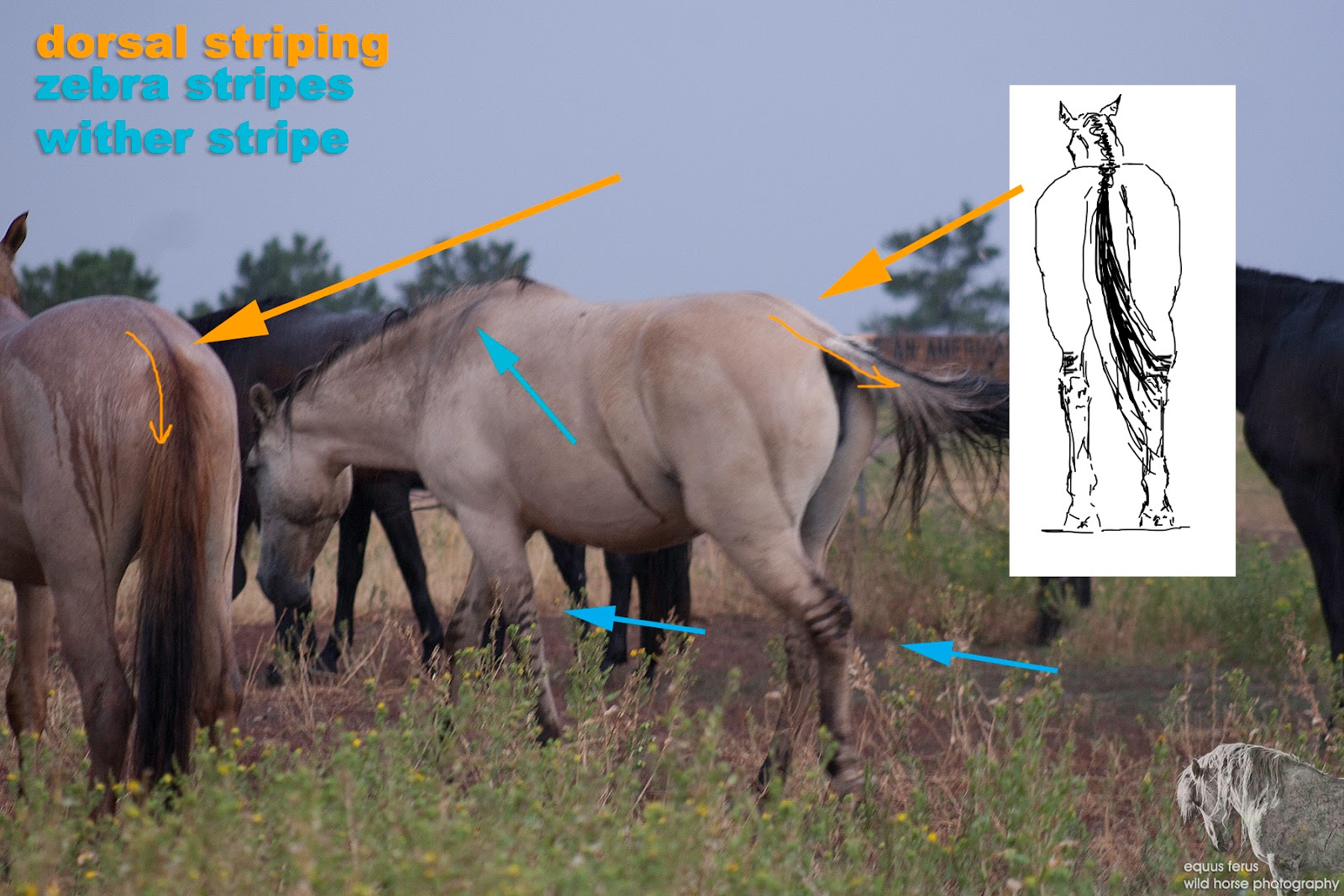
Primitive markings refer to stripes and lines darker than the coat colour that appear on horses carrying the Dun trait (Dn+). The most common marking is a dorsal stripe also called a lineback. The line travels from the mane, down the back and into the tail. Many horses have a dorsal stripe but in duns, the stripe extends from the mane through the tail. There is some debate as to whether the Dun factor- the lightening of red and black on the body- is linked to a separate gene causing the primitive marking, or if they are on the same gene.

Dr. Sponenberg states that if the Dun factor and the primitive markings were located on separate genes, we would see far more horses with primitive markings who are not Duns and more Dun horses without primitive markings (Sponenberg, 2009). Neither of those situations commonly occur, so the traits are most likely located on the same gene. 

© Equus ferus- Wild Horse Photography & Karen McLain Studio

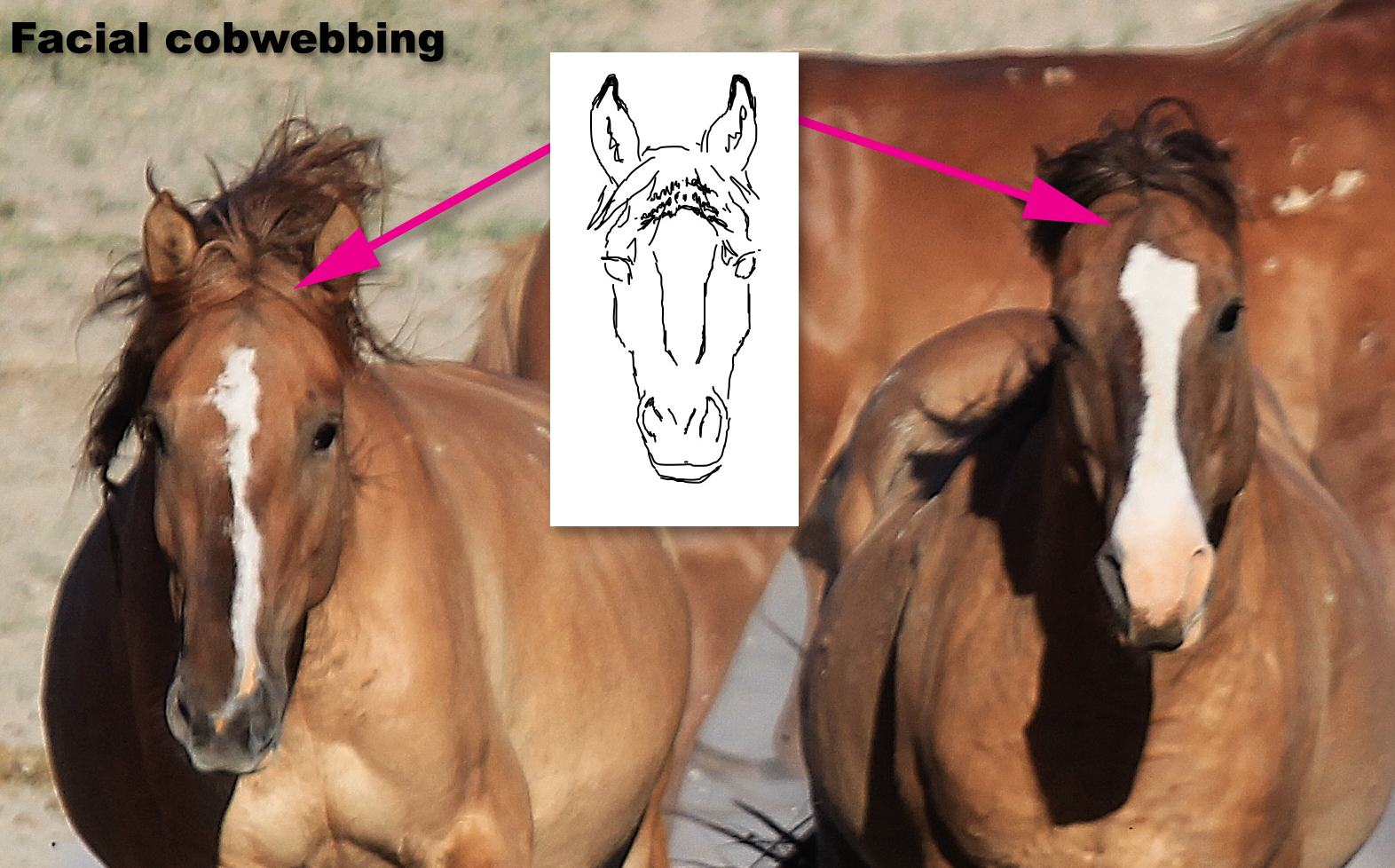
Other makings are zebra stripes on the legs, shoulder or wither stripes- some extending up the neck. Cobwebbing- or facial markings are the rarest. It is extremely rare to find a Dun without a dorsal stripe and zebra stripes are usually present but may be so pale they are not detectable except under certain circumstances. 


© Equus ferus- Wild Horse Photography & Karen McLain Studio

Guard hairs- or lighter hairs on either side of the mane may occur (see photo to the right). Horse Management Areas with a large Dun populations are Sand Wash Basin in Colorado, and Pryor Mountain in Montana, amongst others. There may be darker edges to the ears and mottling/striping on the chest or sides. The Dun factor lightens the body leaving the ‘points’ or lower legs, mane, and tail darker. The head is also left darker which can cause confusion when separating Duns from Roans. The Blue Roan in the photo on the right may have the Dun factor in addition to the Roan which makes identification even more challenging.


© Equus ferus- Wild Horse Photography & Karen McLain Studio

The primitive markings are found on some of the oldest horse breeds such as Sorraia, Icelandic horses, and Norwegian Fjords. They are also seen on Przewalski’s Horse. However, the Dun trait is also seen on more modern breeds such as the Quarter Horse, Spanish Horse breeds and European draft breeds (Stachurska, 1999). The presence of the Dun factor does not mean the horse is from an ancient lineage- the Dun trait is autosomal dominant. This means that if the parent is homozygous (DnDn) or heterozygous (Dndn)- they will have a dun coat and pass the dun trait on to 75% off their offspring making this inherited coat colour common in isolated populations.


Sponenberg, D. (1996). Equine color genetics. Ames: Iowa State University Press.
Stachurska, A. (1999). Inheritance of primitive markings in horses. Journal of Animal Breeding and Genetics, 29-38.


Assateague Island National Park 2015

Hello Everyone!!!
We’re back at Assateague Island NP for a long weekend of photography.  Karen McLain has already been here for over a week as an “Artist-in-Residence”. This is a prestigious appointment in which an artist, often a painter, is invited to spend a fortnight at a location and uses the opportunity to hone their artistic skill in a new environment and they often teach classes as well. 


I joined Karen today after driving down the coast from the Hudson Valley in New York. We shot a few of the ponies, although the conditions were less than optimal with an intermittent light mist falling. We broke early and had a wonderful dinner at a restaurant in Salisbury, Maryland called “Brew River”- the specialty was crab cakes and they did the cakes justice.  The oysters on the half-shell were amazing and we thoroughly enjoyed this dining experience.


It was also nice to see a horse that had been a foal, when we were last here in 2012. One of the things I particularly enjoy is seeing foals grow up and get bands of their own or give birth to their own foals. It lends a more personal aspect to the photography.
Foal 2015- Today
Foal 2012
Same foal today 2015


Tomorrow we are up early and plan to have a full day in the park. Karen is teaching a class for the Assateague Island Alliance on Saturday so we will prepare for that- a local paper did a nice segment of Karen’s residency here . 


As always, continue sharing Equus ferus’ photos! We will be posting live from the park.

Lethal White

Fleck and her foal 2015, most likely sire Picasso

Equus ferus– Equine Coat Colour Genetic -LETHAL WHITE

One of the mares at the Sand Wash Basin was believed to have given birth to a foal with Lethal White Syndrome.  And although we cannot be absolutely sure the foal was a Lethal White foal, the behaviour strongly suggests it might have been. Lethal White Syndrome has been talked about in groups and on Facebook, hence this blog post. Without a necropsy (autopsy on an animal) we won’t know for certain but here is what we do know…

 
Similar to Hirschsprung’s disease in humans, Lethal White Syndrome affects the colon by making it non-functional and in horses it also affects pigment of the coat. The affected foals are born pure white with blue/grey eyes and occasionally a smudge or darker colour on the body or near the tail however, they die within 72 hours of birth. The colon in these foals is a dead-end and the foals cannot pass feces. They do not act normally and exhibit signs of distress.


Lethal white foal (Picasso x Mingo) photo credit Nancy Roberts 2011
 
 
Picasso and Mingo 2012 photo credit Karen McLain
 
The trait, which is inherited, is carried by the horses who also carry the paint trait frame overo. Frame Overo horses typically have jagged white markings along the center of the body. The back and belly may remain solid colored so the effect is a framed area of white. They may have white faces (apron or bald face) and they may have blue eyes although not always. Some horses may minimally express the trait and the only evidence of the frame overo paint trait is a little spot of white along the neck and an unusually shaped blaze. Some horses may also carry other paint traits such as tobiano and they horses are referred to as toveros. Without genetic testing, nothing is certain so we are basing our assumptions on what we have observed and the reproductive history of the individual mustangs.
Yahtzee (R) & Van Gogh (L)
Photo credit Meredith Hudes-Lowder of Equus ferus Wild Horse Photography
In order to produce a foal with Lethal White Syndrome, both parents must be overo. Not all overo horses carry the trait according to the American Paint Horse Association (http://www.apha.com/breed/geneticsarticles/lethal-whites-1) and not all blue-eyed white foals carry the Lethal White gene. Because  Lethal White Syndrome is autosomal recessive, it means when two horses that are overo and each carry the gene , there is a 25% chance the foal with be born with the syndrome. If a dam with the trait and a sire with the trait have three normal foals, it does not mean the fourth foal will carry the trait; the chances a foal will inherit the syndrome resets each gestation and remains one in four with each subsequent preganncy. 
——————————————————
In the Punnett Square below (Horse drawings by Karen McLain)
Oo outside the square
 on top represent the SIRE
Along the left side, the Oo represents the DAM
Both are Overo represented Oo and the carry the trait


The RESULT:
One Solid foal (unaffected) -25%
Two Overo foals- CARRIERS of the Lethal White Trait- 50%
One Lethal White Foal 25%


One Solid Foal (OO) 25%
One Overo Foal (Oo) 25%
ONe Overo Foal (Oo) 25%
One Lethal White Foal (oo) 25%
 
————————————————————————————-

PUNNETT SQUARE REPRESENTING AUTOSOMAL RECESSIVE INHERITANCE

 
————————————————————————————-
 
The photos below are by Danielle M. Williams and they show Fleck’s foal. Fleck is frame overo and the father is believed to be Eagle, a minimally marked frame overo so it is quite possible the foal carries the Lethal White Syndrome.  Sometimes Lethal White Foals do have darker pigment on the muzzle but this foal is not hunched over in the typical posture of a horse in gastric distress however the witness/photographer Danielle did say the foal did not look well and laid down frequently. She said the foal was unable to stand for any length of time. This is consistent with Lethal White Syndrome and the foals with the disorder often roll from side to side. Another possibility is that the foal may have perished in the fight between the band stallion Eagle and Diego who took over part of the band. Stallion infanticide is unfortunately unavoidable and may be more common than previously thought. Regardless of the manner of death, it is heartbreaking to see a young life extinguished so soon.
 
Fleck and her foal
Photo by Danielle M. Williams
 
Fleck and her foal
Photo by Danielle M. Williams
 
 
Fleck and her foal
Photo by Danielle M. Williams
Please email Meredith with any questions regarding the genetic behind Lethal White Syndrome or horse colour genetic in general.
Equus ferus- Wild Horse Photography
Visit us on Facebook:


Dr. Meredith Hudes-Lowder DNP, WHNP-BC, MSN, BSN, RNC, BS Biology
Meredith received a Bachelor of Science Degree from Binghamton University with an emphasis in ethology and genetics. She received a Bachelor of Science in Nursing also from Binghamton and a Masters of Nursing in Perinatal/Women’s Health from Stony Brook University. She currently practices medicine as a Nurse Practitioner in Manhattan for Advantage Care Physicians. She is also enrolled in the Doctoral program at Stony Brook and graduated in 2016 with a Doctorate of Nursing Practice. Her doctoral thesis was a research study on cervical cancer screening intervals. She is a member of several professional organizations and was inducted into Sigma Theta Tau- the nursing honor society in 2007.
 

Painting Wild Horses in the Field with Karen McLain or "En Plein Air"

“All pictures painted inside in the studio will never be as good as the things done outside.”

-Paul Cezanne

I have a rule about not looking at all the photos from a summer trip until they have been backed up at least twice. Sure I scan through them but not really look too closely until all 30,000+ photos are safely backed up on my new 6TB hard drive and up in the Carbonite Cloud. So as I wait, not very patiently, for the over 400,000 files to transfer to the new hard drive… I sat back and remembered the trip…

Karen at McCullough Peaks 2014


Watching Karen McLain paint horses during the Mustang Walkabout 2015 was educational and interesting. I admit I know nothing about painting anything aside from a summer job painting houses on Long Island Sound… And perhaps a set or two from a play or musical, but that’s the limit of my painting skill. I do, however, like to understand the process from a more scientific background since that’s my training, thus I asked Karen numerous questions.

“When you’re on the spot, you’re seeing the best values, the cleanest color and real edges. You’re also seeing objects in a wonderful light, and you’re much more apt to paint a clear, un-muddied picture.”
-Wayne E. Wolfe
Karen paints en plein air, or in the field with live subjects and as a photographer of wild horses, I can tell you they don’t stand still, not at all. Even when they don’t move their feet, they are swishing at flies, or turning their heads. When they do move their feet, it is challenging to keep them in the lens field, let alone try to paint them accurately. But somehow Karen accomplishes just that. She keeps a camera handy to shoot reference photos just in case her subjects spook or decide the grass is indeed greener elsewhere. I asked her why doesn’t she simply concentrate on getting a good reference shot and painting at her studio in a more relaxed and leisurely manner.
Here’s what she said…
Karen paints at Sand Wash Basin

Painting from a photograph is useful and sometimes necessary if your subject is not local or endangered or simply not readily accessible. However danger comes with painting a photograph and not the actual subject represented in the photograph- and therefore inaccuracies may be introduced and perspective is lost. There is a critical difference in painting a three-dimensional object as opposed to a two-dimensional representation and it shows in the finished painting.  Karen explained that being there, at the moment the paint is first put to canvas, is critical in understanding the light, the shadows, ambient light, reflected light, and negative shapes (I’m still not sure what these ‘negative shapes‘ are- they are elusive but they much sought after by painters). After some musing, I think painting from a photograph- without the memory of actually being there- is much like me photographing a photograph. It can be done, especially those with great skill, but something essential is missing from the finished piece…

“As difficult as it is painting outdoors, there is no where else I’d rather work – all the answers stand right before you. You may need to move some things around, but it is still all right there in front of you. A bit like taking an open book test.” 
-William F. Reese

All of these features combine and Karen paints ‘in the moment‘; very much in the Buddhist tradition of the here and now or the present moment. She finishes the vast majority of the painting in the field because she says the paintings looks very different when she brings them indoors and so the essence must be captured as swiftly as she can manage. One would think the painting would look hurried and inaccurate but Karen practices endlessly. She attends numerous workshops, studies techniques, she is well-versed in equine anatomy surpassing even my prodigious knowledge base on that topic, and she spends a great deal of time studying her subjects both in the field and with her horses in their paddocks at home. A strong understanding of equine ethology is critical in representing them faithfully in art. Endless exercises on a white board to hone her accuracy and speed, Karen draws, erases and redraws horses: standing, walking, grazing, interacting, fighting. And she wipes a lot of paintings off when they don’t quite measure up… literally or figuratively.
Painting Picasso -Sand Wash Basin 2015

I watched her prepare her palette. To me it looked like orderly blobs of colour along the circumference of a glass rectangle with the centre area reserved for mixing these fascinating blobs. Each management area has a unique palette of colours. The Pryors need more green; the bright grass green and the darker pine green with the occasional purple lupine and white or yellow asters.  The McCullough Peaks have rich red rock and Sand Wash Basin is soft pastels of brown, cream, tan, sage and slate blue. Even the horses found at each location have customized palettes- the Pryors are abundant in primitive colours- duns, blacks, deep bays, smokey grullas, and the creamy palominos of the Cloud family. Spring Creek Basin is awash in greys, duns, buckskin and dark bays. The Salt River horses have few greys and no paints so the concentration is on chestnuts and bays as well as the river itself. McCullough Peaks and Sand Wash Basin are the most brilliant with paints, overos, tobianos, dilutions, sooty, splashed whites and every other conceivable coat colour combination. The time of day and the weather also influence the choice of colours Karen selects for each palette.


It is almost magical watching her paint swiftly and decisively that I think, only comes after years and years of practice. I marvel at her ability to turn squiggles and lines into a horse standing in front of me. It is pretty amazing. Please view Karen’s beautiful paintings at her website and/or Facebook Page 

-Meredith
Equus ferus Wild Horse Photography
July 2015

Mustang Walkabout 2015

As I sit at 30,000 feet flying to my home in New York, I find myself reflecting over the past two weeks. Karen and I went to three Horse Management Areas: McCullough Peaks, Pryor Mountain and Sand Wash Basin.  We camped out in the horse ranges and we had the privilege of sharing the lives of these magnificent creatures and my photography will be all the better for such intimate contact. It wasn’t easy, the temperatures never dropped below 90 F during the day, the dust was abundant and I had altitude sickness on Pryor Mountain… 

But we persevered and rose each day at dawn and photographed until the sun was directly overhead when we took lunch and a siesta. We resumed photographing the horses until dusk. We drove all over the management areas and often hiking mile after mile to find the mustangs. We drank water and Fresca by the gallon, made cream of wheat in the morning & yaku soba noodles in the evening and treated ourselves to s’mores. We listened to coyotes, thunder and the sound of horses running by our camp… And we photographed- all aspects of the mustangs living free.  Karen took time to paint while I photographed.  We met and spent time with some extraordinary people like Patty, Deb, Rachel, Connie, Robin, Julie, Michael, Heather by proxy…

Still, it is nice to return home, and see the family. I missed Abby, Ben and Bruce as well as my Thoroughbred Ashe and all our pugs plus Stormy and of course, Puppy. It will be wonderful to have a shower every day, indoor plumbing, electricity on demand  and to  luxuriate in air conditioning. But I miss the mustangs and the camaraderie of the other horse people,  especially my best friend Karen.  We are already planning our next Mustang Walkabout for 2016. But before then, I have over 30,000 photographs to catalog and to edit, a new website to update and go live, a book to write, a research paper on ‘Stallion Infanticide’ to finish, and this incredibly fun thing I call work… I miss my patients and my colleagues. I missed my 34-string Celtic floor harp more than I thought and can’t wait to practice. But each evening, when the sun gets low, my thoughts will turn to the horses- is Picasso okay? How is Cloud doing? How are all the new foals thriving?

Thank you for joining Karen and I on this incredible journey of sharing the lives of the wild horses of North America with the world through art and photography… 
-Meredith & Karen

2015- a new year begins…


Corona’s Band. Sand Wash Basin, Colorado ’14
Happy New Year 2015

The past year was a wonderful one for Equus ferus- Wild Horse Photography. We were given the prestigious honor of participating in the Cloud Foundation Art and Music Festival in Colorado Springs over the summer and, to our delight, we sold prints. We had a successful Mustang Walkabout (our summer trip out west to photograph the mustangs) and continue to sell photographs, calendars and prints. We opened an e-store at Red Bubble and are slowly adding to the items fans may purchase.  If you see a photo you’d like as an iPhone cover or mouse pad- or even correctly proportioned for an iPhone or Android (those are free), please don’t hesitate to ask; we can make it happen. Remember all net proceeds from our sales go back to the mustangs!!!

Perhaps the most important event in 2014 was attaining a quarter of a million fans and later passing the 300,000 fan mark. Without our fans, we are just another ordinary Facebook horse-related page. So by way of thanks, we will continue to randomly give away items such as our 2015 Calendar “The Stallion Edition”, and next year, we’ll have The Foal Edition” so stay tuned.
Picasso of the Sand Wash Basin, Colorado ’13
We are planning our summer 2015 Mustang Walkabout and we will visit the Sand Wash Basin, the McCullough Peaks, the Pryor Mountains, Little Book Cliffs and anything interesting along the way. However, before the summer, I will visit the Salt River in Arizona while attending a Mayo Clinic medical conference. I am probably the only person who finds medical conferences based solely on their proximity to wild mustangs. In the fall I will be in Salt Lake City for another conference and therefore will be obligated to visit the Onaqui HMA.
This summer also saw an end to my right anterior cruciate ligament, my medial collateral ligament and both meniscus were torn in my right knee. Since I performed this amazing orthopaedic trick two decades earlier, the ligament used to repair my torn ligament had to be borrowed from a cadaver. I will be spared during the Zombie Apocalypse since I already have a zombie part in my knee, or so my daughter Abigail cheerfully informed me. I had to take an unintended break from riding, Okinawan Kobudo, and even my 34 string Celtic Floor Harp- but I am back at the harp, will start up Kobudo in February and riding will wait until the spring. I was however, able to remain in school this semester, continued editing/posting photos during my convalescence and did not have to take much time off from my job.
I am hoping in 2015 to continue editing the photos collected throughout the year and to have an amazing time with the mustangs so we can bring them to you. I am always available to anyone who is interested in going out to see them; it is easier than you think- just email me. If you happen to be in the neighborhood of the horse management areas in the summer… I’ll guide you out there myself.

We will also be starting a series on ‘Equine Coat Colour’ where we’ll explore the genetics behind the marvellously coloured mustangs… 
Best wishes for health, happiness and joy for 2015
Cloud and I. Pryor Mountains, Montana ’14