The Roan Modifier

We will begin with an in-depth description of the Roan Modifier including genetics. Examples of roans will be provided in as many colours as we could find in the wild horse herds. We will conclude with other types of ‘roaning’ as well as confusing colours.  As with all the horse photographs presented here, we do not know the genetics of the animals; we rely solely upon the phenotype (physical appearance) of the animal.

The term roan or roaning refers to any horse with white hairs intermixed on a base coat.  It can be applied to horses going grey, sabinos patterns, Rabicano, varnish-rain appaloosa, or the dark-headed or ‘classic’ roan.  The classic roan modifier acts on any base coat colour and changes the body to varying degrees of white; leaving the head, mane, tail and lower legs the original colour in most cases. The colour does not change after birth; these horses are roan from birth or after their first foal coat sheds. Grey horses get progressively lighter as they age whereas some roans actually get darker as they age. This darkening appears in some roan lineages and mares seem to darken more than stallions or geldings. Hereafter, “roan” will refer to the classic roaning patterns which are nonprogressive and heritable (Sponenberg, D, 1996).

A bay (left), and a bay roan (right)
The Roan Modifier acts upon an existing coat colour. It causes the intermingling of white hairs amongst the base colour except on the mane, head, tail and lower legs (points). In the image above, we have a bay horse on the left and a bay roan on the right. You can easily see how the colour is lightened by the presence of white hair. Some horses have nearly white body colour, while some have just a dusting of light hair along the back and flank. The amount of white can be quite variable. Additionally, any scars that are acquired in the roan area grow back in the base coat colour (Gower, 2016).

The genetic control is autosomal dominant which means if one parent has the trait, the offspring will have the trait. If both parents have the trait, then all the offspring will have the trait. Roans tend to become common in populations where a dominant stallion has a large harem. He will pass the roan trait to his offspring. For a long time, ‘dominant roans’ were thought to be associated with a lethal gene similar to the Lethal White Syndrome found in. Homozygous roans, or those with two genes for the roan trait (RR), were believed to die in utero because homozygosity was linked to a trait incompatible with life. Since the discovery of, and the mapping of the equine genome, there have been several homozygous roan stallions discovered (Bailey & Brooks, (2013). (See also: https://www.vgl.ucdavis.edu/services/Roan.php.The) KIT region of the third equine chromosome is the site of several traits. The Roan trait, the Extension trait (which controls chestnut or ‘not chestnut’- black or bay), Sabino 1 trait, Dominant white, Tobiano, and proteins used in blood typing. The roan trait effects the main coat, not the points (lower legs, mane and tail) as the extension trait effects the red coat of bays leaving the points dark. The roan trait also darkens the head. occasionally tobiano paints will have areas of roaning mixed within the paint pattern (examples below). Sabinos have a roan-like pattern with a frosted appearance to the patches of colour. All these traits are found on the same chromosome in close proximity, and the effects are similar although they may be caused by different genes (Hauswirth et al., 2013; Marklund, Moller, Sandberg, & Andersson, 1999; Negro Rama et al., 2016; Reissmann & Ludwig, 2013; Waud et al., 2009.).

Nomenclature

Roans have many names and these names are often interchangeable. Blue roan, strawberry roan, red roan, sorrel roan and dun roan are some of the terms to describe roans. For the purposes of this post, we will use the base coat+roan to describe the horses. So a roan modifying a grullo coat will be called a “grullo dun” and a chestnut coat modified by roaning will be a “chestnut roan”.).

Black Roan/Dark Bay Roan

A horse with a black, dark bay, or any other dark colour with the roan modifier.

A black roan from Great Desert Basin, Utah 2016
Here we have a normal Black/Dark Bay in front and a Blue Roan in the middle. In the back is a Bay Roan.
‘Blue’ from Sand Wash Basin (2014). A lovely dark bay/black roan


A grey and a Black Roan. Greys may be confused with roans because of the similar white ‘ticking’ appearance but the greys often have more white in the tail and lighter faces. This can vary from grey to grey but they generally get lighter with age. Great Desert Basin, Utah 2017
Close-up of the legs. The roan (behind) has a more colour on the legs than the grey stallion in front. Great Desert Basin, Utah 2017

The Bay Roan

Roan Foal and her dam. This foal looks more roan in other photos but it is still very subtle. Sand Wash Basin, Colorado 2014
Bay Roan Paint foal. Noter the tendency for even young foals to look distinctly roan. Great Desert Basin, Utah 2017
A bay roan foal, a grey mare, and chestnut roan paint foal behind. This chestnut roan may be a dun as they are several duns in the band. It is hard to see because the legs are white so we cannot see any primitive markings but there is a faint dorsal stripe.
A Bay Roan Paint foal. This youngster may have some grey in the mix as well as roan. The mane and tail are very dark, which is consistent with roan but the face is light. In the roans that have more white- it is usually distributed along the mane, tail, and face. It is hard to assess the points (legs) because there is a great deal of white present. Sand Wash Basin, Colorado 2016.
This is the same bay roan mare as the photo directly below and a good example of how lighting can alter the perceived colour of a horse.  If possible, try to view the horse with direct midday lighting with the sun behind you. Pilot Butte/Rock Springs, Wyoming 2013


A beautiful bay roan mare from Pilot Butte (Rock Springs, 2011). She demonstrates the inverted ‘V’ on the black points of her forelegs. She is very light with very dark points- this image was not enhanced in Photoshop but it was taken at dawn.


A beautiful mare from Great Desert Basin (2017). She has an interesting pattern of the ‘corn spots’ on her left flank. These marks can represent injuries that heal with the base colour replacing the white, or they can occur spontaneously. (Sponenberg, 2009).
This stallion has a very sandy base colour which may be a yellow-bay, or a buckskin/dun. The photo doesn’t allow us to look for any primitive markings. Sand Wash Basin, Colorado 2014. Also, he shows minimal roaning. However, you’ll see him again two photos below chasing another horse.
A handsome Bay Roan from Sand Wash Basin. He has a moderate amount of white as opposed to the stallion in the photo below (2015)
A dun  (?) roan chasing a light bay roan.- he does have a dorsal stripe which would make him a dun, but we cannot see any zebra striping on the legs in this photograph…
The Chestnut Roan
A chestnut roan- from Pryor Mountain.


Chestnut roan stallion from Sand Wash Basin.


The bay mare from earlier photos and her chestnut foal from Pilot Butte/Rock Springs. Some roans have greyish manes and tails.


The same foal from the photo above.


A Alovely light chestnut, possible dun, from Pyror Mountain.


A liver chestnut stallions from  Great Desert Basin, Utah. Note the dark mane and tail.


‘Cody’ -a lovely dark liver chestnut roan from Sand Wash Basin, Colorado 2011. In this photo, Cody looks like a bay. However, in the photo below, he has reddish legs.


More Cody, the liver chestnut roan from Sand Wash Basin, 2014. Note how the colour changes based on season and lighting. Roans usually look darker in winter coats. In this photo, Cody has very light red legs- he may be a liver chestnut with a very dark mane & tail.
A foal who may be a roan. Until the first foal coat sheds, all bets are off. She may be greying out early, or she’ll become darker on her head, legs, mane & tail. Sand Wash Basin, Colorado.


Running to the waterhole, a chestnut roan leads the way. Sand Wash Basin, Colorado.

The Palomino Roan

A foal from Sand Wash Basin, Colorado. This may be a future roan based on the darker head, and legs. The mane and tail are often very light in normally coloured palomino horses and so the roan colour may become nearly the same colour as the mane and tail.


Another Palomino roam foal from Great Desert Basin.

The Dun/Grullo Roan

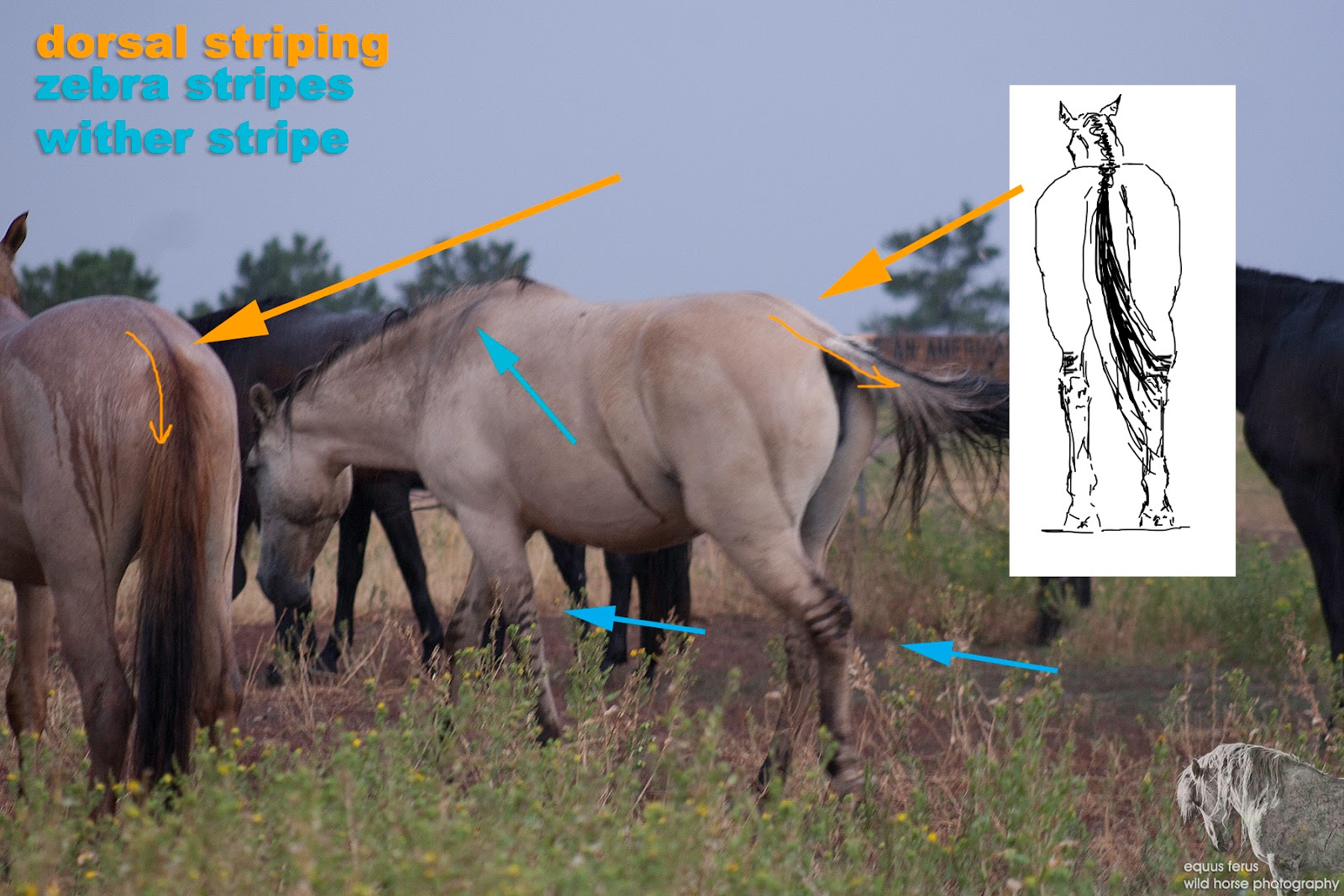
The dun (grullo) stallion in the back (sparring with a bay) tend to have a warmer tone to their coats then black/blue roans. To identify the dun roans, look for primitive markings on the legs.


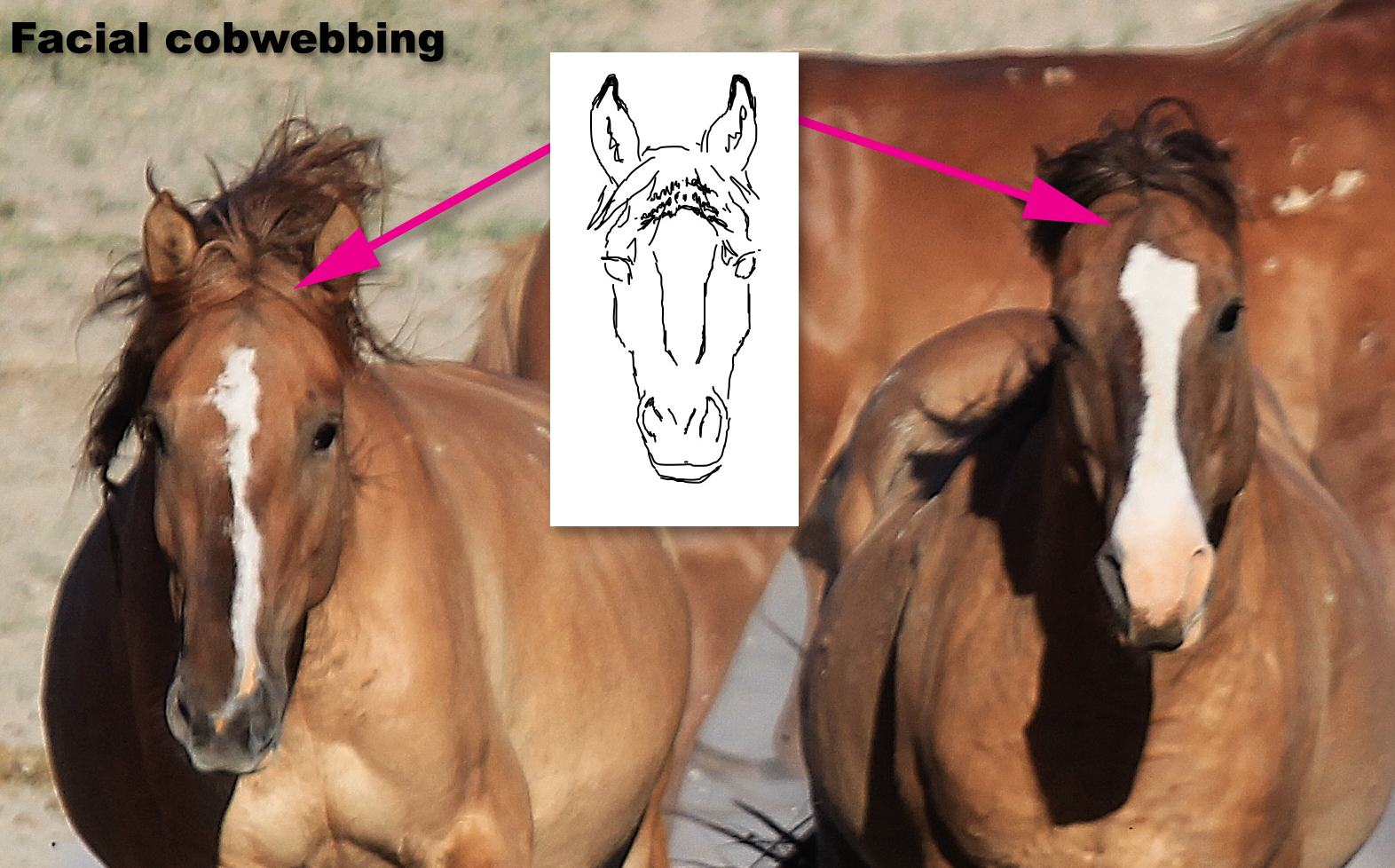
A dun roan- here we can clearly see the zebra striping at the top of the black on the forelegs of this stallion. Primitive markings occur in dun horses and consist of zebra stripes on the legs, shoulders or wither stripes, ‘dorsal stripe from withers to dock, cobwebs’ on the face, and lighter guard hairs on the outside of the mane and tail. Additionally, there is a dorsal stripe along the top line and into the tail.
Nice dun roan with striping visible on the legs and withers/shoulders
A lovely grullo roan from the Pryors. Again they often have a warmer tone to their colouration.


The same grullo roan as above- noted the change in colour due to lighting- from the Pryors.

Other Roans

A frosted roan. The roaning incorporates the mane and tail. The effect is fine patina of white air brushed over the entire horse.
A varnish Appaloosa- similar to roans but they tend to have darker colour over bony prominences.They generally do not have darker legs, manes, or tails.
A fantastically marked roan bay pain from Great Desert Basin.


THe mare is a buckskin roan. The buckskin colour is caused by the presence on one cream gene on a bay horse. The cream gene acts on red base colour of bay turning it lighter yellow nbut leaves the black alone. In a chestnut horse, the cream gene lightens red to a gold to pale cream colour. This includes the mane and tail which are red in chestnut horses. There is clearly no dorsal strip in this horse so it is unlikely to be a dun.


CONFUSING COLOURS

This grey paint resembles a roan but it is more lilely this horse is a sabino (a type of paint similar to roan) that may be greying out slowly.  Grey horses get lighter each year whereas roans do not. Grey horses are born dark and lighten with age, roans are either norn roan or shed into roan after their first foal coat.


At first glance I thought this horse was a roan but it turns out he is just very muddy…


Another almost roan… but it was just water and the sun reflecting off a dusty coat.


A grey sabino paint- note the light head.


A paint with a speckled pattern reminiscent of a roan from the Black Hills Wild Horse Sanctuary. This horse is a paint, possible sabino and/or frame overo.


Another sabino/frame overo (?) paint from Black Hills Wild Horse Sanctuary.


A chestnut paint Sabino from the Black Hills Wild Horse Sanctuary.

Roaning Patterns in other coat types

Picasso, a well-known stallion from Sand Wash Basin is a Tobiano paint. He may have other genetics as well as Tobiano. Because the KIT gene controls roaning as well as Sabino and Tobiano, those traits tend to have similar characteristics.  Many Tobiano  paints have roaning intermingled in their paint pattern. Below are several photographs of Picasso and Cowboy.


Picasso, left side and mud


Picasso, right side


Cowboy, a frame overo with roaning mixed in the paint pattern.


Cowboy left side


Cowboy, right side


Cowboy, right side


Kokomo, Picasso’s son.
References
Bailey, E & Brooks, S. (2013). Horse Genetics (2nd ed.). Boston, MA: CAB International.

<!–[if supportFields]> ADDIN EN.REFLIST <![endif]–>Dürig, N., Jude, R., Holl, H., Brooks, S., Lafayette, C., Jagannathan, V., & Leeb, T. (2017). Whole genome sequencing reveals a novel deletion variant in the KIT gene in horses with white spotted coat colour phenotypes.
Gower, J. (2016). Horse Color Explained: A Breeder’s Perspective. Brattleboro, Vermont: Echo Point Books & Media, Inc.
Haase, B., Brooks, S. A., Schlumbaum, A., Azor, P. J., Bailey, E., Alaeddine, F., . . . Leeb, T. (2007). Allelic Heterogeneity at the Equine KIT Locus in Dominant White (W) Horses. PLOS Genetics, 3(11), e195. doi:10.1371/journal.pgen.0030195

Haase, B., Jude, R., Brooks, S. A., & Leeb, T. (2008). An equine chromosome 3 inversion is associated with the tobiano spotting pattern in German horse breeds. Animal Genetics, 39(3), 306-309. doi:10.1111/j.1365-2052.2008.01715.x

Hauswirth, R., Jude, R., Waud, R Bellone, R., Archer, S., Holl, H., . . . Leeb, T. (2013). Novel variants in the KIT and PAX3 genes in horses with white-spotted coat colour phenotypes (Vol. 44).

Kathman, L. (2012). The Equine Tapestry: Volume I- Draft and Coaching Breeds. Charlotte, NC: Blackberry Lane Publishing.Marklund, S., Moller, M., Sandberg, K., & Andersson, L. (1999). Close association between sequence polymorphism in the KIT gene and the roan coat color in horses KIT sequences: AJ224642–AJ224645 (Vol. 10).
Negro Rama, S., Imsland, F., Valera, M., Molina Alcalá, A., Solé, M., & Andersson, L. (2016). Association analysis of KIT, MITF, and PAX3 variants with white markings in Spanish horses (Vol. 48).
Reissmann, M., & Ludwig, A. (2013). Pleiotropic effects of coat colour-associated mutations in humans, mice and other mammals (Vol. 24).
Santschi, E. M., Vrotsos, P. D., Purdy, A. K., & Mickelson, J. R. (2001). Incidence of the endothelin receptor B mutation that causes lethal white foal syndrome in white-patterned horses. Am J Vet Res, 62(1), 97-103.
Sponenberg, D. (2009). Equine Color Genetics (3rd ed.). Ames, Iowa: Wiley-Blackwell.
Thiruvenkadan, A., Kandasamy, N., & Panneerselvam, S. (2008). Coat colour inheritance in horses (Vol. 117).
Waud, Brooks, S., Tozaki, T., Burger, D., Poncet, P.-A., Rieder, S., . . . Leeb, T. (2009). Seven novel KIT mutations in horses with white coat colour phenotypes (Vol. 40).
Waud, Rieder, S., Tozaki, T., Hasegawa, T., Penedo, C., Jude, R., & Leeb, T. (2011). Five novel KIT mutations in horses with white coat colour phenotypes (Vol. 42).
<!–[if supportFields]><![endif]–>


About the Author & Photographers

AUTHOR & PHOTOGRAPHER

Dr. Meredith Hudes-Lowder,
 DNP, WHNP-BC, MSN, BSN, RNC, BS Biology
Meredith received a Bachelor of Science Degree from Binghamton University with an emphasis in ethology and genetics. She received a Bachelor of Science in Nursing also from Binghamton and a Masters of Nursing in Perinatal/Women’s Health from Stony Brook University. She has a Research Doctorate of Nursing Practice from Stony Brook University. Her doctoral thesis was a research study on cervical cancer screening intervals. She was invited to present her research findings at the podium for the Nurse Practitioners in Women’s Health Annual Conference in New Orleans, October 2016. She is a member of several professional organisations and was inducted into Sigma Theta Tau- the Nursing Honor Society in 2007.


PHOTOGRAPHER

Karen McLain: Painter, artist, photographer

Karen McLain is a third generation Arizona native. Growing up in Arizona, she developed a deep appreciation for the outdoors, and for the rural and ranching lifestyle. Karen graduated from Arizona State University with a B.A. in Studio Art. She went on to pursue more traditional and realistic styles, and to create a style of her own. A number of commissioned works are accepted from collectors. The rest of the time, Karen can be found drawing or painting en plein air. These landscapes and life studies of wild horses are then developed into larger works in her studio.

McLain states: ”Painting from life not only reveals natures beauty first hand, but it also challenges me to focus and see clearly the light, form, and wonderful color present.  Time spent in the saddle, and painting en Plein air, results in an outlook that McLain describes as “Drawn from life, and inspired by life”, which is reflected in her work. See Karen’s “studio tour” here


The Walkabout 2017

The 2017 Mustang Walkabout

So begins our 2017 Mustang Walkabout season. In just over two weeks we will be on the horse ranges. Many fans ask what exactly is a ‘walkabout’? Traditionally, it is a rite of passage among aboriginal Australian adolescent males in which they make the transition to manhood by spending as much a six months alone in the wilderness.  The phrase has become more mainstream as a journey to reach a destination, either literal or spiritual. A craving for the open road, a desire for a road trip, itchy feet are all phrases synonymous with a modern walkabout.  

For Meredith, it is a time to leave a busy medical practice in New York City and focus on the horses, the landscape, and her spiritual growth. Meredith learns a great deal about herself on these long trips into the wilderness, and she learns about ecology, equine ethology, photography, and nature. She brings her 26-string Harpsicle® Harp and plays for the mustangs.

For Karen is is a time for quiet contemplation, for heightened perception, and to experience the energy she gains from painting. There is nothing else to distract her from her art; she can completely focus on the mustangs, the sky, and the sage. There are no cellphones, no technology, no bustle of everyday life. Spending time with the horses, without of the trappings of modern life, offers an experience like no other. On the Walkabout Karen observes the horses as they are, and not from a reference photo. This is her time to paint from life or to simply observe the mustangs. She leaves refreshed and energized.

We live with the horses, we sleep next to them, we eat next to them, we enter their lives, if only as privileged observers. We hike miles in 80-100°F (26-37°C) over cactus, sharp fragrant sage, alongside prairie rattlesnakes, and other less venomous denizens of the western horse ranges. We bathe when we can, often using a bucket and sponge (and soap!) or the occasional foray into town for a ‘real shower’. We cook meals over a camp stove, drink lukewarm beverages, and treat ourselves to “space ice cream”. 

Right now we are gathering equipment, cataloging whatwe have, and purchasing whatever we might need such as spare batteries, memory cards, and lens cleaner. This year, Meredith and her family will be joining Karen at Sand Wash after a family vacation in Alaska. Then the Lowders will fly home and Karen and Meredith will continue on to Great Desert Basin in Utah.

This immersive experience allows us to enter the lives of these magnificent wild horses. We are humbled by their struggle for survival. We feel incredibly honoured to share their lives, if only for a few weeks each year… We will be sharing our walkabout on our Facebook page.

Please join us on our adventures…
Meredith & Karen

The Frame Overo

When I first sat down to go through my photographs, I was hoping to have five or six good examples of the Frame Overo trait. I was pleasantly surprised to find so many mustangs with this particular pattern. Interestingly, I found Frame Overo mustangs principally at Sand Wash Basin and Black Hills Wild Horse Sanctuary. It is entirely possible there are some Frame Overos at other management areas, but neither Karen nor I had photographed any of them. The Frame Overo is also unique to North America. This pinto pattern is common only in Spanish Colonial Horses or their descendants. However, the trait occasionally, but rarely. appears in European-derived horses such as Thoroughbreds, Ethiopian breeds, and miniature horses (Sponenberg, 2009).

Frame Overo horses that have white patches superimposed on a background of any base colour such as roan, bay, chestnut, palomino and so on. The white colour often begins as a patch on the neck or barrel and spreads horizontally. The back almost always remains solid coloured between the withers and tail. The white patches are irregularly edged and splashy (Bailey & Brooks, 2013) although some white markings are clean and crisp, similar to tobianos (Sponenberg, 2009). The markings usually do not have the lacy or frosted appearance of Sabino patterned horses (Kerson, 2015)

The tail is generally one colour and at least one leg is usually solid coloured although often all four legs are solid. If the legs are solid, they may have socks or stockings in a pattern one might find on a non-pinto horse. The markings on the head are often extensive, bonnet or apron-faces are common. Additionally, they may have a pigmented upper or lower lip, or ‘moustache’ (Sponenberg, 2009).

The genetics are simple, the Frame trait is autosomal dominant, which means a Frame foal must have one Frame parent. However, if both parents have the Frame gene, there is a 25% possibility the foal will be homozygous and have two Frame genes. This foal will not survive because a homozygous Frame is linked to another genetic defect which causes loss of peristalsis (the wave-like action that moves food through the intestines), or more rarely, an incomplete colon. (Bailey & Brooks,2013). More information and examples are located at the bottom of this page.
FF= Normal color
Ff-= Frame Overo
ff= Overo Lethal White


Perhaps one of the best-known Frame Overos is Picasso from the Sand Wash Basin. This handsome Bay horse is one of the most photographed mustangs and he has a Breyer Horse modelled after him. He is a Bay Frame Overo (and possibly carries other pinto traits). Many of his numerous offspring are Frame Overos including two know Lethal White foals. There will be more information on this genetic anomaly presented below.
Picasso
Picasso

This is an excellent example of a Bay Frame Overo stallion.
Note the white markings on neck and barrel as well as the four solid coloured legs.
Sand Wash Basin, Colorado

The horse on the right is a Chestnut Frame Overo
Sand Wash Basin, Colorado

A small family band with a Sorrel Frame Overo Stallion and a Frame Overo foal. In the management ranges, we cannot be certain of a foal’s parentage. Identifying a foal’s dam is generally more reliable than the sire. However, mares have been known to steal foals from other mares. Additionally, fillies will leave their natal bands briefly, breed with another stallion, and return to their natal band to deliver and raise the foal within the band they were born. Without genetic testing, we cannot be certain.

Hoot, Juniper, and Pinyon (2014)
Sand Wash Basin, Colorado


A Chestnut Frame Overo. The pigmented lip is common and may appear on the upper lip, lower lip, or both as this mustang demonstrates.
Sand Wash Basin, Colorado

The Chestnut Frame Overo is unusual because the right hind leg is extensively marked with white. This may be an anomalous finding, or an indication there are other pinto genes present, possibly Sabino. The heavily white face and body markings are more characteristic of Frame Overos.
Sand Wash Basin, Colorado

This charmingly marked dark (liver) Chestnut Frame Overo mare is called ‘Crazy Horse’. The freckles on her face are also known as Belton Spots and similar to the spotting found in English Setter dogs. Many horses with Belton Spots on their facial markings, also show “ermine spots” on their legs.  From Sand Wash Basin.

Although not perfectly focused, this Bay Frame Overo has Belton spots on his blaze as well as ermine spots (black spots on socks that are usually found along the coronet band). The ermine spots can cause the hoof to darken and appear striped. From Sand Wash Basin

These two beautiful sparring stallions are from Sand Wash. Kiowa on the left (Bay) and Haze on the right (Sorrel). Haze is a minimally marked Frame Overo- can you find the tiny white mark on Haze?

This is Miss Fleck- she is a Chestnut Frame Overo from Sand Wash Basin: the first image is her as a foal, the second image as a young mare. She was born into Voodoo’s band a but later joined Picasso’s band (2013). Picasso has since lost his band but he has been doing well as a bachelor. Fleck gave birth to a Lethal White Foal.
Fleck: foal, right side
Fleck: left side

This is Kiowa from the near side (left) from Sand Wash Basin. He had just been in a fight and you can see lacerations on his hip and shoulder. There is also a significant scar on Kiowa’s left haunch just below the laceration. It is believed he tangled with either a mountain lion or a wound from fighting that became infected. It is also possible he ran into a fence along the border of Sand Wash Basin and neighbouring ranches.

This is Raindancer. A lovely Chestnut Frame Overo with blue eyes from Sand Wash Basin.

This is an excellent example of a Bay Frame Overo mare from Sand Wash Basin, Colorado with a pigmented lip, flank markings and a small lower neck/shoulder marking.

Here is a lovely colt Named Van Gogh, he is one of Picasso’s many Frame Overo offspring from Sand Wash Basin.

This is Yatzee on the left and a grey stallion on the right from Sand Wash Basin. The grey is actually a Frame Overo – if you look closely at his neck, you’ll see the faint outline of the original white mark in the middle, just under his mane. He also has some white markings on his barrel. Some people refer to grey pinto as “ghost paints/pintos”. In the winter it is impossible to tell them apart from solid grey colour horses. A wet grey pinto in a summer coat is the easiest to recognise because you can see the underlying skin colour: pink under white markings and darker under the base colour

Another “Ghost- Frame Overo Grey from Sand Wash Basin. The horse on the left has several white Frame markings on his neck, barrel and just above his stifle. He also has the distinctive white apron face with the pigmented lip. The pink skin of the white marking is especially noticeable on this horse’s muzzle. If you see a horse with a pigmented lip, there is a good chance they are a pinto- often a Frame Overo. The middle horse is also a Frame Overo, this time black with four white stockings.  Four white stockings may indicate this mustang has other pinto genes.  The last horse is a Bay Frame Overo with a usual number of white leg markings. Generally, the leg markings do not rise above the knees in Frame Overos.

This family band has two Frame Overos from Sand Wash Basin. The foal, a chestnut beginning to grey-out, and the sorrel stallion. Again, notice the solid coloured legs which help distinguish Frame Overos from Tobiano pinto.

A handsome Grullo Frame Overo gelding from Black Hills Wild Horse Sanctuary Black Hills is a wonderful rescue organisation, please click on the link to find out more

A Black Frame Overo from Black Hill  Wild Horse Sanctuary

Bay Frame Overo with a stunning pattern from Black Hill  Wild Horse Sanctuary.

Two Black Frame Overos from Black Hill  Wild Horse Sanctuary. Note the tendency for Frame Overos to have solid colour on the spine from the withers to the dock.

Sugar, a Grulla Frame Overo from Sand Wash Basin, Colorado

This stallion is a Chestnut Frame Overo from Sand Wash Basin. It is evident he is thin but these horses receive no care. Many of the horses are underweight from untreated injuries, dental issue, and other injuries or infections that go untreated. It is truly survival of the fittest and only the strongest survive to reproduce. He was a very fiesty stallion, sparring with the bachelors and band stallions.

A dark chestnut Frame Overo pinto from Sand Wash Basin with very little white on his belly (the rest is dried mud)- referred to as a minimal Frame Overo. This stallion is called Spyder.

A Minimal Dun Frame Overo pinto from Sand Wash Basin.

This beautiful grey colt is a minimally marked Frame Overo. All four legs are solid and there is no white mark on either side. According to Sponenberg (2013), this horse will sire horses with varying amounts of white. Becuase of the lethal white syndrome, any Frame Overo owner should test both horses prior to breeding to avoid the chance of a foal that will not survive. Sand Wash Basin, Colorado


A minimally marked Black Frame Overo from Sand Wash Basin named Spyder.
A beautiful Black Frame Overo from Sand Wash Basin named Lightning. He was believed to be over 35 years of age at his death. He is one of the stallions responsible for the Frame Overo trait becoming so prevalent at Sand Wash Basin. He lived all his years free running amongst the Colorado sage.
A minimally marked Bay Frame Overo from Sand Wash Basin with very little white and four solid legs.

Another Minimal Frame Overo Chestnut. This is Mimi, she is a foal by Picasso and out of Mingo (2012). She has white socks but they are normal height one normally associates with solid coloured horses. The first is her right side, the second image, her left.

A lovely Palomino Frame Overo colt named Meteor. He has a lot of white on both hinds legs (the white goes up the front of the leg to the stifle) and this indicates there is probably another pinto gene such as Sabino or Tobiano, is present. Sand Wash Basin, Colorado

Kokomo, a Bay stallion by Picasso and a minimally marked Chestnut Frame Overo mare walking in front. Although they are muddy, the mare has solid legs and Kokomo has both white legs marked with white including a thin strip almost reaching his chest. Although he is heavily marked with white, like his sire, they both have solid coloured backs. Sand Wash Basin, Colorado
A very Minimally Marked Frame Overo named caballero. The other side is also solid. However, there is a white spot on this stallion’s tail evident by the light colour at the end. The facial marking (apron and pigmented lip) are good indicators of a Frame Overo. Sand Wash Basin, Colorado

Lethal White


The Frame Overo (Ff or Oo) trait is found on the equine chromosome #17 at the same locus (location on a chromosome) that controls EDNRB (Endothelin Receptor B) (Sponenberg, 20009). The change in the dinucleotide that occurs in Frame Overos changes an amino acid from isoleucine to lysine which disrupts the function of the EDNRB. In homozygous Frame Overo horses (Ff), the functional inability of Receptor Type B proteins (EDNRB) causes loss of gastric ganglia precursor cell migration and loss of melanocyte migration (Bailey & Brooks, 2013).The loss of function in EDNRB prevents the embryologic migration of:

  • Gastric ganglia precursor cells from migrating, which means a loss of enervation in the digestive tracts. No nerves ending exist in the colon of these horses and function is completely disrupted. Rarely the loss of EDNRB function results in an incomplete colon (ileocolonic aganglionosis). Foals with either gastric malformation die within a few days of birth and it cannot be surgically corrected.
  • Melanocyte migration means loss of pigment, resulting in white colouration.
In heterozygous horses, the presence of one “f” results in partial solid colour, but the digestive system is normal. In lethal white, the presence of two “ff” results in a pure white horse (no melanocyte migration) and a non-functional colon, or a blocked, atrophied, or dead-end colon. The loss of gastric enervation has a similar aetiology to Hirschsprung’s Disease in humans. Overo Lethal White Syndrome is found in Frame Overo horses as well as highly white calico overo, and frame blend overo (>94%) (Santschi, Vrotsos, Purdy & Mickelson, 2001)
Mingo X Picasso
©Nancy Roberts
©Nancy Roberts

Picasso X Fleck
 ©Danielle M. Williams
 ©Danielle M. Williams
 ©Danielle M. Williams

Here is the link for more information on the Lethal White Syndrome including a handy Punnett Square


References

Bailey, E., & Brooks, S. (2013). Horse Genetics (2nd ed.). Boston, Massachusetts: CABI.

Gower, J. (2016). Horse Color Explained: A Breeder’s Perspective. Brattleboro, Vermont: Echo Point Books & Media, Inc.

Kerson, N. (2015). What Color is that?  A quick guide to horse color identification: Nancy Kerson- Self Published

Santschi, E. M., Vrotsos, P. D., Purdy, A. K., & Mickelson, J. R. (2001). Incidence of the endothelin receptor B mutation that causes lethal white foal syndrome in white-patterned horses. Am J Vet Res, 62(1), 97-103.

Sponenberg, D. (2009). Equine Color Genetics (3rd ed.). Ames, Iowa: Wiley-Blackwell.

***A special thanks to Heather Robson & Nancy Kerson for identification and inspiration, respectively


About the Author & Photographers

AUTHOR & PHOTOGRAPHER

Dr. Meredith Hudes-Lowder,
DNP, WHNP-BC, MSN, BSN, RNC, BS Biology
Meredith received a Bachelor of Science Degree from Binghamton University with an emphasis in ethology, conservation, and genetics. She received a Bachelor of Science in Nursing also from Binghamton and a Masters of Nursing in Perinatal/Women’s Health from Stony Brook University. She has a Doctorate of Nursing Practice from Stony Brook University. Her doctoral thesis was a research study on cervical cancer screening intervals. She was invited to present her research findings at the podium for the Nurse Practitioners in Women’s Health Annual Conference in New Orleans, October 2016. She is a member of several professional organisations and was inducted into Sigma Theta Tau- the Nursing Honor Society in 2007. She works at a busy medical practice in Manhattan as a Nurse Practitioner, specializing in the climacteric & menopause. She teaches Women’s Health to graduate students at Pace University in the clinical setting. When she is not busy taking care of “hot” women, Meredith can be found at the dojo practising Kobudo and Karate, performing pro-bono research for mustang advocacy, learning Korean, or playing her Lyon & Healy concert harp.


PHOTOGRAPHER

Karen McLain: Painter, artist, photographer

Karen McLain is a third generation Arizona native. Growing up in Arizona, she developed a deep appreciation for the outdoors, and for the rural and ranching lifestyle. Karen graduated from Arizona State University with a B.A. in Studio Art. She went on to pursue more traditional and realistic styles, and to create a style of her own. A number of commissioned works are accepted from collectors. The rest of the time, Karen can be found drawing or painting en plein air. These landscapes and life studies of wild horses are then developed into larger works in her studio.

McLain states: ”Painting from life not only reveals natures beauty first hand, but it also challenges me to focus and see clearly the light, form, and wonderful color present.  Time spent in the saddle, and painting en Plein air, results in an outlook that McLain describes as “Drawn from life, and inspired by life”, which is reflected in her work. See Karen’s “studio tour” here

END OF FRAME OVERO Horses

The Tobiano Paints

 THE TOBIANO PAINTS

Disclaimer: The mustang photographs on this blog post are presented without genetic testing; we do not know the actual chromosomal make-up of the mustangs. We rely solely upon the horse’s phenotype, or how they appear physically: coat colour, white markings, eye color, mane, and tail colour.

Mammalian Pigmentation

The colors found in mammalian hair, skin, irises, and some internal organs is produced by the pigment melanin. Melanin appears as colored granules in these pigmented cells and occurs in two forms, eumelanin, and phaeomelanin. Eumelanin is responsible for brown and black colour, and phaeomelanin is responsible for reds and yellows (Bailey & Brooks, 2013).
Black tobiano (muddy) (Black Hills Wild Horse SanctuarySouth Dakota) © Equus ferus- Wild Horse Photography ™ © Karen McLain

The absence of melanin will appear as white in mammals. The lack of color typically associated with Paint Horses is caused by the inability of these cells to produce the base colors from birth. The color loss results in large patches of white against a base coat of any colour (bay, chestnut, roan, grey, dun, champagne, silver dapple, palomino, brown, black, etc). Additionally, the white colour has pink skin beneath. 

Assorted tobiano horses (Black Hills Wild Horse SanctuarySouth Dakota) © Equus ferus- Wild Horse Photography ™ © Karen McLain

There are other forms of white colouration in equines; for example gray or roan. Grey horse color is caused by the failure of melanocytes over time, so the hair starts normally pigmented but loses the ability to maintain the pigment so the horse eventually turns white(Sponenberg, 2009). Roan horses are roan from birth although they are often not recognizable until after the foal coat has shed. Roan horses typically retain the base color on their head, legs, mane, and tail. The skin beneath grey and roan horses is dark and these colors are not actual colours, but rather modifiers that act upon a base coat (Gower, 2016). 

Black tobiano demonstrating the “shield” (Black Hills Wild Horse Sanctuary, South Dakota) © Equus ferus Wild Horse Photography © Karen McLain 
A tobiano horse may also be roan, appaloosa, sabinos, overo, or any other pattern as the tobiano pattern is not a mutually exclusive coat patterns.
Bay Roan tobiano   (Great Desert Basin, Utah) © Equus ferus- Wild Horse Photography ™ © Karen McLain
Roan tobiano foal, palomino tobiano mare  (Great Desert Basin, Utah) © Equus ferus- Wild Horse Photography ™ © Karen McLain

Equine chromosomes
The genes for four white coat patterns: roan (RN), sabinos (SB1), dominant white (W), and tobianos (TO) are located on the KIT gene.The KIT gene is responsible for sending instructions through cells that allow the cell to make specific proteins. The KIT proteins are found on the cell membrane where another protein called a “stem cell factor” binds to the KIT protein. When bound together, they activate the KIT protein, which in turn, activates other proteins within the cell. These proteins serve a variety of functions in mammalian cells such as growth, development, migration, and production of certain cell types such as interstitial gastrointestinal cells and melanocytes (Haase, Jude, Brooks, & Leeb, 2008).
Equine Chromosome #3
The KIT gene is located on the fourth chromosome at the 12 position and located very close is the ECA3 gene. The ECA3, or the third equine chromosome is the location of the chromosomal mutation responsible for tobianos. Although the KIT gene remains normal in these horses, the third chromosome has an area in the gene that has flipped. Approximately one-third the length of the chromosome is an area that is an exact mirror image in tobianos horses. Because the chromosomal inversion is adjacent to the KIT gene, it affects the KIT protein synthesis, and the cells cannot produce melanocytes- so the horse has areas of white. The test for tobianos examines the chromosome and looks for a ‘break’ (telomeric or centromeric) at the positions 13 and 21 on the third chromosome– this serves as an indication they separated and inverted during replication- the horse is genetically a tobianos (Bailey & Brooks, 2009).
The gene for tobiano horses is autosomal dominant. This means to be tobiano, a foal must have at least one tobiano parent, but they also may have two tobiano parents. If one parent is a tobiano, it does not matter what colour or pattern the other parent appears; the foal will be tobiano. If a horse matches the criteria for a tobiano, it is likely the horse has the genetic background of a tobiano, although there may be some mixing of other patterns (Gower, 2016). The patterns are not inherited exactly, however, the proportion of white to colour is inherited. In other words a horse with a lot of white will have offspring with a lot of white but this depends upon the other parent. Interestingly, the study by Woolf (1990) discovered male horses and those with chestnut coats have more white than female or bay horses. The researcher also noted that the inheritance of white leg markings and facial markings is multifactorial; there are many genes involved in the appearance of white markings (Woolf, 1990).

History:

Bay tobiano mare  (McCullough Peaks, Wyoming) © Equus ferus- Wild Horse Photography ™ © Karen McLain

The Tobiano paint pattern was named for General Tobías from Brazil. The General brought the paint horses to Argentina in the mid-1800’s. Before their arrival, tobiano horses were rare and had been grouped with other spotted-type horses. After General Tobías’ arrival, they were renamed after the general and placed into a unique paint coat classification(Kerson, 2015; Sponenberg, 2009)
Tobiano Characteristics:
Bay tobiano mare (McCullough Peaks, Wyoming) © Equus ferus- Wild Horse Photography ™ © Karen McLain
The tobiano is defined by several coat characteristics. As with all horses, unless genetically tested, we evaluate the coat pattern by the phenotype or the horses’ physical appearance. As a general rule, tobiano horses have the following characteristics (there are always exceptions to these rules):

  1. White cross the spine somewhere between the ears and the tail (Gower, 2016; Sponenberg, 2009)
  2. The body white appears to travel down in a vertical fashion (Gower, 2016)
  3. The edges of the white areas tend to be crisp and well-defined (Sponenberg, 2009)
  4. Legs are white and the edge of the socks/stockings is irregular (Gower, 2016; Sponenberg, 2009)
  5. Most tobiano have dark eyes although some tobiano horses have blue eyes  (Sponenberg, 2009)
  6.  Most tobianos have white areas within the mane and tail, this gives the appearance of a bicoloured tail, a trait usually seen only in tobiano horses. (Sponenberg, 2009)
  7. The predominantly solid coloured heads of tobianos are generally conservatively marked: thin blazes, simple stars (Sponenberg, 2009)

 Some tobianos have very little white

Black tobiano (McCullough Peaks, Wyoming) © Equus ferus- Wild Horse Photography ™ © Karen McLain
Minimally marked black tobiano stallion -note the bicoloured tail (McCullough Peaks, Wyoming) © Equus ferus- Wild Horse Photography ™ © Karen McLain
Bay tobiano stallion (McCullough Peaks, Wyoming) © Equus ferus- Wild Horse Photography ™ © Karen McLain
Black tobiano stallion (McCullough Peaks, Wyoming) © Equus ferus- Wild Horse Photography ™ © Karen McLain
Bay tobiano stallion (McCullough Peaks, Wyoming) © Equus ferus- Wild Horse Photography ™ © Karen McLain
Some tobiano horses have very little base colour but they tend retain normally coloured heads even when extensively white.
Minimally marked light bay chestnut tobiano (Black Hills Wild Horse Sanctuary, South Dakota) © Equus ferus- Wild Horse Photography ™ © Karen McLain
Light bay tobiano (note the minimal blaze) (Black Hills Wild Horse SanctuarySouth Dakota) © Equus ferus- Wild Horse Photography ™ © Karen McLain
Extensively white black marked tobiano (Black Hills Wild Horse SanctuarySouth Dakota) © Equus ferus- Wild Horse Photography ™ © Karen McLain
Some tobiano horses have marks within the white areas and there may be some bleeding of colour between the base colour and the white areas. The smaller spots in the white areas are called ink spots, bear tracks, cat’s paws. The areas of darker colour encroaching on the white areas are referred to as halos. There may also be some roaning at the edge of colour and white. This is a historical link between these markings and homozygosity. No genetic link has been found, however anecdotally, homozygous horses often present with these marking whilst heterozygous generally do not show these markings. 

Cat’s paws & halo effect (San Wash Basin, Colorado) © Equus ferus- Wild Horse Photography ™ © Karen McLain

References
Bailey, E., & Brooks, S. (2009). Method for screening for a tobiano coat color genotype  #USPatent 8101354 B2.
Bailey, E., & Brooks, S. (2013). Horse Genetics (2nd ed.). Boston, Massachusetts: CABI.
Gower, J. (2016). Horse Color Explained: A Breeder’s Perspective. Brattleboro, Vermont: Echo Point Books & Media, Inc.
Haase, B., Jude, R., Brooks, S. A., & Leeb, T. (2008). An equine chromosome 3 inversion is associated with the tobiano spotting pattern in German horse breeds. 
Animal Genetics, 39(3), 306-309. doi:10.1111/j.1365-2052.2008.01715.x
Kerson, N. (2015). What Color is that?  A quick guide to horse color identification: Nancy Kerson- Self Published
Sponenberg, D. (2009). Equine Color Genetics (3rd ed.). Ames, Iowa: Wiley-Blackwell.
Woolf, C. M. (1990). Multifactorial inheritance of common white markings in the Arabian horse. J Hered, 81(4), 250-256.

A special thanks to Nancy Kerson for her brilliant book “What Color is that? A quick guide to horse color identification” and to the Black Hills Wild Horse Sanctuary. A worth sanctuary for wild horses.

Perpendicular Approach -Stallion Interaction #2

The Weekly Post
Week of July 17, 2016
Series: Stallions Interactions #2-Perpendicular Approach
© Equus ferus- Wild Horse Photography 
© Karen McLain Studio
In last week’s post on stallions, I discussed the behaviour of stallions. In this post in the continuing series The Interaction between Stallions we examine the “approach”. Generally stallions meet and size one another up before getting within striking distance. Of note, is when stallions approach one another, often one horse will pivot so that they are perpendicular to one another. This behaviour is similar to animals who puff themselves up to appear larger and more formidable to predators or other males.
Additionally, when two stallions approach one another, there is often a lot of posturing consisting of arched necks, raised tails, pawing the ground, squealing, and the action of their legs is high. The trot and canter become big, extended, and powerful. When they approach more closely, they turn to face one another and press nostrils close with necks arched- this may be accompanied by squealing or striking out with a foreleg. Sometimes they fight, and sometimes they go in different directions. In the photos presented in this album, we can clearly see the perpendicular stance of two stallions approaching one another.
The last photo is of Cowboy (paint) and Snowman (grey). Both of these stallions grew up in a bachelor band together. They have been ‘sharing’ the duties of a band stallion for Mayday (colt) and Heidi (mare). They know each other well especially with regards to fighting capabilities and frequently spar with one another. At the time of this photo, Cowboy was leading the small band, and Snowman was the ‘satellite’ or lieutenant stallion. However, Cowboy was usurped by Snowman within a month of this photograph. The father of the colt in this band, Mayday, is unknown because his mother Heidi gave birth to him while still in her natal band.

GETTING READY for the MUSTANG WALKABOUT 2016

Today I took out and examined my equipment (happy dance)…

Camera: I bring a Canon 7D Mark ii and a back-up Canon Rebel T3ii. The lenses fit both. I usually have them professionally cleaned over the winter so they are ready for the spring, summer, and autumn photography trips.

Lenses: I use a 100-400mm image stabilised Canon lens most of the time. The Rebel has a 18-135 mm for panoramic vistas. I carry both in the field to make sure my lenses overlap. I also have a 18-55 mm but that won’t cover the area from 55-100 mm so I bring the 18-135 mm. This way I have a full range of lens choice that overlap. A lot of camera stores sell refurbished used lenses and this is a great way to get a lens for a reduced price.  You must have a lens with a minimum distance of 300 mm because you cannot approach the horses closer than 100 feet in most management areas so a long lens is crucial.

Memory Cards: I buy new cards every year. The most important thing is the speed and the size. Get a size that you won’t have to swap cards out frequently, but make sure to have extras. I find the highest speeds to be the best for mustang photography. For the SD Cards, go for 90-95mb/sec read/write and Class 3. Compact Flash Cards come in 120mb/s for the high speed setting. You want to be able to use the camera’s rapid fire capability, so you’ll want the card to match the speed of the camera. I also recommend many smaller sized cards versus one huge card. I usually carry 64MB, 32MB and few 16MB.

If something spectacular happens (and it often does), those photos may turn out to be some of your best work, take the card out of the camera and put it in a safe place when the action is over. The precious photos will be safe and you won’t have to deal with a card failure (rare, but it happens). I kept my first photos of Picasso on a CF Card and carried all the way home after backing it up multiple times.  Another trick- I keep empty cards in my right pocket, and used cards in my left. They are numbered 1,2,3 etc and this way I instantly know what cards are used and which are empty.

Batteries: I carry four. Two are in the battery-grip for the camera all the time and so far, I haven’t had to replace the double battery even after 12 hours of shooting. But I always carry four freshly charged batteries in the field. The back-up camera has a single battery and I carry a spare. We charge them using car charger adaptors or we also use a PowerVerter or Power Inverter which offers plugs and uses the car lighter for the power source. We charge batteries while we drive to save time.

Monopod/Tripod: There are wonderful to stabilise your camera. At places like the waterhole, there is a lot of action going on all the time. Karen usually has one leg of her tripod extended and she will drop the other two if it looks like we will be stationary for a while. I usually carry the tripod with all three legs extended.

External Hard Drives: I carry a 2TB hard drive and a ColorSpace UDMA2 and I upload every night. I don’t even look at the photos until they are backed-up on two external hard drives and then, sparingly. Once I am home, they get backed up via the Cloud and the hard drive goes into the safe. Only then do I go through all the photos. The nice part about the ColorSpace is functions as a hard drive AND as a file viewer with a nice sized LCD screen.

Computer/ Laptop: I bring my Macbook into the field. It is very light and has a nice sized screen. I opted for the Macbook over the Macbook-Air because the Macbook run Photoshop- always useful to have to examine photos if necessary or after they are backed-up.

Binoculars: As an avid bird watcher, I have a good sturdy pair. You’ll need them for the bands in the distance.  I have a simple pair of 8×42 Bushnell.

Sundries:

  • Snake bite kit, yes there are snakes out on the range. So far, no one has been bitten, just watch where you put your feet at all times. The Prairie Rattlesnake is generally docile but even the shyest snake will bite if it is stepped on. Some people wear snake-gaiters and I carry a pair.
  • Sunscreen- tons of the stuff
  • Cooling evaporative towel (Frog Tog)
  • Lens cleaning kits
  • Storm covers- some of the best photos are just before a storm but protect your camera at all times.
  • Food/water/cellphone with car charger

*Always let some know where you are, how long you plan to be there and when you expect to return.

At the Waterhole : Post for 7 July 2016

Equus ferus- Wild Horse Photography ™
Published by Meredith Hudes-Lowder · 1 hr · 
At the Waterhole
Sand Wash Basin, Colorado 2015
Photography by Karen McLain Studio 
The Waterhole

This is the place to see and to be seen in the mustang world.  Bands come into the waterhole at a dead run, or at a leisurely sedate pace. It is the chance to show off, particularly for the bachelors (studs) who derive great pleasure in chasing each other around and engaging in sparring. It is a chance for band stallions to demonstrate the fitness of their bands. The bands drink in order of dominance; the more dominant drink first while the subordinate bands, bachelors, and lone horses drink last.

There is a lot going on in this photo. In the foreground we have Cowboy (chestnut paint), May Day (dun), and his dam Heidi (pale dunskin). In the background we have Corona and his band (refer to the image below where Heather Robson provided the identification).  Cowboy and Corona eye one another- one stallion to another. It is a glance of appraisal and of acknowledgement but not one of confrontation. The necks remain relaxed and the ears are directed towards one another. Cowboy has healthy action in his trot but it is not excessive.

When stallions intend to spar, the necks are arched and their gait is high, extended, and powerful. They do not play, there is deadly intent in their strikes and blows. Often, the stallions approach with arched necks and simply exchange breath by breathing through mutual nostrils. They may squeal and strike-out, but these often end peacefully; each stallion walking away without any fighting. However, sometimes they fight. Injuries are common and while not usually life threatening, can be debilitating especially if a leg is inured and with more extreme injuries, they face the loss of their band.

Corona runs a very tight ship. He is aggressive, and does not allow any member to successfully challenge his authority. His son Indiana Jones “Indy” is five years old (2011 foal – dark liver chestnut, star, lower very thin blaze and snip) has been stirring up trouble and trying to copulate with the mares in the band and fighting his father. There is a similar situation on Pryor Mountain where Bolder’s older son Echo is also remaining within the band unit and trying to reproduce with a mare in the band as well. Bolder has pushed Echo to the periphery of the band. 

Some scientist theorise that the stallions tolerate their older sons because they act as sentinels 
and lessen the burden of watching for rivals/or predators. Some band stallions even tolerate
mating between their sons and mares in the band. Generally, band stallions drive out the
2-4 year old mares and studs before inbreeding can occur. These groups of bachelors with 
an occasional filly are found scattered throughout the management areas although lone
fillies/mares without a stallion are usually incorporated into other bands.


Wayne L. Linklater, Elissa Z. Cameron, Tests for cooperative behaviour between stallions,
Animal Behaviour, Volume 60, Issue 6, December 2000, Pages 731-743.

Mustang Walkabout 2016

MUSTANG WALKABOUT 2016: Packing List

Essential Items
Notification– Always let someone know where you are going and how long you plan to be there. Someone who is not with you in the Horse Management Area.  It is a big place, and it is easy to get turned around and cell service is not relaible.

Car with high clearance– High clearance is the most useful feature for your mustang-finding-vehicle but four wheel drive comes in handy and will offer you peace of mind. We will carpool at Sand Wash if necessary so let us know what vehicle you have/need.

SLR Digital Camera-If you can afford it, the best choice is a DSLR camera (digital single lens reflex)- Canon, Nikon, Olympus- whatever is most affordable, start with used if finances are an issue. B&H Camera and Video is an excellent resource and they have good on-line service.

Cell phone with car charger- this is an obvious one

Memory cards– I use smaller cards, about 32 MB and switch frequently. You can’t have enough cards. If I manage to get an amazing series of photos, I will remove that memory card, stash it some place safe and continue with a fresh card. This way you don’t ever run the risk of losing precious photos. Spend the extra money on the fast cards- each card has a speed- we use 90MB/second or faster.

Snacks-there is no food in Sand Wash so bring some of your own- salty foods are good, turkey/beef jerky, chips, fruit, sandwiches- all good choices. We can go eight hours without a ‘real meal’.

Water– Hydration is essential- Gatoraid, sports drinks, etc. Bring twice as much as you think you’ll need. A cooler with ice is very nice.

Map- You can get one in Maybell at the gas station- they have an excellent “hunter’s map” and they are very friendly. We will highlight where the horses are on your map. The BLM office in Craig, Colorado also has maps available if you’re near that location.

OtherSunscreen, insect repellent, sturdy boots, hat, Frog Tog (or similar cooling cloth)


Other Useful, but not critical items

Photography vest– a slightly dorky but rather useful article of clothing. It has about 15 pockets of varying sizes. Make sure, if you don’t have a driver friend, put your car keys in a very safe place- zippered pockets are nice and secure. You don’t want to search through sagebrush for your cars keys. The nice thing about the vest is it holds extra lenses, water, monopod, memory cards and lens cloths without a backpack. Useful for hot summer days especially when you have to hoof-it for a mile…. (I’m wearing one in the photo on the right).

Telephoto lens– most cameras come with a 35-110 or 200 mm lens as a package deal. I love my 18-200mm. For mustangs, you will probably want to invest in a 100-400mm and IS is best. (Image Stabilized). You want the most portable lenses you can carry- literally.

Monopod/Tripod- this handy item comes as a single cane-like support for your camera. It has only one leg but if you find your images are blurry, try using a monopod or tripod.

Lens cloth/cleaner- It is quite dusty at Sand Wash

Waterproof cover for your camera

Email us for any questions: Meredith 

The Mustang Management Contraceptive Primer

MUSTANG MANAGEMENT CONTRACEPTIVE PRIMER 

This is not a debate on which is the best method of controlling wild horse numbers. These are simply the facts. It is clear science is far from perfect but research and observation can serve to give us an idea, a general sense of something which can compel us to look for more answers and continue research, preferably as humanely and as compassionately as possible. This is also not a debate as to whether mustangs should be classified as a native species in North America, returned native species, indigenous or invasive. They are here, with limited resources, and they are our responsibility.

————————————————————————–

Porcine Zona Pellucida (PZP):  The compound PZP, which is short for Porcina Zona Pellucida, is derived from sow ovaries. When the pigs are slaughtered for the meat industry, the excess tissue not used for the food industry is either discarded or utilized for non-consumption purposes. Some tissue used for research and others for the preparation of drugs. Heparin is a potent anticoagulant given to almost every patient who has had surgery followed by an overnight stay in the hospital, to prevent the formation of blood clots. Heparin is derived from pig intestines. Insulin, given to diabetics, was originally made from cow, pig, and even whale pancreases. Currently there are still some available that contain animal products, although there are genetically modified human insulins and insulin analogs that are not animal based (http://iddt.org/about/gm-vs-animal-insulin).


Pesticide ClassificationThe FDA classifies PZP as a pesticide simply because they do not have a category for contraception. Pesticides control the numbers of a populations be it insect or mammal, and because they can be quite destructive, pesticides are deemed as negative chemical compounds. PZPdoes not have any direct effect on any of the plants or animals other than the inoculated mares.

How it works: PZP works by stimulating the immune system of a mare to produce antibodies which migrate through the horse’s body to an oocyte (egg). When the mare ovulates, the antibodies immediately surround the egg, making it impenetrable to sperm. The egg cannot be fertilized and there is no foal. The reproductive behavior remains relatively normal, the mare goes into estrus and is covered by a stallion but there is no resulting offspring <!–[if supportFields]> ADDIN EN.CITE Barber200118(Barber, Lee, Steffens, Ard, & Fayrer-Hosken, 2001)181817Barber, M. R.Lee, S. M.Steffens, W. L.Ard, M.Fayrer-Hosken, R. A.Immunolocalization of zona pellucida antigens in the ovarian follicle of dogs, cats, horses and elephantsTheriogenologyTheriogenology1705-17175582001May0093-691XWOS:000168957100010<Go to ISI>://WOS:00016895710001010.1016/s0093-691x(01)00514-3<![endif]–>(Barber, Lee, Steffens, Ard, & Fayrer-Hosken, 2001)<!–[if supportFields]><![endif]–>.

Risks: PZP is not without risks. The currently long acting PZP-22 can last approximately 22 months. PZP is based on the immune system of the mares and this can cause variation in the efficacy and duration of the contraceptive effect. As in humans utilizing long term injectable contraception (Depo-Provera), the mare’s return to fertility is quite variable <!–[if supportFields]> ADDIN EN.CITE Kirkpatrick200924(Kirkpatrick et al., 2009)242417Kirkpatrick, J. F.Rowan, A.Lamberski, N.Wallace, R.Frank, K.Lyda, R.The practical side of immunocontraception: zona proteins and wildlifeJournal of Reproductive ImmunologyJournal of Reproductive Immunology151-157831-22009Dec0165-0378WOS:000273024800028<Go to ISI>://WOS:00027302480002810.1016/j.jri.2009.06.257<![endif]–>(Kirkpatrick et al., 2009)<!–[if supportFields]><![endif]–>. The reason PZP is not offered to humans is because the efficacy rate is not high enough.

“For contraceptive treatment to be an effective management tool, it usually needs to be reversible (Kirkpatrick & Turner 1991). A long term study of feral horses showed that PZP was reversible even when females were treated for several years (Kirkpatrick & Turner 2002). However some females appeared not to return to full fertility after long-term PZP treatment and similar side effects were seen with GNRH treatments in deer (e.g. Miller et al. 2000a). Consequently, most wildlife contraceptives are reversible, or have minimal impact after prolonged use.”  (Gray & Cameron, 2010).

Prolonged use has demonstrated that some mares will never return to fertility. Kirkpatrick, Liu, Turner, Naugle, and Keiper (1992)<!–[if supportFields]><![endif]–> found that three factors determine the return to normal reproductive function: the amount of PZP administered, the number of antibodies produced by the mare, and ovarian dysfunction. Earlier studies also demonstrated damage to ovaries although the PZP preparation was crude in the earlier stages of development <!–[if supportFields]> ADDIN EN.CITE Kirkpatrick199226(Kirkpatrick et al., 1992)262617Kirkpatrick, J. F.Liu, I. M. K.Turner, J. W.Naugle, R.Keiper, R.LONG-TERM EFFECTS OF PORCINE ZONAE-PELLUCIDAE IMMUNOCONTRACEPTION ON OVARIAN-FUNCTION IN FERAL HORSES (EQUUS-CABALLUS)Journal of Reproduction and FertilityJournal of Reproduction and Fertility437-4449421992Mar0022-4251WOS:A1992HR77000018<Go to ISI>://WOS:A1992HR77000018<![endif]–>(Kirkpatrick et al., 1992)<!–[if supportFields]><![endif]–>.

Abscesses at the injection sites have been reported but these are temporary, and heal without complications.

PZP and Tuberculosis: Finally, there were some rumours floating around social media that PZP can cause tuberculosis. Although this may sound like science-fiction or the nefarious work of people against keeping the horses wild, there is some truth. The original method of getting PZP into the animals involved piggy-backing the molecule on a carrier molecule or adjuvant. Adjuvants are not biologically active but their presence can trigger an immune response. It may result in a false positive antibody response for tuberculosis. The animal doesn’t have the disease, and many human vaccines work this way by stimulating the body to form antibodies to something not biologically active.  The original choice for the adjuvant was a mycobacterium- the mycobacteria family are known to cause tuberculosis and many other diseases. Because the PZP was attached to an inactive mycobacterium, in some animals it cause a false-positive tuberculosis antibody response. They changedthe adjuvant for the preparation of PZP so now there is no mycobacterium involved. Additionally, horses cannot contract or transmit tuberculosis <!–[if supportFields]> ADDIN EN.CITE  ADDIN EN.CITE.DATA 3C456E644E6F74653E3C436974653E3C417574686F723E4C7964613C2F417574686F723E3C596561723E323030353C2F596561723E3C5265634E756D3E31313C2F5265634E756D3E3C446973706C6179546578743E284C7964612C2048616C6C2C2026616D703B204B69726B7061747269636B2C2032303035293C2F446973706C6179546578743E3C7265636F72643E3C7265632D6E756D6265723E31313C2F7265632D6E756D6265723E3C666F726569676E2D6B6579733E3C6B6579206170703D22454E222064622D69643D22653974397470647A367365737471657276747A766477643539767A35787A746430326174222074696D657374616D703D2231343531323530383832223E31313C2F6B65793E3C2F666F726569676E2D6B6579733E3C7265662D74797065206E616D653D224A6F75726E616C2041727469636C65223E31373C2F7265662D747970653E3C636F6E7472696275746F72733E3C617574686F72733E3C617574686F723E4C7964612C20522E204F2E3C2F617574686F723E3C617574686F723E48616C6C2C204A2E20522E3C2F617574686F723E3C617574686F723E4B69726B7061747269636B2C204A2E20462E3C2F617574686F723E3C2F617574686F72733E3C2F636F6E7472696275746F72733E3C617574682D616464726573733E536369656E636520616E6420436F6E736572766174696F6E2043656E7465722C203231303020536F757468205368696C6F6820526F61642C2042696C6C696E67732C204D6F6E74616E612035393130362C205553412E3C2F617574682D616464726573733E3C7469746C65733E3C7469746C653E4120636F6D70617269736F6E206F6620467265756E642661706F733B7320436F6D706C65746520616E6420467265756E642661706F733B73204D6F6469666965642041646A7576616E747320757365642077697468206120636F6E747261636570746976652076616363696E6520696E2077696C6420686F727365732028457175757320636162616C6C7573293C2F7469746C653E3C7365636F6E646172792D7469746C653E4A205A6F6F2057696C646C204D65643C2F7365636F6E646172792D7469746C653E3C616C742D7469746C653E4A6F75726E616C206F66207A6F6F20616E642077696C646C696665206D65646963696E65203A206F6666696369616C207075626C69636174696F6E206F662074686520416D65726963616E204173736F63696174696F6E206F66205A6F6F205665746572696E617269616E733C2F616C742D7469746C653E3C2F7469746C65733E3C706572696F646963616C3E3C66756C6C2D7469746C653E4A205A6F6F2057696C646C204D65643C2F66756C6C2D7469746C653E3C616262722D313E4A6F75726E616C206F66207A6F6F20616E642077696C646C696665206D65646963696E65203A206F6666696369616C207075626C69636174696F6E206F662074686520416D65726963616E204173736F63696174696F6E206F66205A6F6F205665746572696E617269616E733C2F616262722D313E3C2F706572696F646963616C3E3C616C742D706572696F646963616C3E3C66756C6C2D7469746C653E4A205A6F6F2057696C646C204D65643C2F66756C6C2D7469746C653E3C616262722D313E4A6F75726E616C206F66207A6F6F20616E642077696C646C696665206D65646963696E65203A206F6666696369616C207075626C69636174696F6E206F662074686520416D65726963616E204173736F63696174696F6E206F66205A6F6F205665746572696E617269616E733C2F616262722D313E3C2F616C742D706572696F646963616C3E3C70616765733E3631302D363C2F70616765733E3C766F6C756D653E33363C2F766F6C756D653E3C6E756D6265723E343C2F6E756D6265723E3C65646974696F6E3E323030372F30322F32333C2F65646974696F6E3E3C6B6579776F7264733E3C6B6579776F72643E416E696D616C733C2F6B6579776F72643E3C6B6579776F72643E416E7469626F647920466F726D6174696F6E3C2F6B6579776F72643E3C6B6579776F72643E436F6E74726163657074696F6E2C20496D6D756E6F6C6F6769632F2A7665746572696E6172793C2F6B6579776F72643E3C6B6579776F72643E4573747275732F6472756720656666656374733C2F6B6579776F72643E3C6B6579776F72643E46656D616C653C2F6B6579776F72643E3C6B6579776F72643E467265756E642661706F733B732041646A7576616E742F61646D696E697374726174696F6E2026616D703B20646F736167652F6164766572736520656666656374732F2A696D6D756E6F6C6F67793C2F6B6579776F72643E3C6B6579776F72643E486F727365732F696D6D756E6F6C6F67792F2A70687973696F6C6F67793C2F6B6579776F72643E3C6B6579776F72643E2A56616363696E65732C20436F6E747261636570746976653C2F6B6579776F72643E3C6B6579776F72643E5A6F6E612050656C6C75636964612F2A696D6D756E6F6C6F67793C2F6B6579776F72643E3C2F6B6579776F7264733E3C64617465733E3C796561723E323030353C2F796561723E3C7075622D64617465733E3C646174653E4465633C2F646174653E3C2F7075622D64617465733E3C2F64617465733E3C6973626E3E313034322D3732363020285072696E7429262378443B313034322D373236303C2F6973626E3E3C616363657373696F6E2D6E756D3E31373331323731373C2F616363657373696F6E2D6E756D3E3C75726C733E3C2F75726C733E3C656C656374726F6E69632D7265736F757263652D6E756D3E31302E313633382F30343130342E313C2F656C656374726F6E69632D7265736F757263652D6E756D3E3C72656D6F74652D64617461626173652D70726F76696465723E4E4C4D3C2F72656D6F74652D64617461626173652D70726F76696465723E3C6C616E67756167653E656E673C2F6C616E67756167653E3C2F7265636F72643E3C2F436974653E3C2F456E644E6F74653E<![endif]–>(Lyda, Hall, & Kirkpatrick, 2005)<!–[if supportFields]><![endif]–>.

GONACON: This method works by injecting mares with a synthetic (man-made) chemical compound called GonaCon. This compound acts against a hormone called gonadotropin releasing hormone (GnRH). In the reproductive cycle of mammals, GnRH is produced by the anterior pituitary gland. This gland controls reproduction by stimulating the release of the follicle stimulating hormone and the luteinizing hormone (and others). ConaCon works by stopping the production of GnRH and subsequently the luteinizing hormone and without LH, there is no ovulation, no corpus luteum, and therefore, no egg/offspring <!–[if supportFields]> ADDIN EN.CITE Speroff201230(Speroff & Fritz, 2012)30306Speroff, L.Fritz, M. Clinical Gynecologic Endocrinology and Infertility 8th2012New Yok Lippincott Williams & Wilkins<![endif]–>(Speroff & Fritz, 2012)<!–[if supportFields]><![endif]–>. Like PZP, GonaCon can result in prolonged infertility (Ransom, 2014). The tables below represent one study each- these data are only reflecting the results one study and may not have generalisability to the entire population. The general consensus amongst zoos and researchers is that PZP is 90% effective when administered correctly.

In a study by <!–[if supportFields]> ADDIN EN.CITE Ransom201429Jason I. Ransom et al. (2014)292917Ransom, Jason I.Powers, Jenny G.Garbe, Heidi M.Oehler Sr, Michael W.Nett, Terry M.Baker, Dan L.Behavior of feral horses in response to culling and GnRH immunocontraceptionApplied Animal Behaviour ScienceApplied Animal Behaviour Science81-92157Equus caballusFertility controlGonadotropin releasing hormoneSocial behaviorWild horseWildlife contraception20148//0168-1591http://www.sciencedirect.com/science/article/pii/S016815911400135Xhttp://dx.doi.org/10.1016/j.applanim.2014.05.002<![endif]–>Jason I. Ransom et al. (2014)<!–[if supportFields]><![endif]–>, the researchers found there were fewer behavioural differences in mares treated with GonaCon, compared to those treated with PZP. They modeled their GonaCon study after the PZP study and found fewer alterations in the wild mare’s behavior. GonaCon is still a recent addition to the world of wildlife contraception and has potential as a potential management tool for equids. It shows promise but the long-term data is still unavailable.  


GonaCon can be given to males because the GnRH stimulates testosterone production in males. However, studies of stags treated with GonaCon resulted in antler deformity and other negative consequences. “In conclusion, the GnRH vaccination in male rusa deer resulted in the increase in GnRH antibody titer, which negatively correlated with blood testosterone. The decrease in blood testosterone might be involved in the lower semen quality and poor antler development” (Phraluk, O. et al, 2015). There is potential for use in stallions but we need more research in this area.


Because GonaCon a works systemically, not targeting the reproductive tract as specifically as PZP, the potential for side effects increases. The closer to the intended target a medication or treatment is administered, the more effective, the lower the dose, and adverse drugs reaction are substantially decreased. The Global Library of Women’s Health states: “In non-reproductive tissues, GnRH has been reported to modulate neuronal migration, visual processing, digestive tract function, and immune T cell chemotaxis. Studies in endometrial, ovarian, and prostate tumor cell lines have implicated GnRH in mediating cell growth, angiogenesis, invasion, and metastasis.” (http://www.glowm.com/section_view/heading/Gonadotropin-releasing%2520Hormone%2520(GnRH)%2520and%2520the%2520GnRH%2520Receptor%2520(GnRHR)/item/284)
——————————————–
Table 1. (Represents data from one study)
Infertility over three-years with equine contraception (Kilian et al., 2006).
Infertility after one year
Infertility after two years
Infertility after three years
Spay- Vac PZP
100%
80%
80%
GonaCon
94%
60%
53%
Copper IUD
80%
29%*
14%*
*The assumption is the IUD’s had been expelled in the mare who became pregnant

Table 2. (Represents data from another study)

Foaling rates at three horse management areas after PZP treatment  (Ransom, J.,et al, 2011).
Foaling Rates
Type of contraception
Treated
Untreated
Little Book Cliffs
6.6%
60.1%
PZP in liquid form requires annual boosters
McCullough
31.7%
75%
PZP in pelleted form- designed to last two years
Pryor Mountain
17.7%
62.8%
PZP in liquid form requires annual boosters
————————————————————–
Any time we begin to tamper with Mother Nature- it places us at risk. Treating mares with immunocontraception and/or Gonacon can have negative consequences on the familial structures of a highly social animal. Treating mares with these two compounds can result in mare giving birth to foal during time of limited resources. A study determined that there are differences in parturition times for mare treated compared with mares that were not treated. Foals born during more normal times for wild horses have a higher survival rate. <!–[if supportFields]> ADDIN EN.CITE Ransom201331(J. I. Ransom, Hobbs, & Bruemmer, 2013)313117Ransom, J. I.Hobbs, N. T.Bruemmer, J.Contraception can Lead to Trophic Asynchrony between Birth Pulse and ResourcesPlos OnePlos One812013Jan1932-6203WOS:000315211500043<Go to ISI>://WOS:000315211500043e5497210.1371/journal.pone.0054972<![endif]–>(J. I. Ransom, Hobbs, & Bruemmer, 2013)<!–[if supportFields]><![endif]–>.  

However, all negative consequences of injectable contraception pale in comparison to the disruption of the social structure during round-ups. Separation of mares from stallions and their offspring occurs during round-ups and culling. Family bands are broken up and the horses face the terrible loss of their freedom. A balance must be found and the benefits and the negative outcomes must be weighed. There is a chance a mare treated with the above methods, may never foal again- but that mare remains free. There is always the potential she may resume ovulation however, she is will not spend her life in a holding pen. A study by Turner, Liu, Flanagan, and Rutberg (2007) indicated one mare out of sixteen in the study, did not have a normal return to fertility. Is a chance of infertility worth the price of freedom?
————————————-

OVARECTOMY: This is removal of a mare’s ovaries. This method is irreversible, the mare will never breed again. Behaviorally, it reverts a mare to a non-breeding state. There is not a lot of data and/or research regarding this permanent method in the wild horse population which is why research proposals are being requested by government agencies The risks are the this surgical procedure are post-operative infection and possible abortion of a fetus if the mare is gravid at the time of the procedure.  Additionally there is the loss of that mare’s potential contribution to the genetic diversity of that herd management area.  This loss is not well defined and may vary based of the genetic variation in a herd management area. Mares should be monitored for three weeks post-operative (optimally), before being returned to the range to live out their lives. The upfront cost is high, but the end result is permanent. It has been proposed for mare over a certain age, selected by the currently proposed studies, as means to control the populations which would allow the mares to live free without foaling year after year (Speroff & Fritz, 2012, National Research Council, 2013).


CHEMICAL STERILIZATION/VASECTOMY/NEUTERING:  These methods, performed on stallions, are permanent means of limiting wild horse populations. In chemical sterilization, stallions have a solution injected into the testes which causes necrosis and eventual tissue death of the testes. It is painful and carries a high risk of infection but is very cost-effective (Zhanwei, 1989),  Orchiectomy (removal of testes: aka gelding/neutering) is another permanent method which removes the testes of a stallion. Like chemical sterilization, ‘gelding’ causes behavioral changes and the stallions become less aggressive, there is less fighting and they cannot reproduce. Vasectomy involves severing the vas deferens of a stallion so that the communication between the testes and the penis is removed. The sperm are not able to be passed through the urethra during copulation. Behavior remains the same because the testes are still present and producing testosterone. Infection rates are much lower in vasectomies, the procedure is less painful but it requires a delicate touch, it may not be 100% effective, and the horse must be anesthetized or sedated (Speroff & Fritz, 2012, National Research Council, 2013).

ROUND-UPS: This method involves gathering the horses by use of helicopters, men on horses, ATV, trucks, and bait trapping. The bait-trapping is the least likely to cause physical harm but none of these methods are without significant risks. Helicopter round-ups have the highest incidences of morbidity and mortality.  The horses are gathered, separated and either returned to the horse management area, or they are removed to a holding facility for potential adoption.

RESERVE DESIGN:  This method of mustang management has merit in a perfect world. The theory is to find a place for the horses to live. A place that has natural horse-predators (may prove to be difficult to find), natural barriers to prevent migration in/out of the area, and neighbours sympathetic to mustangs.  The area has to have sufficient food, water, shelter, and other necessities for survival year round. Funds for this preserve may be obtained through ‘eco-tourism’ and public education regarding the wild horses are included in this plan.  Reserve design is a wonderful idea but it does not have practical application. The land that would be needed is not available, at least not at this time, for the numbers necessary.  The monitoring of these herds and the management of these herds must be carried out as well and the necessary people to oversee each area. The goal of ‘reserve design’ is to be self-sufficient in which the wild horses achieve homoeostasis with regards to population growth. Because the predation is very low, and we cannot safely import predators, this will prove to be challenging. Incorporating natural predators to assist in controlling the wild horse population can have deleterious effects on the domestic population of horses and of livestock. Historically, once a predator begins to hunt within the domestic population, the end result usually has rather negative consequences for the predator.


SELF-REGULATION: This involves leaving the mustangs alone to establish population equilibrium without any interference. There is no scientific evidence that this methods works and history has shown us wild horses do not fare well with a hands-off approach. Unfortunately the resources the mustangs have within the management areas are limited and the horses will suffer in one way or another if left unmanaged. There are three factors that determine a population’s ability to grow. They are: available resources, predation, and disease. Many of the wild horses at Cold Creek starved to death or had to be humanely euthanized because resources became compromised.  The resources may be limited due to naturally occurring factors such as drought or fire, or they may face competition from livestock grazing on the same land. Regardless of the mechanism, reduced resources will cause competition, and result starvation or disease in the wild horse population. Occasionally a mountain lion will take a foal or an older/injured horse but cougars are not primary predators of the mustangs . Wolves generally do not live in the horse management areas with any regularity. Disease is a concern with any animal left in overcrowded situations. Chronic Wasting Disease is a disease that began in the mule deer population, and has spread to other cervids (herbivorous even-toed mammals in which the male carries antlers). The current deer populations are substantially larger than the available resources in the north-east United States, and this disease has now been identified in white-tailed deer of the Adirondack Mountains. Similar to Bovine Spongiform Encephalopathy (BSE), or Mad Cow Disease, this disease is affecting all cervids, not just the deer (Chronic Wasting Disease Alliance, 2016).  If the populations of wild horses were left alone, they would increase to the point of starvation and disease. It would only be a matter of time before a disease mutated in that population and spread to the domestic horse population with devastating consequences.

DECLARING THE MUSTANG “ENDANGERED”: This method is to first declare the mustang a ‘native wild species’ and then have it declared endangered- which may prove difficult. The mustang is the same species as domestic horses. They fall within the same genera: Equus and species: caballus. They have no genetic markers or any other characteristic that differentiate them from their domestic counterparts.  There has been proposed theories that they behave differently but this was not enough for the United States Fish and Wildlife to declare mustangs as a separate subspecies.  The wild horses are identical genetically, physiologically, and behaviorally to the horses in your paddock.  There are currently 40-50,000 presumably wild horses in captivity at BLM holding facilities. There are an estimated 20-40,000 living wild on horse management areas, and several thousand more domesticated mustangs living with people. These numbers alone are not sufficient for endangered species status, or even threatened species if USFW was willing to grant them subspecies status. 

Proponents of making mustangs endangered believe that once they achieve the endangered species status, the mustangs would be granted the ultimate protection. However, advocacy groups would no longer have a say in their conservation; they would be managed by Fish and Wildlife. The now ‘endangered’ mustangs may be moved to locations to protect their numbers and they may very well lose their freedom if they were to ever to gain protected status. Our descendants would not be able to see these ‘endangered mustangs’ living free; they would only see them in zoos and protected reserves.


The belief that mustangs are a separate species or a separate animal from domestic horses is the first hurdle to overcome with this method. However, that has proven to be impossible. They are not separate; they are the same species just as a miniature horse and a Clydesdale are the same species. They are horses that have returned to the wild and been wildly successful at surviving and reproducing.   

Managing them to extinction” is a catch-phrase often used to describe the situation of the wild horses. Mustangs will never become extinct because they aren’t recognized as a separate sub-species of the modern horse. However, there is a very good chance our children and their descendants will never see a free roaming mustang, and that would be the greatest tragedy of all. Regardless of their origin, regardless of their heritage, the mustangs are our responsibility. We need science to save the mustangs, scientists with the necessary credentials and expertise in wildlife management, ecology, contraceptive experts, and equine ethology all working to establish the best and most humane method of managing wild horses. Each management area is unique and each management area needs its own method of achieving appropriate and healthy numbers. The phrase “managing them to eradication” is more accurate, less sensational rhetoric and implies the same message without any controversy regarding the species/subspecies status of the wild mustangs.  


————————————————
Meredith Hudes-Lowder is a Nurse Practitioner in Women’s Health and an expert on contraception. Additionally, she has a bachelor’s of biology with a concentration in environmental education.  She will graduate in May 2016 with a Doctorate of Nursing Practice. She runs the largest exclusively wild horse photography site on Facebook with Karen McLain- they have almost half a million fans. Bruce Lowder was consulted for this blog. He is a wildlife expert, naturalist, and worked for U.S. Fish and Game.
References:

Barber, M. R., Lee, S. M., Steffens, W. L., Ard, M., & Fayrer-Hosken, R. A. (2001). Immunolocalization of zona pellucida antigens in the ovarian follicle of dogs, cats, horses and elephants. Theriogenology, 55(8), 1705-1717. doi:10.1016/s0093-691x(01)00514-3
Gray, M. E., & Cameron, E. Z. (2010). Does contraceptive treatment in wildlife result in side effects? A review of quantitative and anecdotal evidence. Reproduction, 139(1), 45-55. doi:10.1530/rep-08-0456


Chronic Wasting Disease Alliance (2016). Webage URL http://www.cwd-info.org/index.php/fuseaction/about.main. Accessed 01/11/2016.

Killian, G., Diel, N., Miller, L., Rhyan, J, Thain, D. (2006). Long-Term Efficacy of Three Contraceptive Approaches for Population Control of Wild Horses. USDA National Wildlife Research Center – Staff Publications.

Kirkpatrick, J. F., Liu, I. M. K., Turner, J. W., Naugle, R., & Keiper, R. (1992). LONG-TERM EFFECTS OF PORCINE ZONAE-PELLUCIDAE IMMUNOCONTRACEPTION ON OVARIAN-FUNCTION IN FERAL HORSES (EQUUS-CABALLUS). Journal of Reproduction and Fertility, 94(2), 437-444.  Retrieved from ://WOS:A1992HR77000018
Kirkpatrick, J. F., Rowan, A., Lamberski, N., Wallace, R., Frank, K., & Lyda, R. (2009). The practical side of immunocontraception: zona proteins and wildlife. Journal of Reproductive Immunology, 83(1-2), 151-157. doi:10.1016/j.jri.2009.06.257
Lyda, R. O., Hall, J. R., & Kirkpatrick, J. F. (2005). A comparison of Freund’s Complete and Freund’s Modified Adjuvants used with a contraceptive vaccine in wild horses (Equus caballus). J Zoo Wildl Med, 36(4), 610-616. doi:10.1638/04104.1

National Research Council, (2013). Using Science to Improve the BLM Wild Horse and Burro Program: A Way Forward. PDF accessed 01/12/16: http://www.nap.edu/catalog/13511/using-science-to-improve-the-blm-wild-horse-and-burro-program.

Phraluk, Orasa; Wajjwalku, Worawidh; Siriaroonrat, Boripat; Booddee, Orawan; Thongtip, Nikorn. (2015). Effects of immunization against gonadotropin releasing hormone on reproductive functions in male rusa deer (Rusa timorensis). The Thai Journal of Veterinary Medicine 45.1   (Mar 2015): 1,3-10.
Ransom, J.,   Roelle, J.,  Cade, B., Coates-Markle, L., Kane, A., Ransom, Jason I., Roelle, James E., Cade, Brian S.,Coates-Markle, L., & Kane, A. (2011) Foaling Rates in Feral Horses Treated With the Immunocontraceptive Porcine Zona Pellucida. WILDLIFE SOCIETY BULLETIN.
Ransom, J. I., Hobbs, N. T., & Bruemmer, J. (2013). Contraception can Lead to Trophic Asynchrony between Birth Pulse and Resources. Plos One, 8(1). doi:10.1371/journal.pone.0054972
Ransom, J. I., Powers, J. G., Garbe, H. M., Oehler Sr, M. W., Nett, T. M., & Baker, D. L. (2014). Behavior of feral horses in response to culling and GnRH immunocontraception. Applied Animal Behaviour Science, 157, 81-92. doi:http://dx.doi.org/10.1016/j.applanim.2014.05.002
Speroff, L., & Fritz, M. (2012). Clinical Gynecologic Endocrinology and Infertility (8th ed.). New Yok: Lippincott Williams & Wilkins.
Turner, J. W., Liu, I. K. M., Flanagan, D. R., & Rutberg, A. T. (2007). Immunocontraception in wild horses: One inoculation provides two years of infertility. Journal of Wildlife Management, 71(2), 662-667. doi:10.2193/2005-779

Zhanwei, S. (1989). Chemical castration of horses and mules by injecting testis with iodine tincture. Journal of Liaoning Animal Husbandry and Veterinary Medicine.

—————————————————————————-

Other resources:

Barber, M. R., Lee, S. M., & Fayrer-Hosken, R. A. (1998). Staining patterns to the zona pellucida of the dog, cat, horse and elephant with porcine zona pellucida (pZP) antisera. Theriogenology, 49(1), 307-307. doi:10.1016/s0093-691x(98)90660-4
Barber, M. R., Lee, S. M., Steffens, W. L., Ard, M., & Fayrer-Hosken, R. A. (2001). 

Immunolocatiom of zona pellucida antigens in the ovarian follicle of dogs, cats, horses and elephants. Theriogenology, 55(8), 1705-1717. doi:10.1016/s0093-691x(01)00514-3


Berger, J. (1983). Induced abortion and social factors in wild horses. Nature, 303(5912), 59-61.  Retrieved from http://dx.doi.org/10.1038/303059a0

Bowling, A. T., & Touchberry, R. W. (1990). Parentage of Great Basin Feral Horses. The Journal of Wildlife Management, 54(3), 424-429. doi:10.2307/3809652

Duncan, P. (1982). Foal killing by stallions. Applied Animal Ethology, 8(6), 567-570. doi:http://dx.doi.org/10.1016/0304-3762(82)90221-8
Feh, C. (1990). Long-term paternity data in relation to different aspects of rank for camargue stallions, Equus caballus. Animal Behaviour, 40(5), 995-996. doi:http://dx.doi.org/10.1016/S0003-3472(05)81007-3

Feh, C., & Munkhtuya, B. (2008). Male infanticide and paternity analyses in a socially natural herd of Przewalski’s horses: sexual selection? Behav Processes, 78(3), 335-339. doi:10.1016/j.beproc.2007.12.009

Gray, M. E. (2009). An infanticide attempt by a free-roaming feral stallion (Equus caballus). Biol Lett, 5(1), 23-25. doi:10.1098/rsbl.2008.0571

Gray, M. E., & Cameron, E. Z. (2010). Does contraceptive treatment in wildlife result in side effects? A review of quantitative and anecdotal evidence. Reproduction, 139(1), 45-55. doi:10.1530/rep-08-0456
Gray, M. E., Thain, D. S., Cameron, E. Z., & Miller, L. A. (2010). Multi-year fertility reduction in free-roaming feral horses with single-injection immunocontraceptive formulations. Wildlife Research, 37(6), 475-481. doi:10.1071/wr09175
Jordana, J., Pares, P. M., & Sanchez, A. (1995). ANALYSIS OF GENETIC-RELATIONSHIPS IN HORSE BREEDS. Journal of Equine Veterinary Science, 15(7), 320-328. doi:10.1016/s0737-0806(06)81738-7
Kavar, T., & Dovc, P. (2008). Domestication of the horse: Genetic relationships between domestic and wild horses. Livestock Science, 116(1-3), 1-14. doi:10.1016/j.livsci.2008.03.002

Kirkpatrick, J. F., Liu, I. M. K., Turner, J. W., Naugle, R., & Keiper, R. (1992). LONG-TERM EFFECTS OF PORCINE ZONAE-PELLUCIDAE IMMUNOCONTRACEPTION ON OVARIAN-FUNCTION IN FERAL HORSES (EQUUS-CABALLUS). Journal of Reproduction and Fertility, 94(2), 437-444.  Retrieved from ://WOS:A1992HR77000018

Kirkpatrick, J. F., Rowan, A., Lamberski, N., Wallace, R., Frank, K., & Lyda, R. (2009). The practical side of immunocontraception: zona proteins and wildlife. Journal of Reproductive Immunology, 83(1-2), 151-157. doi:10.1016/j.jri.2009.06.257

Kirkpatrick, J. F., & Turner, A. (2002). Reversibility of action and safety during pregnancy of immunization against porcine zona pellucida in wild mares (Equus caballus). Reproduction (Cambridge, England) Supplement, 60, 197-202.  Retrieved from http://europepmc.org/abstract/MED/12220160

Linklater, W. L., Cameron, E. Z., Minot, E. O., & Stafford, K. J. (1999). Stallion harassment and the mating system of horses. Anim Behav, 58(2), 295-306. doi:10.1006/anbe.1999.1155

Linklater, W. L., Cameron, E. Z., Stafford, K. J., & Minot, E. O. (2013). Removal experiments indicate that subordinate stallions are not helpers. Behav Processes, 94, 1-4. doi:http://dx.doi.org/10.1016/j.beproc.2013.02.005

Lyda, R. O., Hall, J. R., & Kirkpatrick, J. F. (2005). A comparison of Freund’s Complete and Freund’s Modified Adjuvants used with a contraceptive vaccine in wild horses (Equus caballus). J Zoo Wildl Med, 36(4), 610-616. doi:10.1638/04104.1

Madosky, J. M., Rubenstein, D. I., Howard, J. J., & Stuska, S. (2010). The effects of immunocontraception on harem fidelity in a feral horse (Equus caballus) population. Applied Animal Behaviour Science, 128(1–4), 50-56. doi:http://dx.doi.org/10.1016/j.applanim.2010.09.013

Mask, T. A., Schoenecker, K. A., Kane, A. J., Ransom, J. I., & Bruemmer, J. E. (2015). Serum antibody immunoreactivity to equine zona protein after SpayVac vaccination. Theriogenology, 84(2), 261-267. doi:10.1016/j.theriogenology.2015.03.012

Massei, G., & Cowan, D. (2014). Fertility control to mitigate human-wildlife conflicts: a review. Wildlife Research, 41(1), 1-21. doi:10.1071/wr13141

Nuñez, C. M. V., Adelman, J. S., Mason, C., & Rubenstein, D. I. (2009). Immunocontraception decreases group fidelity in a feral horse population during the non-breeding season. Applied Animal Behaviour Science, 117(1–2), 74-83. doi:http://dx.doi.org/10.1016/j.applanim.2008.12.001

Pluhacek, J., & Bartos, L. (2000). Male infanticide in captive plains zebra, Equus burchelli. Anim Behav, 59(4), 689-694. doi:10.1006/anbe.1999.1371

Ransom, J. I., Hobbs, N. T., & Bruemmer, J. (2013). Contraception can Lead to Trophic Asynchrony between Birth Pulse and Resources. Plos One, 8(1). doi:10.1371/journal.pone.0054972

Ransom, J. I., Powers, J. G., Garbe, H. M., Oehler Sr, M. W., Nett, T. M., & Baker, D. L. (2014). Behavior of feral horses in response to culling and GnRH immunocontraception. Applied Animal Behaviour Science, 157, 81-92. doi:http://dx.doi.org/10.1016/j.applanim.2014.05.002

Schulman, M. L., Botha, A. E., Muenscher, S. B., Annandale, C. H., Guthrie, A. J., & Bertschinger, H. J. (2013). Reversibility of the effects of GnRH-vaccination used to suppress reproductive function in mares. Equine Veterinary Journal, 45(1), 111-113. doi:10.1111/j.2042-3306.2012.00577.x

Speroff, L., & Fritz, M. (2012). Clinical Gynecologic Endocrinology and Infertility (8th ed.). New Yok: Lippincott Williams & Wilkins.

Turner, J. W., Liu, I. K. M., Flanagan, D. R., & Rutberg, A. T. (2007). Immunocontraception in wild horses: One inoculation provides two years of infertility. Journal of Wildlife Management, 71(2), 662-667. doi:10.2193/2005-779


Primitive Markings in Dun Horses

The Primitive Markings

 © Equus ferus- Wild Horse Photography & Karen McLain Studio

Primitive markings refer to stripes and lines darker than the coat colour that appear on horses carrying the Dun trait (Dn+). The most common marking is a dorsal stripe also called a lineback. The line travels from the mane, down the back and into the tail. Many horses have a dorsal stripe but in duns, the stripe extends from the mane through the tail. There is some debate as to whether the Dun factor- the lightening of red and black on the body- is linked to a separate gene causing the primitive marking, or if they are on the same gene.

Dr. Sponenberg states that if the Dun factor and the primitive markings were located on separate genes, we would see far more horses with primitive markings who are not Duns and more Dun horses without primitive markings (Sponenberg, 2009). Neither of those situations commonly occur, so the traits are most likely located on the same gene. 

© Equus ferus- Wild Horse Photography & Karen McLain Studio

Other makings are zebra stripes on the legs, shoulder or wither stripes- some extending up the neck. Cobwebbing- or facial markings are the rarest. It is extremely rare to find a Dun without a dorsal stripe and zebra stripes are usually present but may be so pale they are not detectable except under certain circumstances. 


© Equus ferus- Wild Horse Photography & Karen McLain Studio

Guard hairs- or lighter hairs on either side of the mane may occur (see photo to the right). Horse Management Areas with a large Dun populations are Sand Wash Basin in Colorado, and Pryor Mountain in Montana, amongst others. There may be darker edges to the ears and mottling/striping on the chest or sides. The Dun factor lightens the body leaving the ‘points’ or lower legs, mane, and tail darker. The head is also left darker which can cause confusion when separating Duns from Roans. The Blue Roan in the photo on the right may have the Dun factor in addition to the Roan which makes identification even more challenging.


© Equus ferus- Wild Horse Photography & Karen McLain Studio

The primitive markings are found on some of the oldest horse breeds such as Sorraia, Icelandic horses, and Norwegian Fjords. They are also seen on Przewalski’s Horse. However, the Dun trait is also seen on more modern breeds such as the Quarter Horse, Spanish Horse breeds and European draft breeds (Stachurska, 1999). The presence of the Dun factor does not mean the horse is from an ancient lineage- the Dun trait is autosomal dominant. This means that if the parent is homozygous (DnDn) or heterozygous (Dndn)- they will have a dun coat and pass the dun trait on to 75% off their offspring making this inherited coat colour common in isolated populations.


Sponenberg, D. (1996). Equine color genetics. Ames: Iowa State University Press.
Stachurska, A. (1999). Inheritance of primitive markings in horses. Journal of Animal Breeding and Genetics, 29-38.